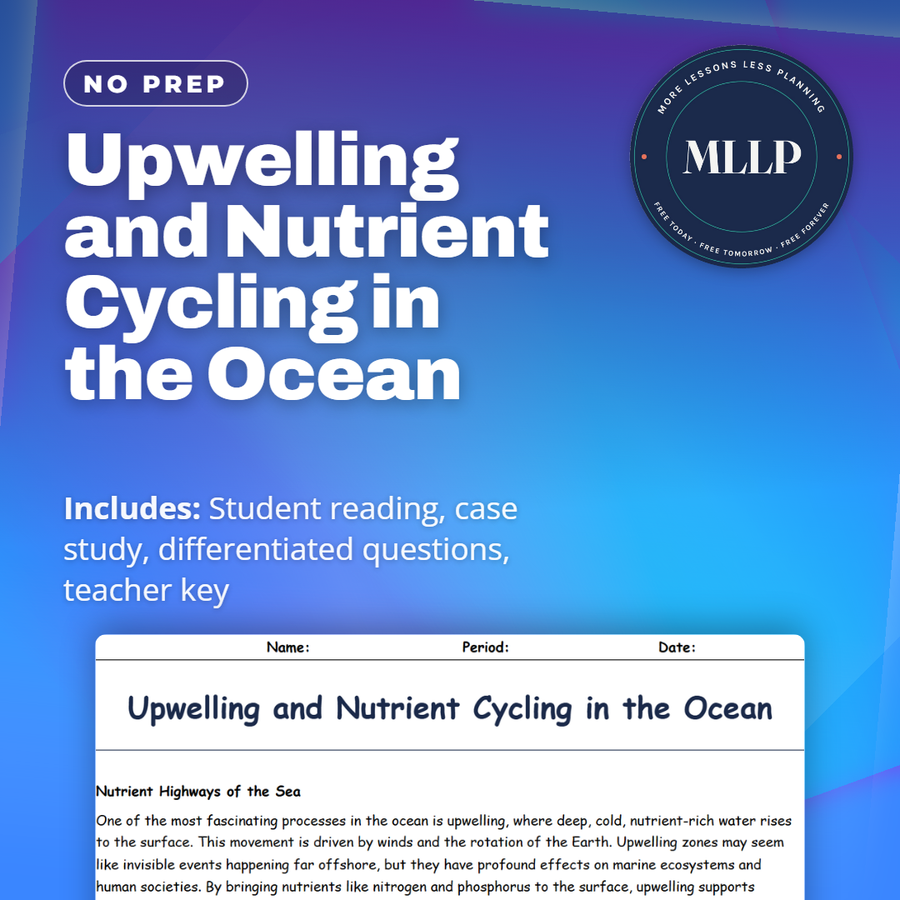
Upwelling and Nutrient Cycling in the Ocean
Quality reviewed September 2026
Facts verified September 14, 2026
- Subject
- Science
- Grades
- Grades 9-12
- Length
- 6-page student worksheet
- Time
- About one 50-minute class period
- Great for
- Sub plans and independent work
- Includes
- Reading passage, comprehension questions + full answer key
- Format
- Print-and-go PDF
What students do
- Match terms like Ekman transport, phytoplankton, the biological pump, upwelling, and the anchovy fishery to their correct definitions
- Fill in the blank sentences on cold nutrient-rich water rising to the surface, the Peruvian anchovy collapse, and the biological pump
- Answer multiple choice questions on what makes upwelling zones so productive, what process explains wind-driven upwelling, and what role the biological pump plays in climate
- Write short answers on why upwelling happens along western coastlines, how nutrient cycling supports global food webs, and why managing fisheries in upwelling zones matters
What it covers
- How wind-driven Ekman transport pulls cold, nutrient-rich water to the surface in upwelling zones
- How upwelling fuels phytoplankton blooms that support fisheries and the biological pump that stores carbon
- A case study on the Peruvian anchovy fishery and its collapse when El Niño disrupted upwelling
Start reading this worksheet
Nutrient Highways of the Sea
One of the most fascinating processes in the ocean is upwelling, where deep, cold, nutrient-rich water rises to the surface. This movement is driven by winds and the rotation of the Earth. Upwelling zones may seem like invisible events happening far offshore, but they have profound effects on marine ecosystems and human societies. By bringing nutrients like nitrogen and phosphorus to the surface, upwelling supports explosive growth of phytoplankton, the microscopic plants that form the base of the marine food web. These blooms, in turn, feed fish, seabirds, and marine mammals. Without upwelling, much of the ocean surface would be nutrient-poor, limiting life to only a few regions. The process helps explain why some of the world’s most productive fisheries, such as those off Peru and California, exist in relatively narrow coastal bands where winds drive surface waters away, pulling up nutrient-rich waters from below.
Like what you read? The full reading, the case study, and every question set are in the free download below, along with the answer key.
Why this matters
The Peruvian anchovy fishery boomed through the 1960s because deep, cold, nutrient-rich water kept rising to the surface, pushed there by wind and Ekman transport. When a strong El Niño shut that upwelling down in the early 1970s, the fishery collapsed almost as fast as it had grown.
I use the anchovy story to get students past the idea that ocean productivity is just a given. A fishery's fortunes tracked the physics of wind-driven upwelling almost exactly, and that link turns the biological pump, the process that buries carbon in sinking organic matter, from a side detail into the same mechanism that fed an entire industry.
From one teacher to another
Some of the richest fishing grounds on Earth exist because deep, cold water gets pushed up to the surface, carrying nutrients with it. This worksheet explains how wind and Ekman transport drive upwelling, how the nutrients it delivers fuel phytoplankton blooms at the base of the marine food web, and how sinking organic matter locks carbon away in the deep ocean through the biological pump. The case study on the Peruvian anchovy fishery shows what happens when a strong El Niño shuts down upwelling, tracing the fishery's boom in the 1960s and its collapse in the early 1970s.
What you get
Download
Where should I send the next one?
Everything here is free and it stays that way. Leave your email and I'll send you the new lessons as they go up. You can unsubscribe from any one of them.
Related resources
Coastal Processes: Erosion, Deposition, Barrier Islands, and Estuaries
El Niño and La Niña: Ocean-Atmosphere Climate Connections
Ocean Tides: Gravitational Forces of the Moon and Sun
Properties of Seawater: Salinity, Temperature, and Density
Surface Currents and Wind Patterns: The Coriolis Effect and Gyres
The Role of Oceans in Weather and Climate Systems
Every lesson on this site is free to download and use. If one of them saved you a prep period, you can chip in a few bucks toward my three kids' daycare fund. That's genuinely where tips go.