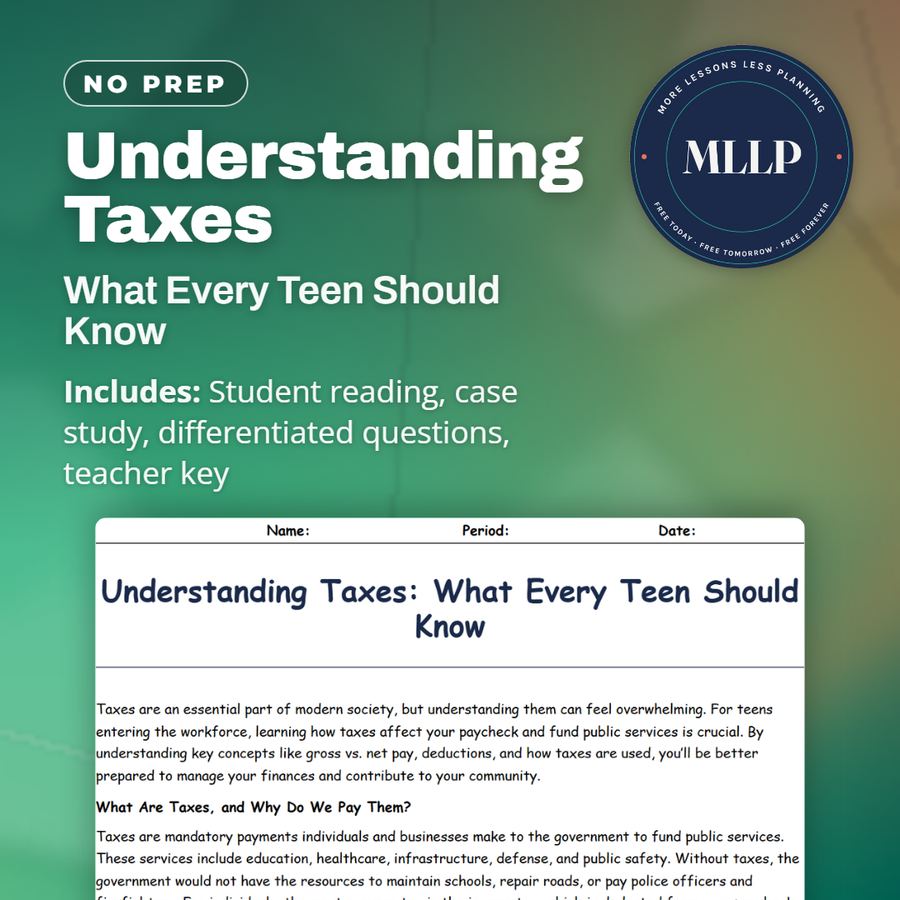
Understanding Taxes: What Every Teen Should Know
Quality reviewed September 2026
Facts verified September 24, 2026
- Subject
- Career & Life Skills
- Grades
- Grades 9-12
- Length
- 7-page student worksheet
- Time
- About one 50-minute class period
- Great for
- Sub plans and independent work
- Includes
- Reading passage, comprehension questions + full answer key
- Format
- Print-and-go PDF
What students do
- Match five terms including deductions, exemptions, net pay, gross pay, and the W-4 form to what each one means
- Fill in the blanks on what gross income means, what taxes like Social Security fund, and why filing a return matters
- Answer multiple choice questions on the difference between gross and net pay, what counts as a deduction, and why filing a tax return matters
- Write short answers on why understanding deductions helps, how taxes benefit a community, and how to prepare for filing
What it covers
- Gross pay versus net pay, and common paycheck deductions like federal tax and Social Security
- Key tax terms including exemptions, the W-4 form, and filing a tax return
- A case study on Alex's first paycheck, where $180 in gross pay becomes $140 after deductions
Start reading this worksheet
Taxes are an essential part of modern society, but understanding them can feel overwhelming. For teens entering the workforce, learning how taxes affect your paycheck and fund public services is crucial. By understanding key concepts like gross vs. net pay, deductions, and how taxes are used, you’ll be better prepared to manage your finances and contribute to your community.
What Are Taxes, and Why Do We Pay Them?
Taxes are mandatory payments individuals and businesses make to the government to fund public services. These services include education, healthcare, infrastructure, defense, and public safety. Without taxes, the government would not have the resources to maintain schools, repair roads, or pay police officers and firefighters. For individuals, the most common tax is the income tax, which is deducted from your paycheck. Other taxes include sales tax, property tax, and payroll tax, each serving a specific purpose. While taxes may seem like a burden, they ensure society functions smoothly and provides essential services for everyone. For example, when you buy a pair of shoes, a percentage of the price might go toward sales tax, which helps fund local projects like parks or libraries. Similarly, when you start earning money, a portion of your paycheck will go to federal and state income taxes to support national and state programs.
Gross vs. Net Pay: What’s the Difference?
When you start working, your employer will provide you with a paycheck, but the amount you see on paper might not match the amount deposited in your bank account. This is because of the difference between gross pay and net pay. Gross pay is your total earnings before any deductions are taken out. Net pay, often called "take-home pay," is what’s left after deductions like taxes, healthcare, and retirement contributions. Here’s an example: If you earn $15 an hour and work 20 hours a week, your gross pay is $300. However, after taxes and other deductions, your net pay might be closer to $240. Understanding this difference is important for budgeting and planning your expenses. A common misconception is that gross pay is the amount you’ll have to spend. Teens who don’t understand deductions may overspend or fail to save enough for their goals. Recognizing this distinction early helps prevent financial stress later.
Like what you read? The full reading, the case study, and every question set are in the free download below, along with the answer key.
Why this matters
A $40 gap between expected and actual pay, the kind that confused Alex, is close to universal the first time a paycheck arrives, and knowing the deductions are coming ahead of time turns that moment from a shock into something expected. Filing a first tax return can also mean getting money back if too much was withheld, which most teens don't realize applies to them too. A first job usually comes with a W-4 form to fill out, and knowing what it does ahead of time turns it into something other than blind paperwork.
From one teacher to another
Before students see a real pay stub, this reading explains the gap between gross pay, what you earned, and net pay, what actually lands in the bank. A table lists common deductions like federal income tax, state income tax, Social Security, and Medicare alongside what each one funds, from national defense to retirement benefits for seniors. It also defines the vocabulary of a first job: exemptions, filing a tax return, and the W-4 form that tells an employer how much to withhold. Alex earns $12 an hour for 15 hours a week, expects a $180 paycheck, and is confused when only $140 shows up until a manager walks through the $25 in federal taxes, $8 in Social Security, and $7 in Medicare that came out first.
What you get
Download
Where should I send the next one?
Everything here is free and it stays that way. Leave your email and I'll send you the new lessons as they go up. You can unsubscribe from any one of them.
Related resources
Banking Basics: Checking, Savings, and Debit Cards Explained
Budgeting Basics: How to Plan and Track Your Spending

How to Avoid Debt: Smart Money Habits for Teens

Investing 101: Simple Ways to Grow Your Money Over Time
Needs vs. Wants: Making Smart Spending Choices
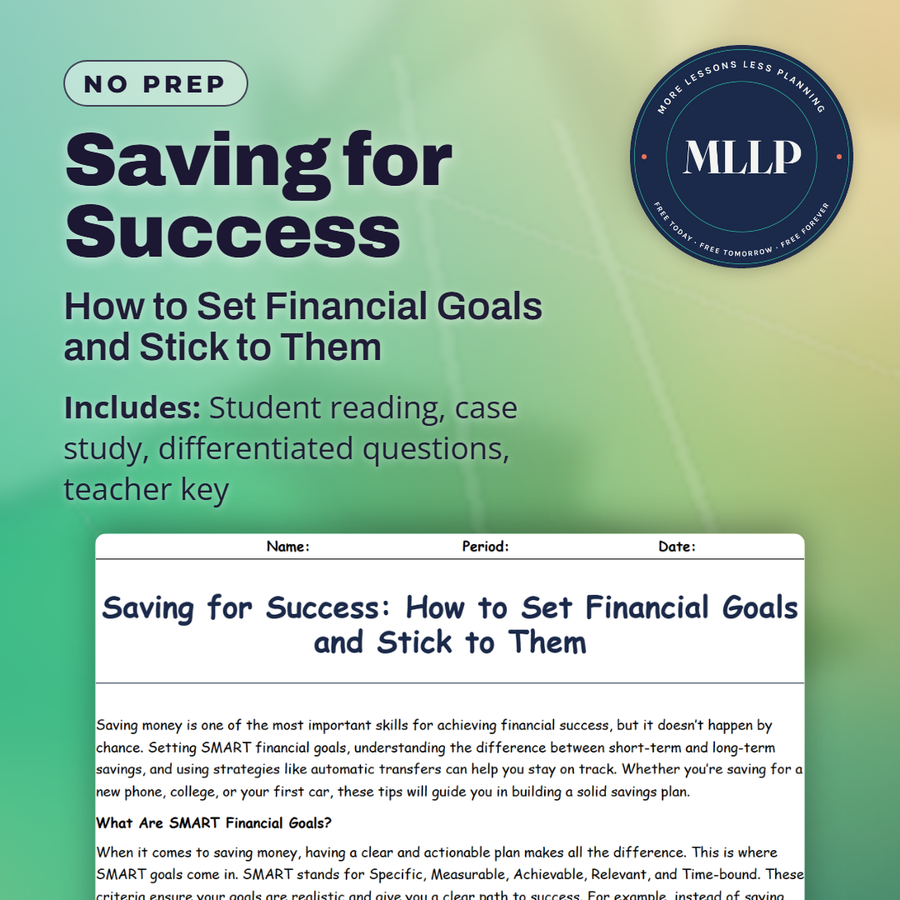
Saving for Success: How to Set Financial Goals and Stick to Them
Every lesson on this site is free to download and use. If one of them saved you a prep period, you can chip in a few bucks toward my three kids' daycare fund. That's genuinely where tips go.