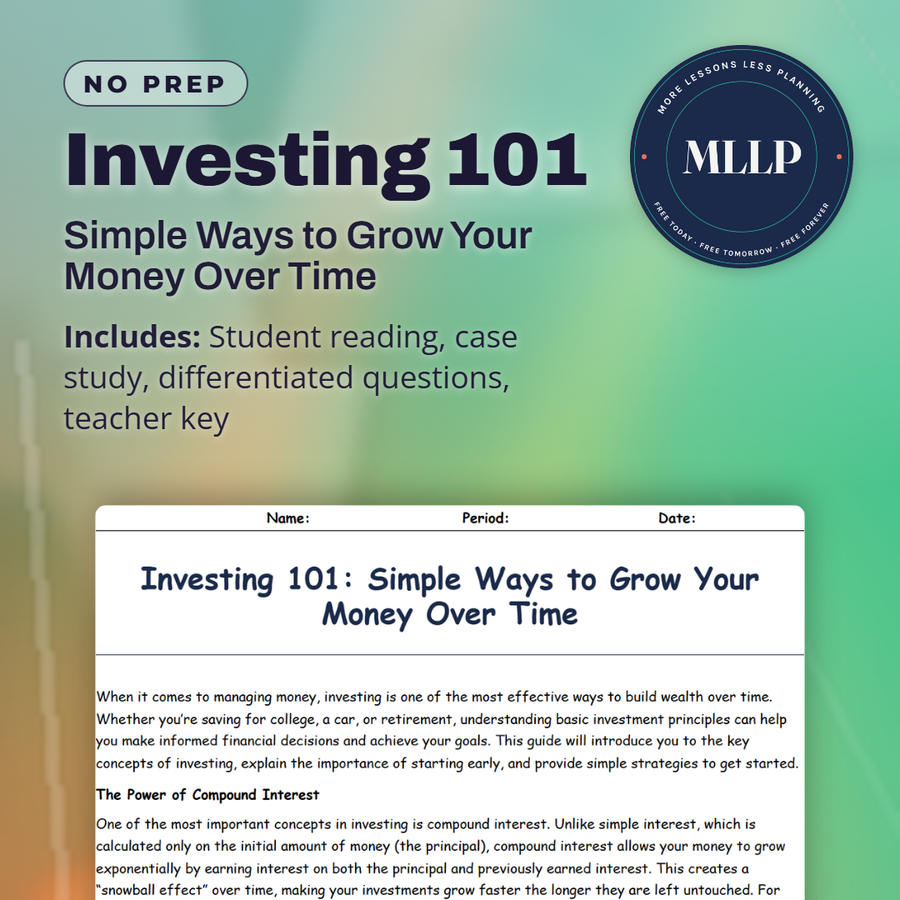
Investing 101: Simple Ways to Grow Your Money Over Time
Quality reviewed September 2026
Facts verified September 24, 2026
- Subject
- Career & Life Skills
- Grades
- Grades 9-12
- Length
- 6-page student worksheet
- Time
- About one 50-minute class period
- Great for
- Sub plans and independent work
- Includes
- Reading passage, comprehension questions + full answer key
- Format
- Print-and-go PDF
What students do
- Match five items on stocks, bonds, index funds, diversification, and compound interest to what each one does
- Fill in the blanks on spreading risk across investments, benefiting from starting early, and what index funds track
- Answer multiple choice questions on the advantage of compound interest, which investment suits beginners, and how to manage risk
- Write short answers on knowing your risk tolerance, the advantages of index funds, and how compound interest differs from simple interest
What it covers
- Compound interest, and how it grows an initial investment faster than simple interest
- Stocks, bonds, and index funds, along with risk versus reward and diversification
- A case study comparing Alex, who starts investing at 18, and Taylor, who starts at 30
Start reading this worksheet
When it comes to managing money, investing is one of the most effective ways to build wealth over time. Whether you’re saving for college, a car, or retirement, understanding basic investment principles can help you make informed financial decisions and achieve your goals. This guide will introduce you to the key concepts of investing, explain the importance of starting early, and provide simple strategies to get started.
The Power of Compound Interest
One of the most important concepts in investing is compound interest. Unlike simple interest, which is calculated only on the initial amount of money (the principal), compound interest allows your money to grow exponentially by earning interest on both the principal and previously earned interest. This creates a “snowball effect” over time, making your investments grow faster the longer they are left untouched. For example, imagine you invest $1,000 in an account that earns 5% annual interest. After the first year, you’ll have $1,050. In the second year, you’ll earn interest on $1,050 instead of the original $1,000, giving you $1,102.50 by the end of year two. Over decades, this small annual growth can turn into a significant amount of money. This is why starting early is so crucial: the longer your money has to grow, the more powerful compound interest becomes. To better understand how compound interest works, let’s look at the case of two investors:
Stocks, Bonds, and Index Funds
Investments come in many forms, but the three most common for beginners are stocks, bonds, and index funds. Stocks represent ownership in a company. When you buy a stock, you are essentially purchasing a small piece of that company. Stocks have high potential for growth but also come with higher risks. Bonds are loans you make to a company or government. In exchange, they pay you back with interest over time. Bonds are generally considered safer than stocks, but they offer lower returns. Index funds are a type of mutual fund that tracks a market index, such as the S&P 500. They allow you to invest in many companies at once, reducing risk while providing solid, long-term returns. For beginners, index funds are an excellent option. They require minimal effort, have low fees, and consistently outperform most actively managed investments over the long term.
Like what you read? The full reading, the case study, and every question set are in the free download below, along with the answer key.
Why this matters
Alex and Taylor invested the same monthly amount, and the twelve-year head start is worth more than the extra money Taylor put in later, which is the single hardest idea in personal finance to feel in your gut before you've lived it. Most students haven't thought about retirement at all, let alone at 18, but the math in this reading makes the case better than a lecture would. Stocks, bonds, and index funds get introduced here first, so the vocabulary won't be new the first time a paycheck actually comes with a retirement account attached.
From one teacher to another
Compound interest is the idea everything else here builds on: money invested earlier has more time to grow, because interest gets paid on your interest, on top of the original deposit. It covers the three investments beginners run into most, stocks for growth, bonds for stability, and index funds that track something like the S&P 500 for a mix of both, plus a table ranking each by risk and typical return. A section on diversification explains why spreading money across investment types protects a portfolio when one part of the market drops. In the case study, Alex invests $100 a month from 18 to 30 and ends up with over $126,000 by 60, while Taylor puts in more total money starting at 30 and only reaches about $100,000.
What you get
Download
Where should I send the next one?
Everything here is free and it stays that way. Leave your email and I'll send you the new lessons as they go up. You can unsubscribe from any one of them.
Related resources
Banking Basics: Checking, Savings, and Debit Cards Explained
Budgeting Basics: How to Plan and Track Your Spending
How to Avoid Debt: Smart Money Habits for Teens
Needs vs. Wants: Making Smart Spending Choices
Saving for Success: How to Set Financial Goals and Stick to Them
The Power of Emergency Funds: Why Every Teen Should Save for the Unexpected
Every lesson on this site is free to download and use. If one of them saved you a prep period, you can chip in a few bucks toward my three kids' daycare fund. That's genuinely where tips go.