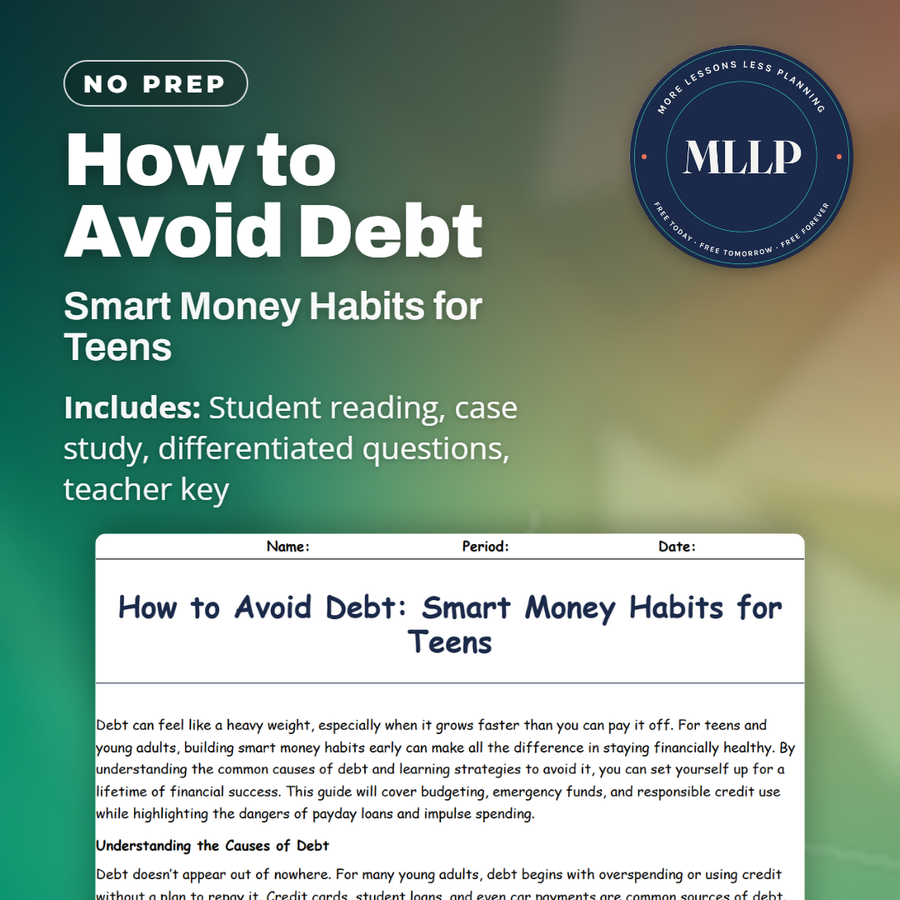
How to Avoid Debt: Smart Money Habits for Teens
Quality reviewed September 2026
Facts verified September 24, 2026
- Subject
- Career & Life Skills
- Grades
- Grades 9-12
- Length
- 6-page student worksheet
- Time
- About one 50-minute class period
- Great for
- Sub plans and independent work
- Includes
- Reading passage, comprehension questions + full answer key
- Format
- Print-and-go PDF
What students do
- Match five items on budgeting, payday loans, credit scores, and responsible credit use to the term each one describes
- Fill in the blanks on the 50/30/20 rule, what an emergency fund covers, and why payday loans should be avoided
- Answer multiple choice questions on a common cause of debt, the purpose of an emergency fund, and the benefit of the 50/30/20 rule
- Write short answers on why an emergency fund matters, how budgeting apps help, and why payday loans are risky
What it covers
- Common causes of debt, including minimum payments and impulse spending
- The 50/30/20 budgeting rule, emergency funds, and responsible credit use
- A case study on Sarah, who budgets $600 a month and builds an $800 emergency fund
Start reading this worksheet
Debt can feel like a heavy weight, especially when it grows faster than you can pay it off. For teens and young adults, building smart money habits early can make all the difference in staying financially healthy. By understanding the common causes of debt and learning strategies to avoid it, you can set yourself up for a lifetime of financial success. This guide will cover budgeting, emergency funds, and responsible credit use while highlighting the dangers of payday loans and impulse spending.
Understanding the Causes of Debt
Debt doesn’t appear out of nowhere. For many young adults, debt begins with overspending or using credit without a plan to repay it. Credit cards, student loans, and even car payments are common sources of debt. While some forms of debt, like student loans, can be considered an investment in your future, other types, such as high-interest credit card debt, can quickly spiral out of control. One of the biggest challenges for teens is the “buy now, pay later” mentality. It’s easy to swipe a card or click “purchase” without thinking about how long it will take to repay the balance. If you only pay the minimum amount on your credit card each month, the unpaid balance will grow due to interest. Over time, you could end up paying far more than the original purchase price. Impulse buying is another trap. Social media ads, online shopping, and peer pressure can lead to unnecessary spending. Without a budget, it’s easy to lose track of where your money is going, leaving you unable to cover essentials like rent, groceries, or gas.
The Role of Budgeting
A budget is one of the simplest and most effective tools for avoiding debt. At its core, a budget helps you track your income and expenses so you can live within your means. Start by listing all your monthly income, including allowances, part-time jobs, or gifts. Next, write down all your expenses, dividing them into “needs” (rent, utilities, food) and “wants” (dining out, entertainment). A good rule of thumb is the 50/30/20 rule: 50% of your income should go toward needs. 30% can be spent on wants. 20% should be saved or used to pay off debt. Using this approach ensures you’re covering necessities while setting aside money for the future. Budgeting apps like Mint or YNAB (You Need a Budget) can make the process easier, helping you see where your money goes in real-time.
Like what you read? The full reading, the case study, and every question set are in the free download below, along with the answer key.
Why this matters
Plenty of students will get their first credit card or first payday loan offer before they fully understand what either one costs them, and the reading's payday loan math, $500 borrowed turning into $1,500 owed, makes that risk concrete instead of abstract. Sarah's $800 fund covering her broken phone shows what the 50/30/20 rule is actually for: turning a crisis into a non-event. Those are habits worth building before the first real bill shows up, not after.
From one teacher to another
This one names the traps that lead to debt first: paying only the credit card minimum while interest keeps building, and impulse spending fed by social media and online shopping. From there it lays out the 50/30/20 rule, putting half of income toward needs, 30 percent toward wants, and 20 percent toward savings or debt payoff, along with why an emergency fund of $500 to $1,000 keeps a surprise expense from becoming a credit card balance. There's a section on keeping a credit score healthy by paying on time and avoiding payday loans, which can charge over 300% interest. Sarah earns $600 a month, splits it using the 50/30/20 rule, and ends up with $800 saved by the time her phone breaks, so she pays for a new one in cash instead of charging it.
What you get
Download
Where should I send the next one?
Everything here is free and it stays that way. Leave your email and I'll send you the new lessons as they go up. You can unsubscribe from any one of them.
Related resources
Banking Basics: Checking, Savings, and Debit Cards Explained
Budgeting Basics: How to Plan and Track Your Spending
Investing 101: Simple Ways to Grow Your Money Over Time
Needs vs. Wants: Making Smart Spending Choices
Saving for Success: How to Set Financial Goals and Stick to Them
The Power of Emergency Funds: Why Every Teen Should Save for the Unexpected
Every lesson on this site is free to download and use. If one of them saved you a prep period, you can chip in a few bucks toward my three kids' daycare fund. That's genuinely where tips go.