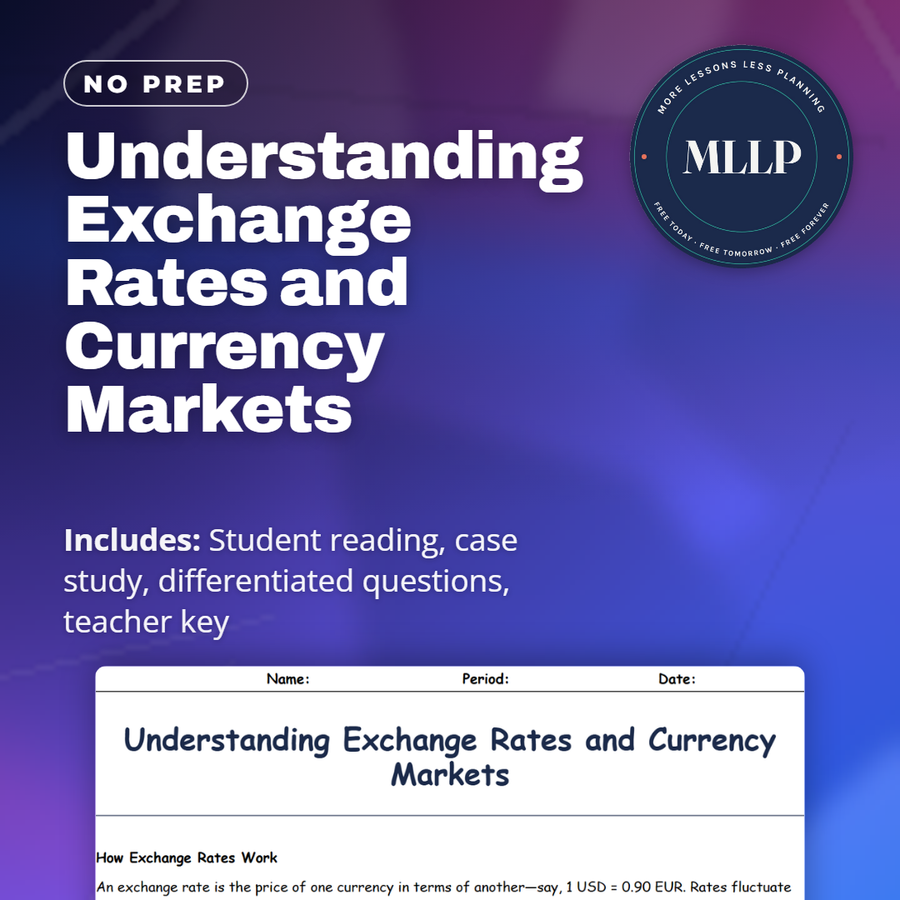
Understanding Exchange Rates and Currency Markets
Quality reviewed September 2026
Facts verified September 8, 2026
- Grades
- Grades 9-12
- Length
- 6-page student worksheet
- Time
- About one 50-minute class period
- Great for
- Sub plans and independent work
- Includes
- Reading passage, comprehension questions + full answer key
- Format
- Print-and-go PDF
What students do
- Analyze how the ECB's quantitative easing announcement and the Fed's tapering signal diverged U.S. and euro-area monetary policy, depreciating the euro from 1.38 USD to near parity
- Trace how the euro's depreciation benefited exporters and inbound tourists but squeezed household budgets with higher import costs
- Match exchange-rate concepts like appreciation, depreciation, forex markets, fixed rates, and floating rates to their definitions
- Explain why speculators can amplify short-term currency volatility and how central banks intervene to smooth excessive swings or defend fixed pegs
What it covers
- How exchange rates fluctuate based on supply and demand in the daily $6 trillion forex market, affecting trade, inflation, and travel costs
- Determinants of currency value: interest rate differentials, inflation gaps, GDP growth, political stability, and balance-of-payments positions
- Central bank intervention strategies and the limits of defending a fixed exchange rate when sustained intervention depletes reserves
Start reading this worksheet
How Exchange Rates Work
An exchange rate is the price of one currency in terms of another. For example, 1 USD = 0.90 EUR. Rates fluctuate based on supply and demand in the foreign exchange (Forex) market, the largest financial market globally, with daily trading exceeding $6 trillion. Participants include banks, corporations, governments, and speculators. Exchange rates determine how much foreigners pay for a country’s exports and how expensive imports become, directly affecting trade balances, inflation, and travel costs. Two main regimes exist: floating rates, determined by market forces, and fixed rates, pegged by governments to another currency or basket.
Determinants of Currency Value
Several factors influence exchange rates. Interest rate differentials are paramount: higher rates attract foreign capital seeking better returns, appreciating the currency. Inflation gaps can erode purchasing power, leading to depreciation. Economic growth, measured by GDP, signals investment opportunities, boosting demand for that currency. Political stability and policy credibility matter: safe‐haven currencies (e.g., USD, CHF, JPY) often strengthen during global turmoil. Balance of payments positions, whether surplus or deficit, reflect net capital flows and trade competitiveness, further swaying rates.
Impacts on Trade and Prices
When a currency appreciates, exports become pricier for foreigners, potentially reducing demand, while imports become cheaper, benefiting consumers. For example, if the USD strengthens from 1 USD = 100 JPY to 1 USD = 110 JPY, Japanese imports cost more yen, but Americans find Japanese electronics cheaper. Conversely, depreciation boosts export competitiveness but can stoke inflation by raising import costs. Tourism and remittances also feel the impact: a weaker currency improves inbound tourist spending power but reduces the home‐currency value of overseas earnings.
Like what you read? The full reading, the case study, and every question set are in the free download below, along with the answer key.
Why this matters
A euro bought $1.38 in mid-2014. By early 2015 it barely bought a dollar, after the European Central Bank announced a 60 billion-euro monthly bond-purchase program while the Federal Reserve ended its own stimulus and signaled higher rates. Two central banks' decisions moved a currency more than a year of ordinary trade ever could.
A weaker currency looks like bad news to most students until they find the winners in this reading: German automakers posted record overseas sales and American tourists found Europe suddenly affordable. Then we get to euro-area families paying more for imported electronics and fuel.
From one teacher to another
I use this reading to make currency markets concrete and connected to real policy decisions. Students learn that an exchange rate is simply the price of one currency in terms of another, but that "simple" price moves millions of dollars daily. The euro case study is where the reading connects theory to events. Between mid-2014 and early 2015, the euro plunged as the ECB announced a massive 60 billion-euro monthly bond-purchase program to counter deflationary pressures. Investors anticipating euro dilution sold euros short. Meanwhile, the Fed ended QE and signaled future rate hikes, attracting capital to dollar assets. The euro collapsed to near parity with the dollar. My students fill in blanks about speculation, quantitative easing, and trade balances. Then we examine the winners and losers. German automakers reported record overseas sales thanks to cheaper prices. Tourism into Europe surged as Americans found vacations more affordable. But euro-area consumers faced higher import costs for electronics and fuel, squeezing household budgets. By 2017, the euro recovered to about 1.20 USD as euro-area inflation approached target and the Fed delayed hikes. Students complete multiple-choice questions distinguishing between fixed and floating rates, then work through short-answer prompts on why stronger currencies hurt exporters and why central banks might intervene. The matching section reinforces the mechanics: higher interest rates lead to appreciation, higher inflation to depreciation, strong growth to appreciation.
What you get
- Answer Key
-
Student Worksheet
When the Swiss National Bank wanted to stop the franc from climbing past 1.20 per euro, it defended that ceiling by buying euros on a massive scale, a strategy the reading notes drains reserves if kept up too long. Safe haven currencies such as the dollar, the franc, and the yen tend to strengthen during global turmoil for the same reason, since political stability attracts capital instead of driving it away.
Download
Where should I send the next one?
Everything here is free and it stays that way. Leave your email and I'll send you the new lessons as they go up. You can unsubscribe from any one of them.
Related resources
Emerging Markets and Economic Growth Around the World
Free Trade vs. Protectionism: Economic Pros and Cons

Globalization: Economic Interdependence and Transformation
How Trade Affects Domestic Industries and Jobs

Multinational Corporations and the Global Marketplace
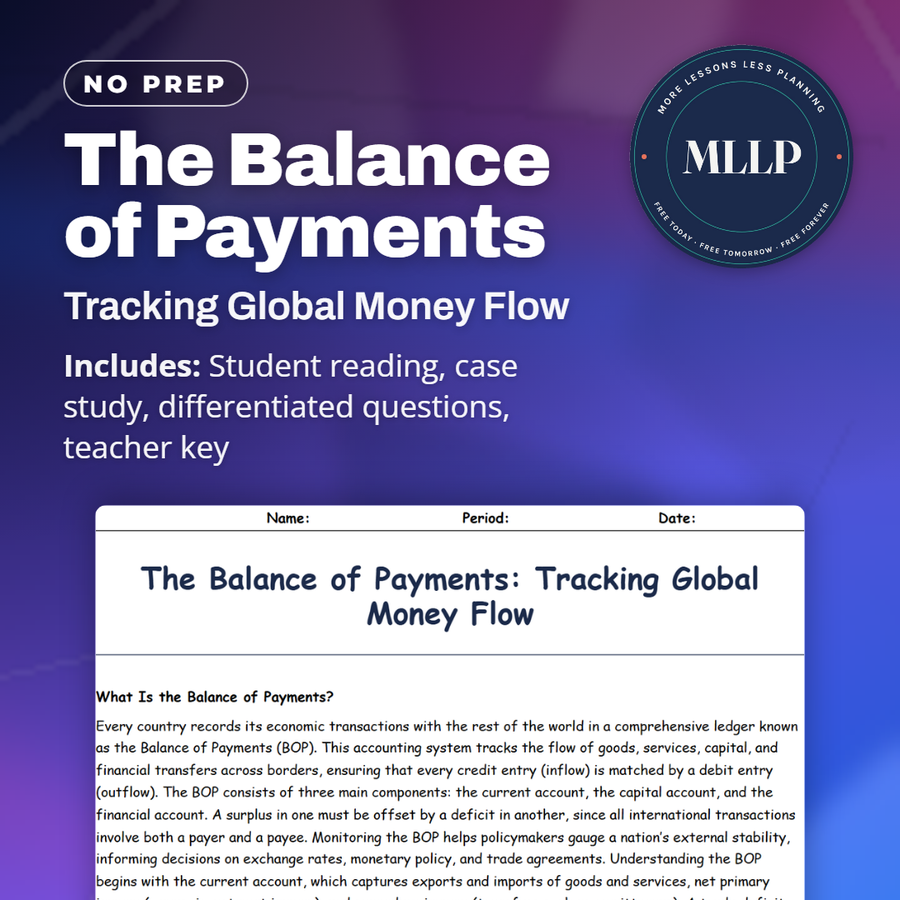
The Balance of Payments: Tracking Global Money Flow
Every lesson on this site is free to download and use. If one of them saved you a prep period, you can chip in a few bucks toward my three kids' daycare fund. That's genuinely where tips go.