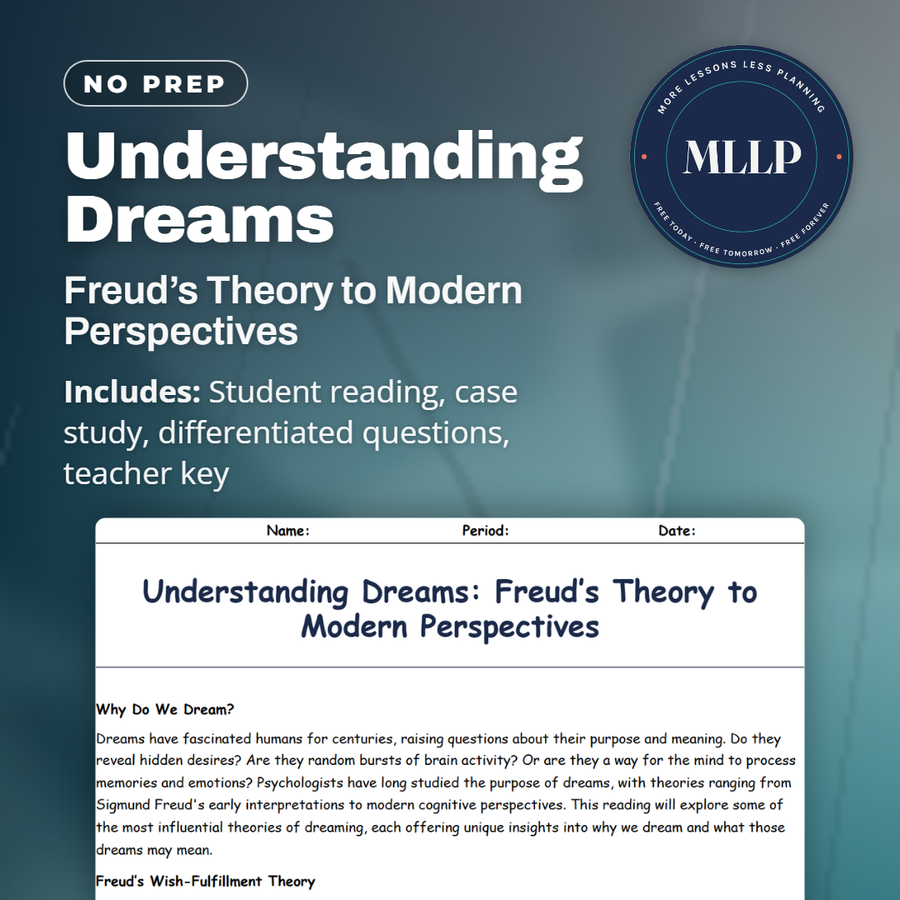
Understanding Dreams: Freud’s Theory to Modern Perspectives
Quality reviewed September 2026
Facts verified September 10, 2026
- Subject
- Social Studies
- Grades
- Grades 9-12
- Length
- 7-page student worksheet
- Time
- About one 50-minute class period
- Great for
- Sub plans and independent work
- Includes
- Reading passage, comprehension questions + full answer key
- Format
- Print-and-go PDF
What students do
- Match terms like Freud's theory, cognitive theory, and activation-synthesis theory to their correct definitions
- Fill in the blank sentences on unconscious desires, Hobson and McCarley, and problem-solving in dreams
- Answer multiple choice questions on wish fulfillment, random neural signals, and the purpose of dreams under cognitive theory
- Write short answers on activation-synthesis, how cognitive theory differs from Freud, and how Barrett's study connects dreams to problem-solving
What it covers
- Freud's wish-fulfillment theory, including manifest and latent content
- The activation-synthesis theory and the cognitive theory of dreaming, and how the three theories compare
- A case study on Freud's "Wolf Man" and a second case study on Deirdre Barrett's research on dreams and problem-solving
Start reading this worksheet
Why Do We Dream?
Dreams have fascinated humans for centuries, raising questions about their purpose and meaning. Do they reveal hidden desires? Are they random bursts of brain activity? Or are they a way for the mind to process memories and emotions? Psychologists have long studied the purpose of dreams, with theories ranging from Sigmund Freud's early interpretations to modern cognitive perspectives. This reading will explore some of the most influential theories of dreaming, each offering unique insights into why we dream and what those dreams may mean.
Freud’s Wish-Fulfillment Theory
One of the earliest and most famous theories about dreams was proposed by Sigmund Freud, often regarded as the father of psychoanalysis. Freud believed that dreams are a form of wish fulfillment, a way for the unconscious mind to express desires that are often hidden from the conscious mind. According to Freud, the content of dreams can be divided into two parts: the manifest content (the literal storyline of the dream) and the latent content (the hidden, symbolic meaning). Freud argued that the latent content often represents unconscious desires, fears, or unresolved conflicts. For example, Freud might interpret a dream about flying as a subconscious desire for freedom or escape from current stressors. He believed that understanding these symbolic meanings could help individuals gain insight into their unconscious thoughts and emotions. While Freud’s theory is widely known, it has also been criticized for relying heavily on interpretation, making it challenging to test scientifically.
The Activation-Synthesis Theory
In contrast to Freud’s theory, the activation-synthesis theory, proposed by Harvard psychiatrists John Allan Hobson and Robert McCarley, suggests that dreams do not have any inherent meaning. According to this theory, dreams are the brain’s attempt to make sense of random neural activity that occurs during sleep, particularly in the REM (rapid eye movement) stage. During REM sleep, the brainstem generates random signals that activate various parts of the cortex, which is responsible for higher-order thinking. The cortex then synthesizes these signals, creating a cohesive story, or dream, out of what would otherwise be meaningless activity. According to activation-synthesis, if you dream about being chased, it may simply be because your brain was processing random signals that your cortex interpreted as “chasing.” This theory treats dreams as byproducts of brain function, with no specific purpose or symbolic meaning. The activation-synthesis theory is widely supported in neuroscience as it connects directly to observable brain processes. However, it doesn’t account for why dreams often reflect real-life experiences or emotions, leaving some questions unanswered.
Like what you read? The full reading, the case study, and every question set are in the free download below, along with the answer key.
Why this matters
Freud's wish fulfillment theory is not the only explanation for dreaming here, and it is not treated as the final word either. Hobson and McCarley's activation-synthesis theory proposes something less mystical: dreams as the brain making sense of random neural signals, set against a third, cognitive theory.
I pair the Wolf Man case with Deirdre Barrett's research on dreams and problem-solving so students see a live disagreement, not a settled textbook fact. Keeping manifest content separate from latent content gives them the vocabulary to argue, on paper, which of the three theories convinces them most.
From one teacher to another
I bring this out when we cover theories of dreaming because it lines up Freud's wish fulfillment idea against activation-synthesis theory and cognitive theory instead of treating dreaming as one settled explanation. The Wolf Man case study gets students into how Freud actually read a patient's dream, and the Barrett problem-solving case study gives them a modern counterpoint for the short answer questions. The matching and fill-in-the-blank sections keep manifest content, latent content, and the theorists straight before students compare the three theories in writing.
What you get
Download
Where should I send the next one?
Everything here is free and it stays that way. Leave your email and I'll send you the new lessons as they go up. You can unsubscribe from any one of them.
Related resources
Classical Conditioning Explained: Pavlov and Beyond
False Memories: How Our Minds Create Misinformation
How We Remember: An Overview of Memory Processes
Operant Conditioning Basics: Reinforcement, Punishment, and Behavior
Sleep Disorders and Their Impact on Health: Insomnia to Narcolepsy
Stages of Sleep: NREM, REM, and Their Effects on Health
Every lesson on this site is free to download and use. If one of them saved you a prep period, you can chip in a few bucks toward my three kids' daycare fund. That's genuinely where tips go.