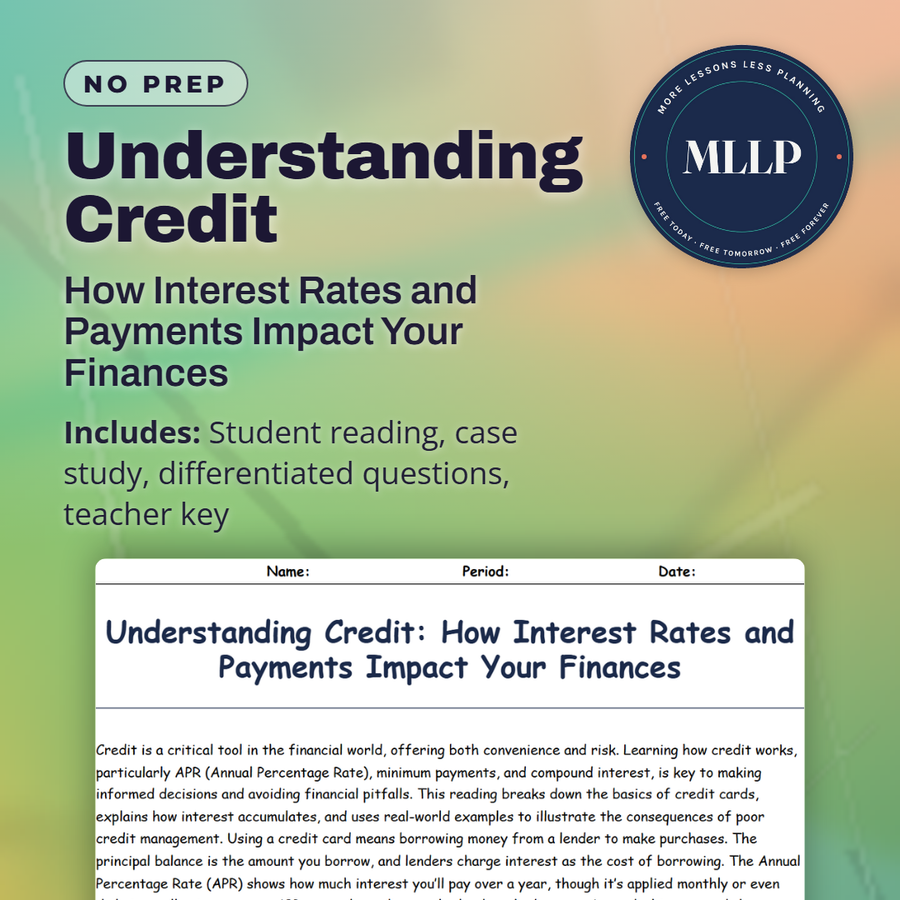
Understanding Credit: How Interest Rates and Payments Impact Your Finances
Quality reviewed September 2026
Facts verified September 24, 2026
- Subject
- Career & Life Skills
- Grades
- Grades 9-12
- Length
- 6-page student worksheet
- Time
- About one 50-minute class period
- Great for
- Sub plans and independent work
- Includes
- Reading passage, comprehension questions + full answer key
- Format
- Print-and-go PDF
What students do
- Match five terms including APR, compound interest, principal balance, and minimum payment to what each one means
- Fill in the blanks on what APR represents, how minimum payments extend debt, and how compound interest grows a balance
- Answer multiple choice questions on what APR stands for, what happens when you pay only the minimum, and how compound interest works
- Write short answers on why paying more than the minimum matters, how compound interest raises the total cost, and how to avoid excess interest
What it covers
- APR, principal balance, and how interest is charged on unpaid credit card balances
- Why minimum payments stretch debt out for years and cost more in the end
- A case study on Alex, whose $1,100 balance barely shrinks after a year of minimum payments
Start reading this worksheet
Credit is a critical tool in the financial world, offering both convenience and risk. Learning how credit works, particularly APR (Annual Percentage Rate), minimum payments, and compound interest, is key to making informed decisions and avoiding financial pitfalls. This reading breaks down the basics of credit cards, explains how interest accumulates, and uses real-world examples to illustrate the consequences of poor credit management. Using a credit card means borrowing money from a lender to make purchases. The principal balance is the amount you borrow, and lenders charge interest as the cost of borrowing. The Annual Percentage Rate (APR) shows how much interest you’ll pay over a year, though it’s applied monthly or even daily in smaller increments. APRs vary depending on the lender, the borrower’s credit history, and the type of card. Credit cards provide flexibility, but they come with responsibility. Paying off your balance on time prevents interest charges. If you pay less than the full balance, the lender charges interest on the unpaid amount. For instance, a $1,000 balance with a 20% APR can cost an extra $200 in interest annually if unpaid.
The Trap of Minimum Payments
Every credit card requires a minimum payment, usually 2–3% of the balance, to keep the account in good standing. While this seems manageable, paying only the minimum stretches debt over years and significantly increases the cost. Consider a $1,000 balance with a 20% APR. If the minimum payment is $25, it could take over five years to pay off the balance, costing more in interest than the original debt. Minimum payments are designed to keep borrowers in debt longer, generating profits for lenders.
Like what you read? The full reading, the case study, and every question set are in the free download below, along with the answer key.
Why this matters
Alex's balance goes from $1,065 to $1,085 in a single month of minimum payments, which is the kind of number that explains why credit card debt feels impossible to escape once it starts. A first credit card often arrives right around the age these students are now, usually with none of this math attached to it. Seeing how a $1,000 purchase can turn into years of payments before it's ever paid off is the difference between using a card carefully and learning the hard way.
From one teacher to another
When a credit card balance isn't paid off, the lender charges APR, or annual percentage rate, on whatever is left unpaid, and compound interest means that charge applies to previous interest too, on top of the original purchase. A payment strategies table compares three approaches to a balance, showing that paying only the minimum on one example costs $1,200 in interest over seven years while paying the full balance costs nothing extra. Alex gets a first credit card, spends $1,100 on a laptop and smaller purchases, and pays only the $35 minimum each month, watching the balance barely move as 22% interest keeps rebuilding it.
What you get
Download
Where should I send the next one?
Everything here is free and it stays that way. Leave your email and I'll send you the new lessons as they go up. You can unsubscribe from any one of them.
Related resources
Banking Basics: Checking, Savings, and Debit Cards Explained
Budgeting Basics: How to Plan and Track Your Spending
How to Avoid Debt: Smart Money Habits for Teens
Investing 101: Simple Ways to Grow Your Money Over Time
Needs vs. Wants: Making Smart Spending Choices
Saving for Success: How to Set Financial Goals and Stick to Them
Every lesson on this site is free to download and use. If one of them saved you a prep period, you can chip in a few bucks toward my three kids' daycare fund. That's genuinely where tips go.