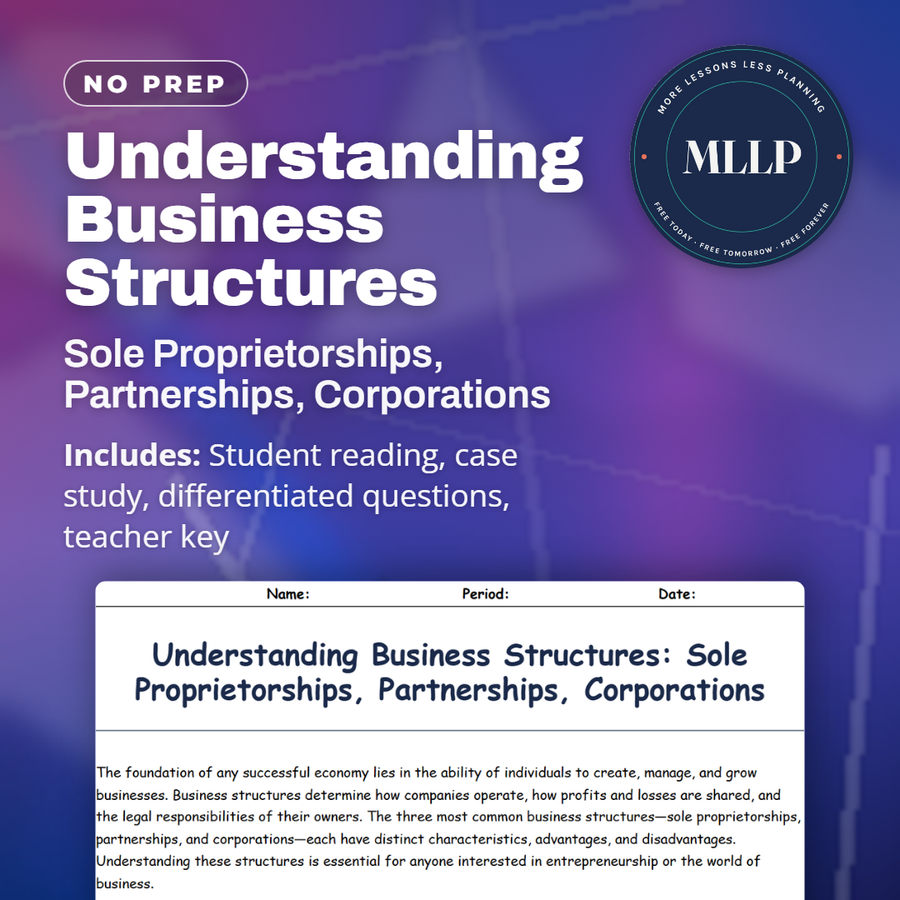
Understanding Business Structures: Sole Proprietorships, Partnerships, Corporations
Quality reviewed September 2026
Facts verified September 8, 2026
- Grades
- Grades 9-12
- Length
- 7-page student worksheet
- Time
- About one 50-minute class period
- Great for
- Sub plans and independent work
- Includes
- Reading passage, comprehension questions + full answer key
- Format
- Print-and-go PDF
What students do
- Read passages on the three main business structures and how ownership, control, and liability differ among them
- Compare advantages and disadvantages of sole proprietorships (simplicity but unlimited liability) versus corporations (limited liability but complexity)
- Analyze the case study of Emma's bakery expanding from sole proprietorship through partnership to incorporation
- Answer questions about how incorporating protects personal assets and enables access to investor capital
What it covers
- Sole proprietorships as the simplest structure with one owner, full control, and personal liability
- Partnerships that share ownership, resources, and complementary skills among two or more owners
- Corporations as legal entities separate from owners, offering limited liability and access to capital through shares
Start reading this worksheet
The foundation of any successful economy lies in the ability of individuals to create, manage, and grow businesses. Business structures determine how companies operate, how profits and losses are shared, and the legal responsibilities of their owners. The three most common business structures—sole proprietorships, partnerships, and corporations—each have distinct characteristics, advantages, and disadvantages. Understanding these structures is essential for anyone interested in entrepreneurship or the world of business.
Sole Proprietorships: The Simplest Form of Business
A sole proprietorship is the most straightforward and common type of business structure. It is owned and operated by one individual, making it ideal for small-scale businesses such as local shops, freelancers, and service providers. A major advantage of a sole proprietorship is its simplicity. Setting up this type of business is inexpensive and requires minimal paperwork. The owner has full control over the business, including decision-making and profit retention. However, this simplicity comes with significant risks. The owner is personally responsible for all debts and liabilities, meaning their personal assets, such as their home or savings, could be at risk if the business fails. For example, consider a freelance graphic designer operating as a sole proprietor. They keep all the income they generate, but if they face legal action for copyright infringement, they are personally liable for any damages.
Partnerships: Sharing Responsibility and Resources
A partnership involves two or more individuals who share ownership of a business. Partnerships are particularly common in professional services, such as law firms, medical practices, and consulting firms. There are two main types of partnerships: general partnerships, where all partners share equal responsibility, and limited partnerships, where one or more partners have limited liability and a reduced role in management. Partnerships allow for shared decision-making, pooled resources, and the opportunity to combine complementary skills. However, partnerships can also lead to conflicts if partners disagree on how to run the business. Furthermore, in a general partnership, all partners are personally liable for the debts and actions of the business. An example of a partnership is a law firm where one partner specializes in litigation and the other in contract law. Together, they can offer a broader range of services to clients, but disagreements over case strategies could complicate their relationship.
Like what you read? The full reading, the case study, and every question set are in the free download below, along with the answer key.
Why this matters
Emma sells cookies at a farmers market under her own name, so a lawsuit over a bad batch could reach her house and car, not just her business. That is the trade-off in a sole proprietorship: full control, full personal risk. Watching her add a partner and later incorporate to fund new locations shows students that structure changes as a business grows.
Emma's shift from sole proprietor to partner to incorporation tracks funding needs and risk, not business size, and that ordering is the part nobody predicts. A few ask why she skipped incorporating on day one. Explaining why that would have been the wrong move at her bakery's small start is the real payoff.
From one teacher to another
I use this worksheet when students explore how businesses organize themselves and the trade-offs in each structure. The reading walks through three options: a sole proprietorship where one person owns and controls everything but risks personal assets if the business fails, a partnership where two or more owners share resources and decision-making but also share liability, and a corporation that operates as its own legal entity so shareholders are only liable for what they invested. Emma's bakery case study tracks a real progression. She starts as a sole proprietor selling cookies at farmers' markets, brings in a partner to expand, then incorporates to secure funding for multiple locations. Students see how each structure fits different business stages and answer questions about liability protection, capital access, and complexity.
What you get
- Answer Key
-
Student Worksheet
A freelance graphic designer keeps every dollar earned alone but stays personally on the hook if a client sues over copyright infringement, an example of unlimited liability in practice. Law firms show the partnership side, where one partner handles litigation while another handles contract law, splitting expertise and liability alike. A technology company, by contrast, can raise millions selling shares once its profits are taxed twice.
Download
Where should I send the next one?
Everything here is free and it stays that way. Leave your email and I'll send you the new lessons as they go up. You can unsubscribe from any one of them.
Related resources
Anti-Trust Laws and Regulation: Promoting Fair Competition
Barriers to Entry: What Keeps Competitors Out
Monopoly Power: Why Single Sellers Dominate the Market
Non-Price Competition: How Firms Compete Beyond Cost
Oligopoly: Competition Among the Few
Perfect Competition: How Markets Operate at Maximum Efficiency
Every lesson on this site is free to download and use. If one of them saved you a prep period, you can chip in a few bucks toward my three kids' daycare fund. That's genuinely where tips go.