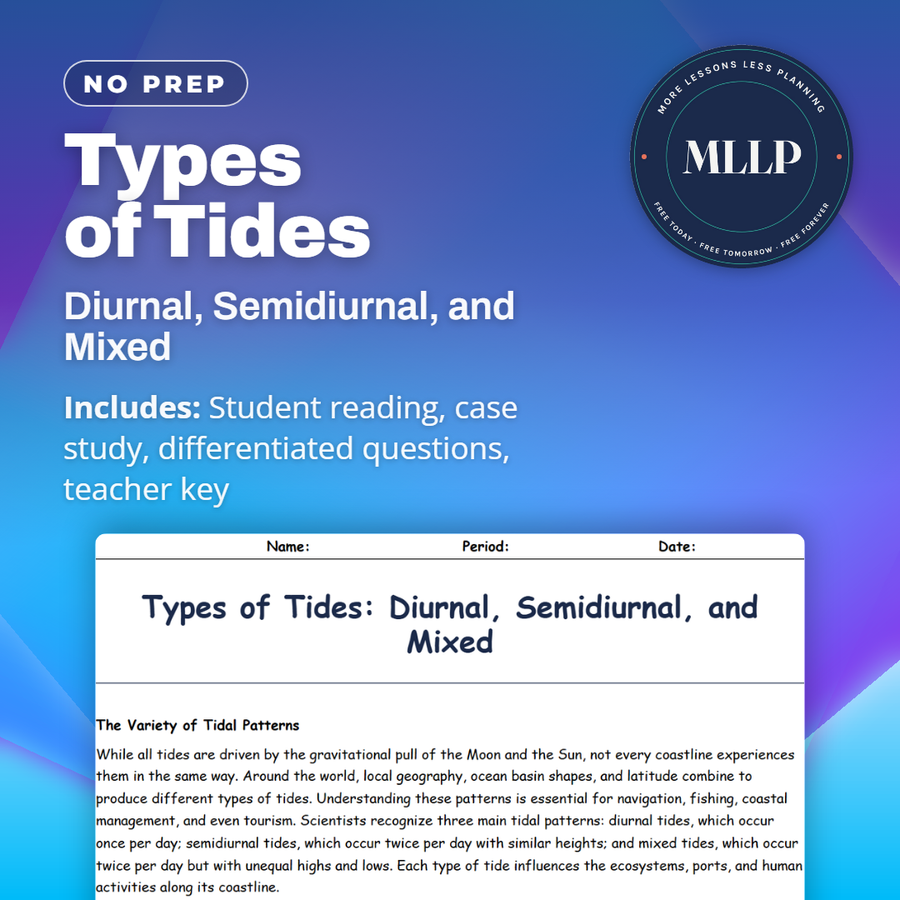
Types of Tides: Diurnal, Semidiurnal, and Mixed
Quality reviewed September 2026
Facts verified September 14, 2026
- Subject
- Science
- Grades
- Grades 9-12
- Length
- 6-page student worksheet
- Time
- About one 50-minute class period
- Great for
- Sub plans and independent work
- Includes
- Reading passage, comprehension questions + full answer key
- Format
- Print-and-go PDF
What students do
- Match terms like diurnal tide, semidiurnal tide, mixed tide, the Gulf of Mexico, and the Atlantic coast to their correct definitions
- Fill in the blank sentences on Pacific coast mixed tides, diurnal tides, and the 12-hour semidiurnal cycle
- Answer multiple choice questions on which tide type has one high and one low per day, which U.S. coast sees mixed tides most often, and why semidiurnal tides matter for estuaries
- Write short answers on how mixed tides complicate shipping and fishing, why tidal types vary around the globe, and how communities can use tidal knowledge to protect ecosystems
What it covers
- The three main tidal patterns, diurnal, semidiurnal, and mixed, and what shapes each one
- How coastal geography and basin shape determine which tidal pattern a coastline experiences
- A case study comparing the Gulf of Mexico's diurnal tides to the Atlantic coast's semidiurnal tides
Start reading this worksheet
The Variety of Tidal Patterns
While all tides are driven by the gravitational pull of the Moon and the Sun, not every coastline experiences them in the same way. Around the world, local geography, ocean basin shapes, and latitude combine to produce different types of tides. Understanding these patterns is essential for navigation, fishing, coastal management, and even tourism. Scientists recognize three main tidal patterns: diurnal tides, which occur once per day; semidiurnal tides, which occur twice per day with similar heights; and mixed tides, which occur twice per day but with unequal highs and lows. Each type of tide influences the ecosystems, ports, and human activities along its coastline.
Like what you read? The full reading, the case study, and every question set are in the free download below, along with the answer key.
Why this matters
A fisherman working the Gulf of Mexico plans around one high tide and one low tide a day. A fisherman working the Atlantic coast a few states over plans around two of each, spaced almost exactly twelve hours apart. Both are reading the same ocean, just shaped by different coastline geometry into a diurnal pattern on one coast and a semidiurnal pattern on the other, with mixed tides splitting the difference elsewhere.
A tide chart from one coast does nothing for a student vacationing on another, which surprises kids who picture the tide as one universal clock. I like putting the Gulf and the Atlantic side by side, because it turns an abstract term like basin shape into something as practical as when a port can safely bring a ship in.
From one teacher to another
Not every coastline feels the tide the same way. The reading walks through the three main tidal patterns, diurnal tides with a single daily high and low, semidiurnal tides with two roughly equal cycles, and mixed tides with two unequal cycles, along with the geography that produces each. The case study compares the Gulf of Mexico's single daily tide to the Atlantic coast's twice-daily cycle, showing how fishermen and ports adjust their schedules to match.
What you get
Download
Where should I send the next one?
Everything here is free and it stays that way. Leave your email and I'll send you the new lessons as they go up. You can unsubscribe from any one of them.
Related resources
Coastal Processes: Erosion, Deposition, Barrier Islands, and Estuaries
El Niño and La Niña: Ocean-Atmosphere Climate Connections
Ocean Tides: Gravitational Forces of the Moon and Sun
Properties of Seawater: Salinity, Temperature, and Density
Surface Currents and Wind Patterns: The Coriolis Effect and Gyres
The Role of Oceans in Weather and Climate Systems
Every lesson on this site is free to download and use. If one of them saved you a prep period, you can chip in a few bucks toward my three kids' daycare fund. That's genuinely where tips go.