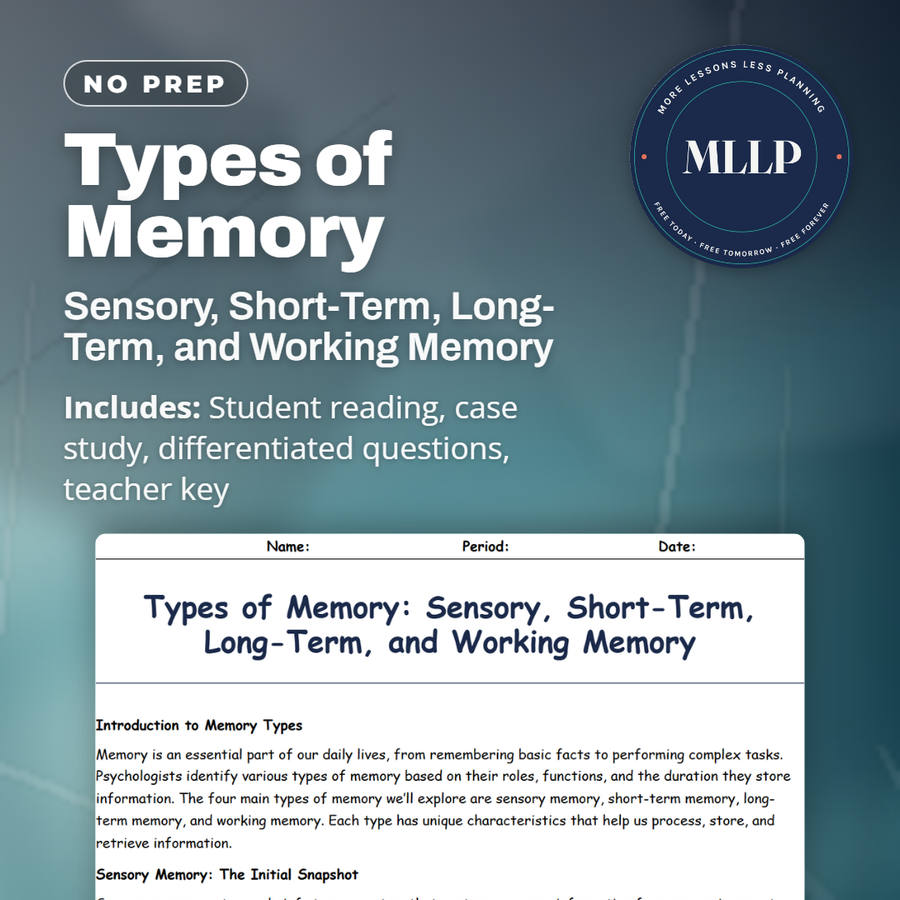
Types of Memory: Sensory, Short-Term, Long-Term, and Working Memory
Quality reviewed September 2026
Facts verified September 10, 2026
- Subject
- Social Studies
- Grades
- Grades 9-12
- Length
- 6-page student worksheet
- Time
- About one 50-minute class period
- Great for
- Sub plans and independent work
- Includes
- Reading passage, comprehension questions + full answer key
- Format
- Print-and-go PDF
What students do
- Match terms like episodic memory, iconic memory, and implicit memory to their correct definitions
- Fill in the blank sentences on the episodic buffer, sensory memory, and implicit memory
- Answer multiple choice questions on iconic memory, rehearsal, and the phonological loop
- Write short answers on sensory memory versus long-term memory, chunking, and how working memory differs from short-term memory
What it covers
- The four types of memory: sensory, short-term, long-term, and working memory
- Iconic, echoic, and haptic sensory memory, plus explicit and implicit long-term memory
- Baddeley's model of working memory and a case study on rehearsal and short-term memory retention
Start reading this worksheet
Introduction to Memory Types
Memory is an essential part of our daily lives, from remembering basic facts to performing complex tasks. Psychologists identify various types of memory based on their roles, functions, and the duration they store information. The four main types of memory we’ll explore are sensory memory, short-term memory, long-term memory, and working memory. Each type has unique characteristics that help us process, store, and retrieve information.
Sensory Memory: The Initial Snapshot
Sensory memory acts as a brief storage system that captures sensory information from our environment, such as sights, sounds, and smells. This type of memory is very short-lived, often lasting only a fraction of a second to a few seconds. Sensory memory provides an initial “snapshot” of the information we encounter, giving us a chance to decide if we want to pay attention to it and pass it along to short-term memory. There are different types of sensory memory: Iconic Memory: Visual information storage, which lasts around a second. For example, the brief image you see after closing your eyes is due to iconic memory. Echoic Memory: Storage of auditory information, which can last for a few seconds. This is why you can recall the last words someone said even after a brief pause. Haptic Memory: Sensory memory for touch, which allows us to briefly retain a feeling or sensation. Sensory memory’s primary purpose is to hold incoming sensory information just long enough for us to pay attention to it. If we ignore it, the information fades away almost instantly.
Short-Term Memory: Temporary Storage
Short-term memory (STM) is a temporary storage system that holds information we are actively thinking about. STM typically lasts for about 20 to 30 seconds and can store around 5-9 items at a time, often remembered in the form of a “chunk” or a group of related items. For example, when memorizing a phone number, we might remember it as three sets of numbers, like "555-123-4567," rather than ten individual digits. The capacity and duration of STM can be improved through rehearsal and chunking: Rehearsal: Repeating information to keep it in STM longer. This is why you repeat a phone number to yourself before dialing it. Chunking: Grouping information into manageable chunks. For instance, remembering a long number as a sequence of smaller numbers.
Like what you read? The full reading, the case study, and every question set are in the free download below, along with the answer key.
Why this matters
Sensory, short-term, long-term, and working memory get treated as one blurry system more often than not. This reading keeps them separate, down to iconic and echoic memory inside the sensory stage and explicit versus implicit inside long-term memory.
Baddeley's model, with its phonological loop and central executive, gives working memory a structure students can diagram instead of just naming. Chunking gets a concrete example too: the rehearsal case study gives students something specific to point to when they explain how working memory differs from short-term memory.
From one teacher to another
I use this one when we break down the different types of memory because students always lump them all together until they see iconic memory, short-term memory, and long-term memory side by side. The reading covers Baddeley's working memory model with the phonological loop and central executive, which sets up the matching and fill-in-the-blank sections well. The case study on rehearsal gives students a concrete study to reference in the short answer questions, where they have to explain how chunking increases short-term memory capacity and how working memory differs from short-term memory.
What you get
Download
Where should I send the next one?
Everything here is free and it stays that way. Leave your email and I'll send you the new lessons as they go up. You can unsubscribe from any one of them.
Related resources
Classical Conditioning Explained: Pavlov and Beyond
False Memories: How Our Minds Create Misinformation
How We Remember: An Overview of Memory Processes
Operant Conditioning Basics: Reinforcement, Punishment, and Behavior
Sleep Disorders and Their Impact on Health: Insomnia to Narcolepsy
Stages of Sleep: NREM, REM, and Their Effects on Health
Every lesson on this site is free to download and use. If one of them saved you a prep period, you can chip in a few bucks toward my three kids' daycare fund. That's genuinely where tips go.