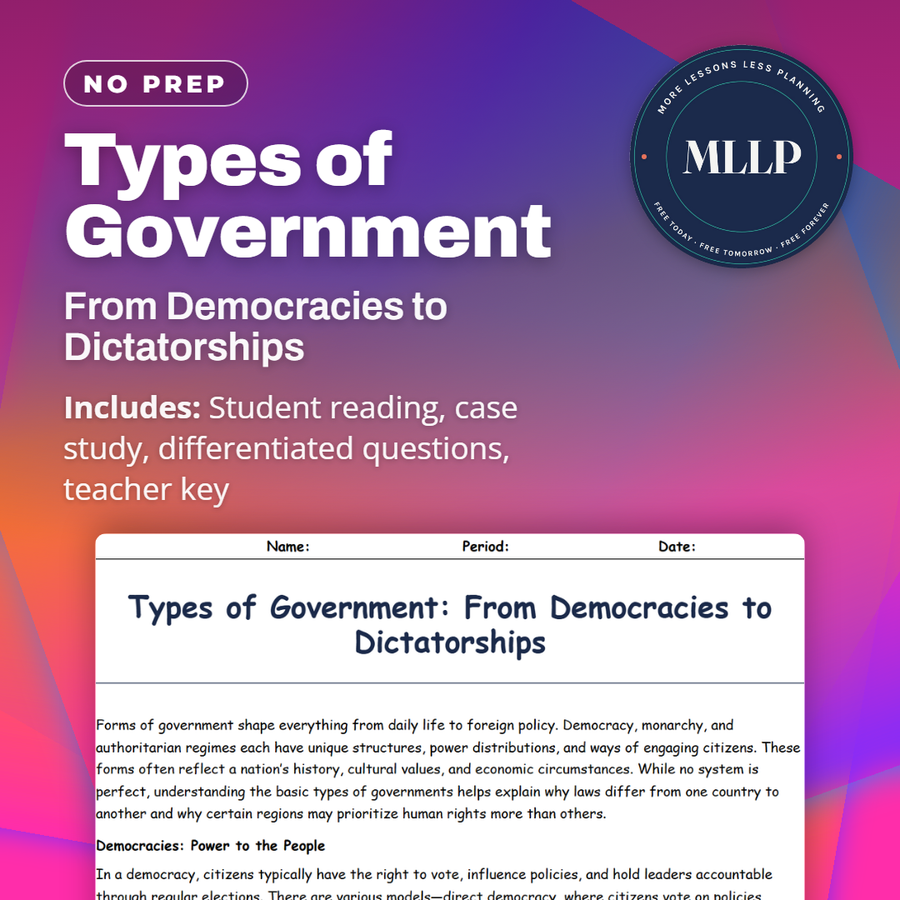
Types of Government: From Democracies to Dictatorships
Quality reviewed September 2026
Facts verified September 14, 2026
- Subject
- Social Studies
- Grades
- Grades 9-12
- Length
- 7-page student worksheet
- Time
- About one 50-minute class period
- Great for
- Sub plans and independent work
- Includes
- Reading passage, comprehension questions + full answer key
- Format
- Print-and-go PDF
What students do
- Match terms like Constitution, Divine Right, and Oligarchy to their correct definitions
- Fill in the blank sentences on absolute monarchy, authoritarian regimes, and a Supreme Leader
- Answer multiple choice questions on what a theocracy is and what defines a totalitarian regime
- Write short answers on why a constitutional monarchy might be more stable than an absolute one and how economic factors support authoritarian governments
What it covers
- Democracies, monarchies, authoritarian and totalitarian systems, and theocracies, with real-world examples of each
- Why most countries are hybrids that blend traits from more than one type of government
- A case study excerpt on Iceland's direct democracy and its crowdsourced constitution after the 2008 financial crisis
Start reading this worksheet
Forms of government shape everything from daily life to foreign policy. Democracy, monarchy, and authoritarian regimes each have unique structures, power distributions, and ways of engaging citizens. These forms often reflect a nation’s history, cultural values, and economic circumstances. While no system is perfect, understanding the basic types of governments helps explain why laws differ from one country to another and why certain regions may prioritize human rights more than others.
Democracies: Power to the People
In a democracy, citizens typically have the right to vote, influence policies, and hold leaders accountable through regular elections. There are various models—direct democracy, where citizens vote on policies themselves, and representative democracy, where elected officials make decisions on behalf of the people. Many countries blend these approaches with checks and balances. In theory, democracy promotes freedom of speech, press, and assembly. However, real-world democracies face challenges like gerrymandering, lobbying, and voter disenfranchisement. A healthy democracy relies on civic participation, a fair legal system, and competitive elections. Countries like the United States, India, and much of Western Europe pride themselves on democratic values, though each continues to refine and debate its processes.
Monarchies: Traditional Forms of Rule
A monarchy places power in the hands of a king, queen, or royal family. Historically, monarchs claimed divine right or lineage-based authority. Modern constitutional monarchies, such as the United Kingdom or Japan, limit the monarch’s powers through a constitution, often making the royal family more symbolic than governing. On the other hand, absolute monarchies, like Saudi Arabia, grant significant authority to the ruling family, though even these are influenced by global pressures and internal reform movements. Monarchies can evoke strong cultural unity, tying national identity to a royal house. Critics argue, however, that monarchies perpetuate inequality by making leadership a matter of birth rather than merit or election.
Like what you read? The full reading, the case study, and every question set are in the free download below, along with the answer key.
Why this matters
Ask a student to define democracy and most will describe elections every few years, not a room of citizens rewriting their own constitution together. Iceland did that after its 2008 financial crisis, crowdsourcing a new constitution through town hall meetings instead of leaving the job to officials. That example sits alongside monarchy, theocracy, authoritarianism, and totalitarianism, vocabulary students use all year to describe how a country is run.
Absolute monarchy, authoritarianism, and totalitarianism get confused constantly, so separating those terms early pays off for the rest of the course. Iceland's example also breaks the assumption that democracy only looks one way, which matters once the class reaches countries that blend traits from more than one system.
From one teacher to another
This reading gives students a vocabulary they will use for the rest of the year, from democracy through monarchy to theocracy and totalitarianism. I like the Iceland case study because it shows democracy working in a way students do not usually picture, with town hall meetings and a crowdsourced constitution instead of just elections every few years. The key terms table keeps absolute monarchy, authoritarianism, and totalitarianism clearly separated, which helps since students often confuse them. This pairs well with the political conflicts and border disputes reading.
What you get
Download
Where should I send the next one?
Everything here is free and it stays that way. Leave your email and I'll send you the new lessons as they go up. You can unsubscribe from any one of them.
Related resources
Colonialism and Imperialism: Shaping the Modern Political Map
Drawing the Lines: Borders, Boundaries, and Political Control
Geopolitics Explained: Power, Territory, and Global Influence
How Elections Are Mapped: A Guide to Electoral Geography
Nation, State, or Nation-State? Understanding Global Political Units
Political Conflicts and Border Disputes Around the World
Every lesson on this site is free to download and use. If one of them saved you a prep period, you can chip in a few bucks toward my three kids' daycare fund. That's genuinely where tips go.