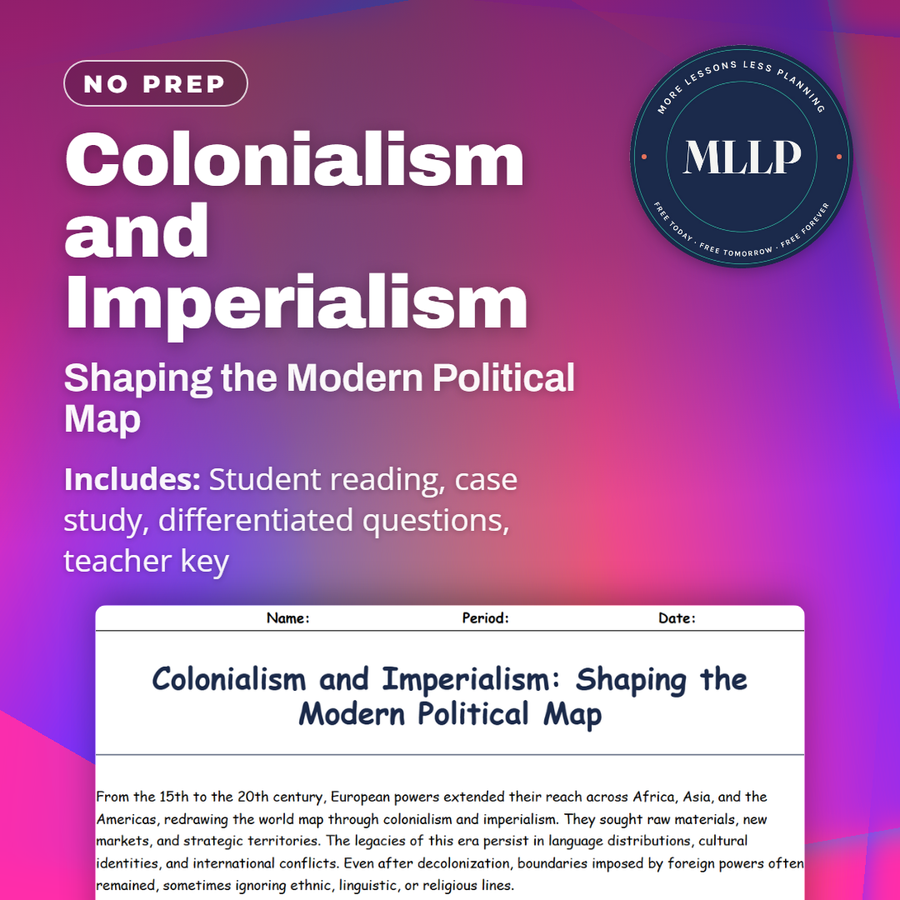
Colonialism and Imperialism: Shaping the Modern Political Map
Quality reviewed September 2026
Facts verified September 14, 2026
- Subject
- Social Studies
- Grades
- Grades 9-12
- Length
- 7-page student worksheet
- Time
- About one 50-minute class period
- Great for
- Sub plans and independent work
- Includes
- Reading passage, comprehension questions + full answer key
- Format
- Print-and-go PDF
What students do
- Match terms like Protectorate, Sphere of Influence, and Indirect Rule to their correct definitions
- Fill in the blank sentences on imperialism, the Berlin Conference, and weak institutions after decolonization
- Answer multiple choice questions on what colonialism primarily involves and why colonial-era boundaries still cause conflict
- Write short answers on why newly independent states kept colonial borders and how economic motives drove European expansion
What it covers
- European expansion into Africa, Asia, and the Americas, and the economic and religious motives behind it
- The Berlin Conference and how colonial powers redrew boundaries with no local input
- A case study excerpt on the Scramble for Africa, covering resistance leaders and the lasting effects of arbitrary borders
Start reading this worksheet
From the 15th to the 20th century, European powers extended their reach across Africa, Asia, and the Americas, redrawing the world map through colonialism and imperialism. They sought raw materials, new markets, and strategic territories. The legacies of this era persist in language distributions, cultural identities, and international conflicts. Even after decolonization, boundaries imposed by foreign powers often remained, sometimes ignoring ethnic, linguistic, or religious lines.
European Expansion and Motives
Nations like Portugal, Spain, Britain, and France raced to acquire colonies. Motivations included economic gain through gold, spices, and other resources, as well as missionary zeal to spread Christianity. Technological advances in navigation and weaponry gave Europeans an edge, allowing them to establish trading posts and eventually dominate entire regions. Mercantilism, in which colonies provided raw materials to the mother country, became an economic model. This disrupted local economies, forcing them into global trade networks on unequal terms. Native cultures encountered new religions, languages, and governance systems that often challenged or suppressed traditional ways of life.
Redefining Boundaries
Colonial powers frequently carved up continents, ignoring local tribal or ethnic boundaries. The Berlin Conference of 1884–1885 famously partitioned Africa among European nations without African input. These arbitrary divisions forced distinct groups together or separated unified ones. When independence movements swept across colonized regions in the 20th century, new nations emerged but often retained colonial borders. These borders became a source of tension and conflict, exemplified by ethnic strife in Africa and Asia. Some states, lacking strong pre-colonial governance systems, struggled to unify diverse populations. Today’s border disputes in parts of Africa and the Middle East trace back to these imperial impositions.
Like what you read? The full reading, the case study, and every question set are in the free download below, along with the answer key.
Why this matters
European powers drew the Berlin Conference's borders without a single person from the affected land in the room, and a surprising number of those lines still mark national boundaries today. Students who know colonialism only as a chapter title need that detail to see why old borders still cause conflict.
Naming leaders who fought colonization, and pointing at treaties that got broken, is what shifts students away from picturing colonized people as passive. I pair indirect rule and sphere of influence with the Scramble for Africa case study so the vocabulary describes real strategies, not just glossary entries.
From one teacher to another
I like this one because it does not stop at the idea that Europeans built empires. It walks students through why the Berlin Conference mattered, how colonial borders got drawn without any input from the people living inside them, and why those same lines still cause conflict today. The case study on the Scramble for Africa gives real texture to the idea, naming leaders who resisted and showing how broken treaties shaped the outcome. This pairs well with a unit on political geography or modern conflict.
What you get
Download
Where should I send the next one?
Everything here is free and it stays that way. Leave your email and I'll send you the new lessons as they go up. You can unsubscribe from any one of them.
Related resources
Drawing the Lines: Borders, Boundaries, and Political Control
Geopolitics Explained: Power, Territory, and Global Influence
How Elections Are Mapped: A Guide to Electoral Geography
Nation, State, or Nation-State? Understanding Global Political Units
Political Conflicts and Border Disputes Around the World
Separatist Movements and the Fight for Independence
Every lesson on this site is free to download and use. If one of them saved you a prep period, you can chip in a few bucks toward my three kids' daycare fund. That's genuinely where tips go.