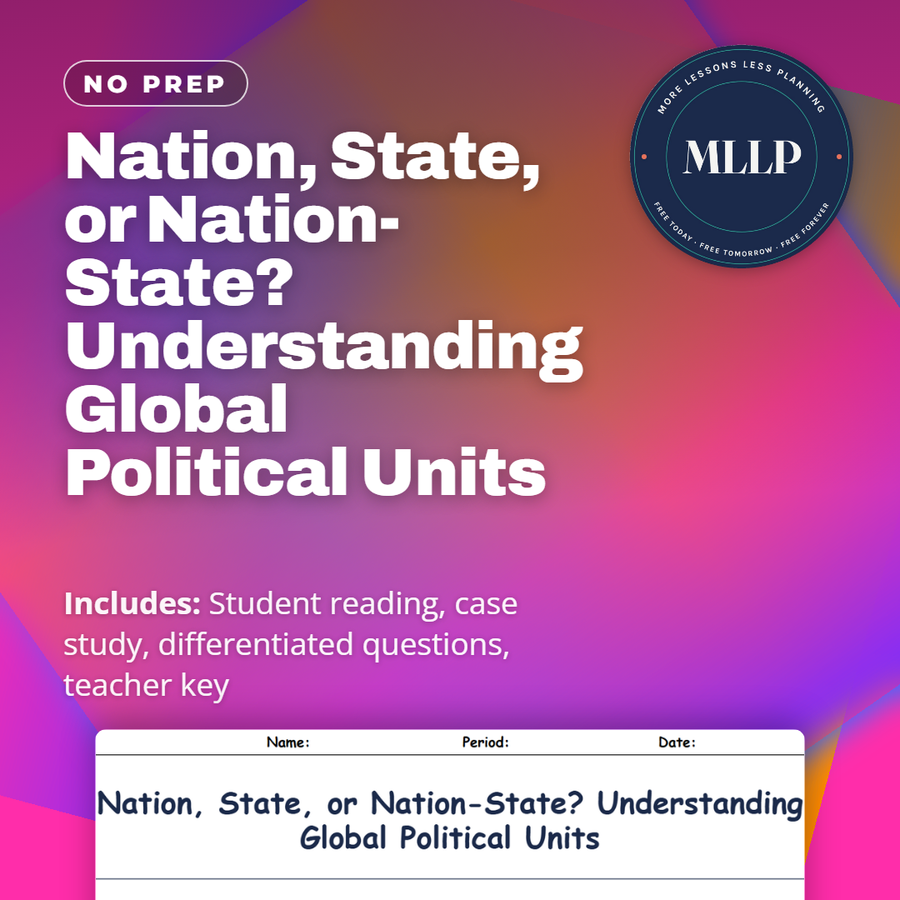
Nation, State, or Nation-State? Understanding Global Political Units
Quality reviewed September 2026
Facts verified September 14, 2026
- Subject
- Social Studies
- Grades
- Grades 9-12
- Length
- 7-page student worksheet
- Time
- About one 50-minute class period
- Great for
- Sub plans and independent work
- Includes
- Reading passage, comprehension questions + full answer key
- Format
- Print-and-go PDF
What students do
- Match terms like National Identity, Stateless Nation, and Multinational State to their correct definitions
- Fill in the blank sentences on stateless nations, self-determination, and nation-states
- Answer multiple choice questions on what a nation-state is and what sovereignty allows a state to do
- Write short answers on why some nations remain divided across multiple states and what role international recognition plays
What it covers
- The difference between a nation, a state, and a nation-state, using Japan and Canada as examples
- Sovereignty and self-determination, and how cultural identity can conflict with political boundaries
- A case study excerpt on the Kurdish people as a nation without a state of their own
Start reading this worksheet
Nations and states are words we hear often, yet they carry different meanings in political geography. A nation focuses on the people—a group sharing a common cultural identity, language, or heritage—while a state highlights a political entity with sovereignty, recognized borders, and governance structures. Sometimes, these elements align to form a nation-state, such as Japan, where a relatively homogeneous culture occupies a specific territory under one government. In other cases, people with a shared identity exist across multiple states, like the Kurds spread across Turkey, Iraq, Iran, and Syria. As students explore global events, recognizing these differences helps clarify why some communities seek sovereignty or why some countries struggle with internal cultural divisions.
Defining the Nation
A nation is not just about borders but about the collective identity of a people. Language, religion, traditions, and shared history often serve as cultural glue that binds a group together. These elements can cross existing political boundaries. For instance, the Pashtuns in Afghanistan and Pakistan speak the same language, follow similar customs, and see themselves as part of one cultural family despite being divided by an international boundary. Because a nation is so closely tied to culture, its members often feel deep loyalty and pride, sometimes driving independence movements. However, a nation does not always have political power over a region. It may live within a larger state, split among many states, or move across borders due to migration or historical conquests. Understanding the nature of a nation is crucial for grasping why certain groups mobilize for autonomy or why cultural conflicts can arise within a single state.
What Is a State?
A state is a politically defined territory that exercises sovereign authority over its internal and external affairs. It has recognized borders, a permanent population, and a government that crafts and enforces laws. This notion of sovereignty implies that a state has supreme power within its domain, free from external control. States range widely in size and power. For example, Vatican City is tiny yet fully recognized, while Russia spans multiple time zones. States also maintain diplomatic ties with other states, shape foreign policy, and sometimes form alliances for mutual benefit. They can be republics, monarchies, dictatorships, or any other form of governance. The key is that a state has formal recognition, both by its own people and by the international community. This status allows it to join organizations like the United Nations, make treaties, and participate in global decisions.
Like what you read? The full reading, the case study, and every question set are in the free download below, along with the answer key.
Why this matters
The Kurdish people share a language and history across four countries and still have no state of their own, which shows a student that nation and state are not the same thing. The reading then turns to Japan and Canada, two more cases for testing what a nation-state actually requires.
This is the reading I want in place before a unit moves into borders or separatist movements, since students confused about nation versus state get lost in every conflict that follows. The Kurdish case study also raises what international recognition actually requires.
From one teacher to another
Nation and state are easy to mix up, so this is a good place to start before moving into borders or conflict. The Kurdish case study does the heavy lifting, showing what it means to share a language and history across four different countries with no state of your own. The key terms table lines up nation, state, nation-state, and sovereignty side by side, which makes a good reference sheet for the rest of the unit. This pairs well with the readings on borders and separatist movements.
What you get
Download
Where should I send the next one?
Everything here is free and it stays that way. Leave your email and I'll send you the new lessons as they go up. You can unsubscribe from any one of them.
Related resources
Colonialism and Imperialism: Shaping the Modern Political Map
Drawing the Lines: Borders, Boundaries, and Political Control
Geopolitics Explained: Power, Territory, and Global Influence
How Elections Are Mapped: A Guide to Electoral Geography
Political Conflicts and Border Disputes Around the World
Separatist Movements and the Fight for Independence
Every lesson on this site is free to download and use. If one of them saved you a prep period, you can chip in a few bucks toward my three kids' daycare fund. That's genuinely where tips go.