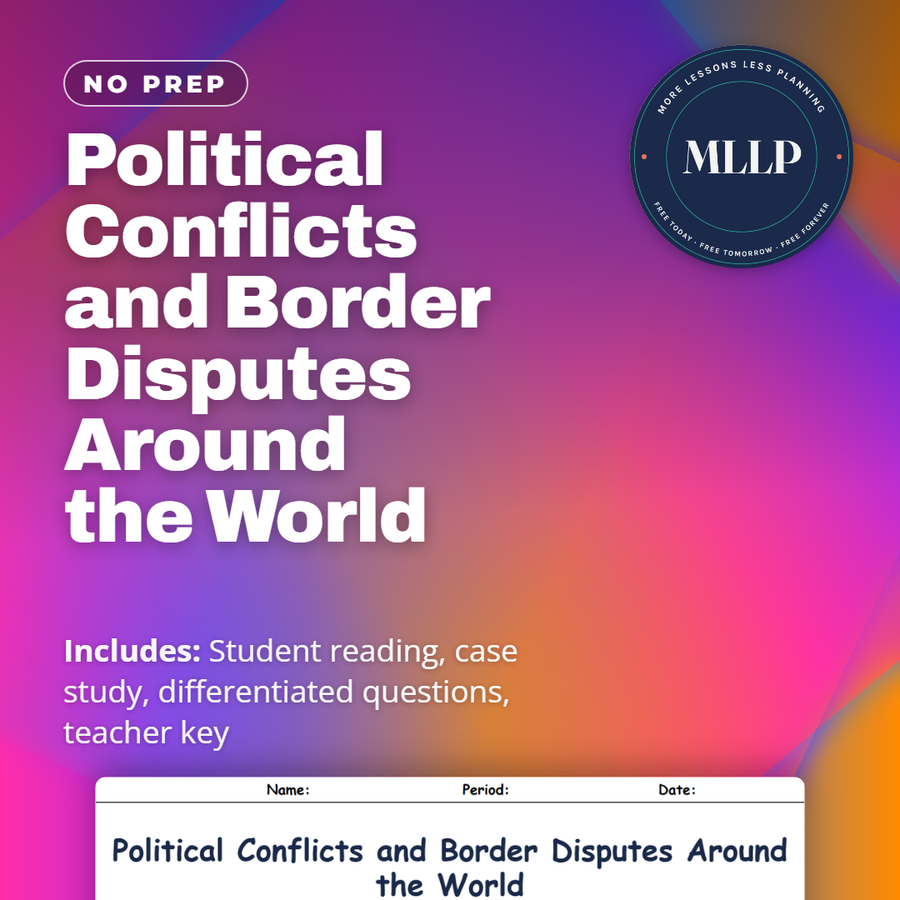
Political Conflicts and Border Disputes Around the World
Quality reviewed September 2026
Facts verified September 14, 2026
- Subject
- Social Studies
- Grades
- Grades 9-12
- Length
- 7-page student worksheet
- Time
- About one 50-minute class period
- Great for
- Sub plans and independent work
- Includes
- Reading passage, comprehension questions + full answer key
- Format
- Print-and-go PDF
What students do
- Match terms like Occupied Territory, Demilitarized Zone, and Peacekeeping Mission to their correct definitions
- Fill in the blank sentences on Kashmir, the nine-dash line, and ceasefires
- Answer multiple choice questions on why the South China Sea is contested and what a ceasefire is
- Write short answers on how international organizations can mediate disputes like Kashmir and Israel-Palestine
What it covers
- The Israel-Palestine conflict, including the status of Jerusalem and the Oslo Accords
- The Kashmir dispute between India and Pakistan, and China's claim over Aksai Chin
- The South China Sea dispute and a case study excerpt with voices from Kashmir describing daily life along the Line of Control
Start reading this worksheet
From the Middle East to South Asia and beyond, border disputes and political conflicts shape international headlines. Whether it’s longstanding tension between Israel and Palestine or disputes over Kashmir between India and Pakistan, territorial claims often fuel national pride, political rhetoric, and sometimes armed conflict. Understanding these issues involves exploring historical claims, religious or cultural differences, and the strategic value of contested lands.
Israel/Palestine: A Promised Land for Whom?
The conflict in Israel/Palestine traces back to early 20th-century aspirations for a Jewish homeland, British colonial mandates, and Arab nationalism. After Israel’s establishment in 1948, wars and shifting borders redrew the map. Key points of contention include the status of Jerusalem, considered holy by Jews, Christians, and Muslims, and the fate of Palestinian refugees. Peace deals like the Oslo Accords sought two states (one Israeli, one Palestinian) but stalled over settlements, security, and mutual recognition. Today, the region remains tense, with periodic violence erupting over control of territories like the West Bank and Gaza.
Kashmir: Between India and Pakistan
Located in the Himalayas, Kashmir has been disputed since the partition of British India in 1947. Both India and Pakistan claim the region, with a Line of Control effectively dividing it. A majority of Kashmir’s population is Muslim, yet the region is governed by India’s secular democracy, resulting in waves of protests and militancy. Pakistan supports certain rebel groups, though it denies direct involvement. China also controls a portion of Kashmir (Aksai Chin), adding another dimension. Harsh terrain and high-altitude militarization make it one of the world’s most dangerous flashpoints. Diplomatic efforts have waxed and waned, with sporadic talks failing to resolve core issues of sovereignty and regional identity.
Like what you read? The full reading, the case study, and every question set are in the free download below, along with the answer key.
Why this matters
A family farm that straddles the Line of Control in Kashmir still trades apples with cousins on the other side, even though that line separates India and Pakistan, the two countries that dispute the territory. That single detail does more than any definition of demilitarized zone to show what a border dispute actually costs the people living inside it.
This unit covers three conflicts at once, Kashmir, Israel-Palestine, and the South China Sea, so I lean on shared vocabulary, ceasefire, occupied territory, demilitarized zone, to keep students oriented as we move between them. Once they have that vocabulary, they start noticing how the same pattern, a disputed line and competing claims, repeats across regions with nothing else in common.
From one teacher to another
This is a dense one, covering three separate conflicts, so it can easily run across two class periods. The Kashmir case study is the strongest part, told from the perspective of someone whose family farm sits on the Line of Control and who still trades apples with cousins across it. I like that the key terms table gives students shared vocabulary, like ceasefire and arbitration, before they read about disputes that use those words constantly in the news. This works well right before or after the borders and boundaries reading.
What you get
Download
Where should I send the next one?
Everything here is free and it stays that way. Leave your email and I'll send you the new lessons as they go up. You can unsubscribe from any one of them.
Related resources
Colonialism and Imperialism: Shaping the Modern Political Map
Drawing the Lines: Borders, Boundaries, and Political Control
Geopolitics Explained: Power, Territory, and Global Influence
How Elections Are Mapped: A Guide to Electoral Geography
Nation, State, or Nation-State? Understanding Global Political Units
Separatist Movements and the Fight for Independence
Every lesson on this site is free to download and use. If one of them saved you a prep period, you can chip in a few bucks toward my three kids' daycare fund. That's genuinely where tips go.