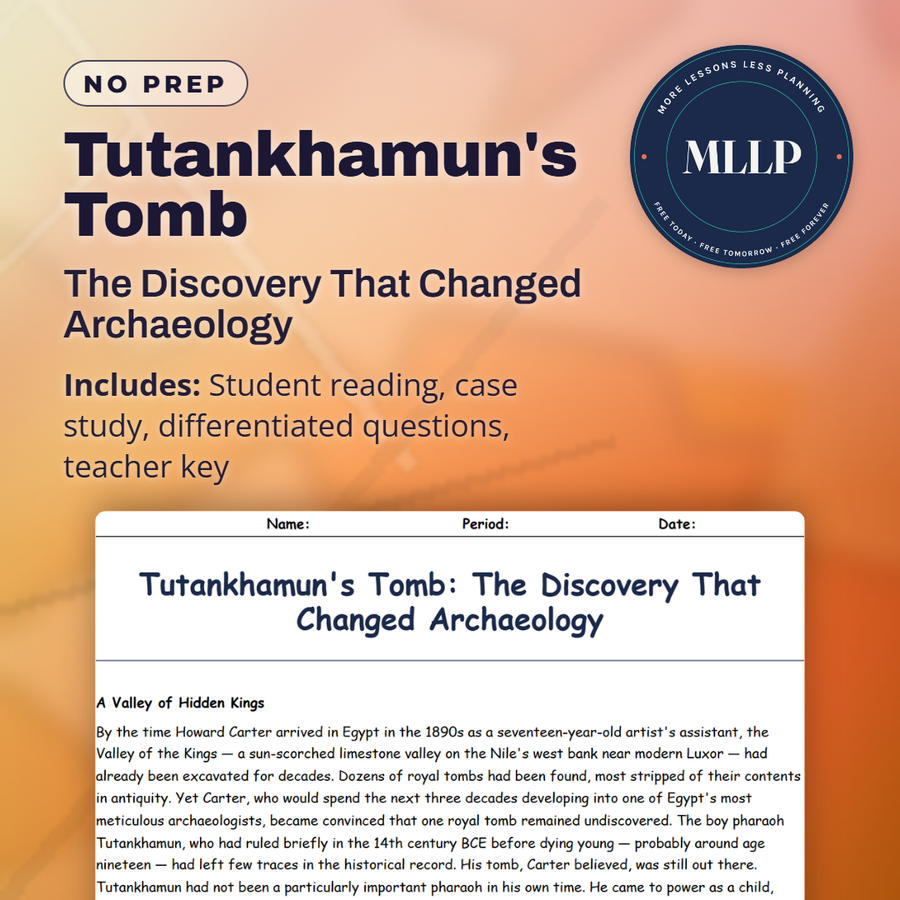
Tutankhamun's Tomb: The Discovery That Changed Archaeology
Quality reviewed September 2026
Facts verified September 21, 2026
- Subject
- Social Studies
- Grades
- Grades 9-12
- Length
- 9-page student worksheet
- Time
- About one 50-minute class period
- Great for
- Sub plans and independent work
- Includes
- Reading passage, comprehension questions + full answer key
- Format
- Print-and-go PDF
What students do
- Explain why Tutankhamun's minor status in his own lifetime is the reason his tomb survived intact
- The timeline of Carter's 1922 discovery gets sorted from the first step to the sealed burial chamber
- The "Curse of the Pharaohs" media story gets tested against what actually killed Lord Carnarvon
- A water boy named Ahmed finds the first step of the tomb, and students explain why his name never made it into the record
What it covers
- Howard Carter's 1922 discovery and what the tomb contained
- Why Tutankhamun's tomb escaped ancient looting
- The "Curse of the Pharaohs" media myth and what really happened
Start reading this worksheet
A Valley of Hidden Kings
By the time Howard Carter arrived in Egypt in the 1890s as a seventeen-year-old artist's assistant, the Valley of the Kings, a sun-scorched limestone valley on the Nile's west bank near modern Luxor, had already been excavated for decades. Dozens of royal tombs had been found, most stripped of their contents in antiquity. Yet Carter, who would spend the next three decades developing into one of Egypt's most meticulous archaeologists, became convinced that one royal tomb remained undiscovered. The boy pharaoh Tutankhamun, who had ruled briefly in the 14th century BCE before dying young (probably around age nineteen), had left few traces in the historical record. His tomb, Carter believed, was still out there. Tutankhamun had not been a particularly important pharaoh in his own time. He came to power as a child, likely around age eight or nine, inheriting the aftermath of a religious upheaval created by his predecessor Akhenaten, who had tried to abolish Egypt's traditional gods in favor of worshipping a single deity, the sun disc Aten. Tutankhamun restored the old religion, returned the capital to Thebes, and died before he could accomplish much else. His relatively minor status may actually be why his tomb survived: tomb robbers, who systematically plundered the Valley of the Kings even in ancient times, apparently deemed him not worth the effort.
Carter's Obsession and Lord Carnarvon's Patience
Howard Carter's search for Tutankhamun's tomb consumed years and required extraordinary financial backing. That backing came from Lord Carnarvon, a wealthy English aristocrat who had developed a passion for Egyptian archaeology after health problems drove him to winter in Egypt's dry climate. Carnarvon funded Carter's excavations season after season, but by 1922 he had nearly given up. He summoned Carter to his English estate and informed him that this would be the last season he would finance. Carter persuaded him to fund one final push. On November 1, 1922, Carter's team began excavating a section of the valley floor below the entrance to another tomb, an area that had previously been ignored. On November 4, a water boy on Carter's team noticed a stone step beneath the sand. Carter's workers carefully cleared the debris to reveal a staircase cut into the bedrock, leading down to a plastered doorway bearing the royal seal of the necropolis, the stamp of the priests who guarded the valley's burials. Carter immediately sent a telegram to Carnarvon in England: 'At last have made wonderful discovery in valley; a magnificent tomb with seals intact; re-covered same for your arrival; congratulations.'
The Moment the World Held Its Breath
Lord Carnarvon arrived in Egypt on November 23. On November 26, 1922, with Carnarvon, his daughter Lady Evelyn Herbert, and the Egyptian Antiquities official Pierre Lacau present, Carter made a small hole in the plastered doorway and held a candle inside. The warm air rushing out of the tomb after more than 3,200 years made the candle flame flicker. As his eyes adjusted, Carter saw, in the candlelight, 'everywhere the glint of gold.' Carnarvon, unable to wait, asked: 'Can you see anything?' Carter's reply has become one of the most famous sentences in the history of archaeology: 'Yes, wonderful things.' What Carter could see, packed into the antechamber beyond the doorway, were golden shrines, overturned chariots, wooden statues covered in black resin, alabaster vessels, flowers, and the gilded figure of a guardian statue standing watch. It took Carter's team nearly a decade to fully record and remove the contents of the tomb. The burial chamber itself, containing Tutankhamun's nested coffins and his famous gold death mask, was not opened until February 1923.
Like what you read? The full reading, the case study, and every question set are in the free download below, along with the answer key.
Why this matters
Ahmed's name never appears in Howard Carter's official account of the discovery, only "a water boy." That detail is worth pausing on. The people whose labor makes a discovery possible, the workers who dig, carry water, and clear sand, rarely get their names attached to what they helped uncover, then or now. Students who notice that pattern in Ahmed's case have a lens for asking who gets credited for any kind of work, in a classroom, a workplace, or a museum exhibit.
The curse story matters for a different reason. A newspaper industry competing for readers turned an infected mosquito bite into a supernatural death sentence, and the story stuck for a century despite there being no warning inscription in the tomb at all. That is a useful case study in how a dramatic explanation can outcompete a boring, true one, especially when the boring explanation involves nothing more exciting than bacteria in a sealed room.
From one teacher to another
Howard Carter spent nearly three decades convinced that one more tomb was still hidden in the Valley of the Kings, and on November 4, 1922, a stone step under the sand proved him right. This reading follows the discovery from that first step to Carter's famous words, "Yes, wonderful things," through the ten years it took his team to record and remove more than 5,000 objects, including a 110-kilogram solid gold coffin and the gold and lapis lazuli mask that is still the most recognized object from the ancient world. It also explains why the tomb survived when so many others were looted: Tutankhamun was a minor pharaoh whose short reign made his burial not worth an ancient robber's risk. Students separate that real archaeology from the "Curse of the Pharaohs" myth invented by newspapers after Lord Carnarvon died of an infected mosquito bite. The case study follows Ahmed, the eleven-year-old water boy whose foot caught the first step, and whose name Carter never wrote down.
What you get
Download
Where should I send the next one?
Everything here is free and it stays that way. Leave your email and I'll send you the new lessons as they go up. You can unsubscribe from any one of them.
Related resources
Ancient Egypt: Land of the Pharaohs, An Overview
Building the Pyramids: Engineering Without Modern Technology
Daily Life in Ancient Egypt: Beyond the Pharaohs
Egyptian Religion and the Afterlife
Hatshepsut: The Woman Who Became Pharaoh
Hieroglyphics and the Rosetta Stone: Cracking the Code
Every lesson on this site is free to download and use. If one of them saved you a prep period, you can chip in a few bucks toward my three kids' daycare fund. That's genuinely where tips go.