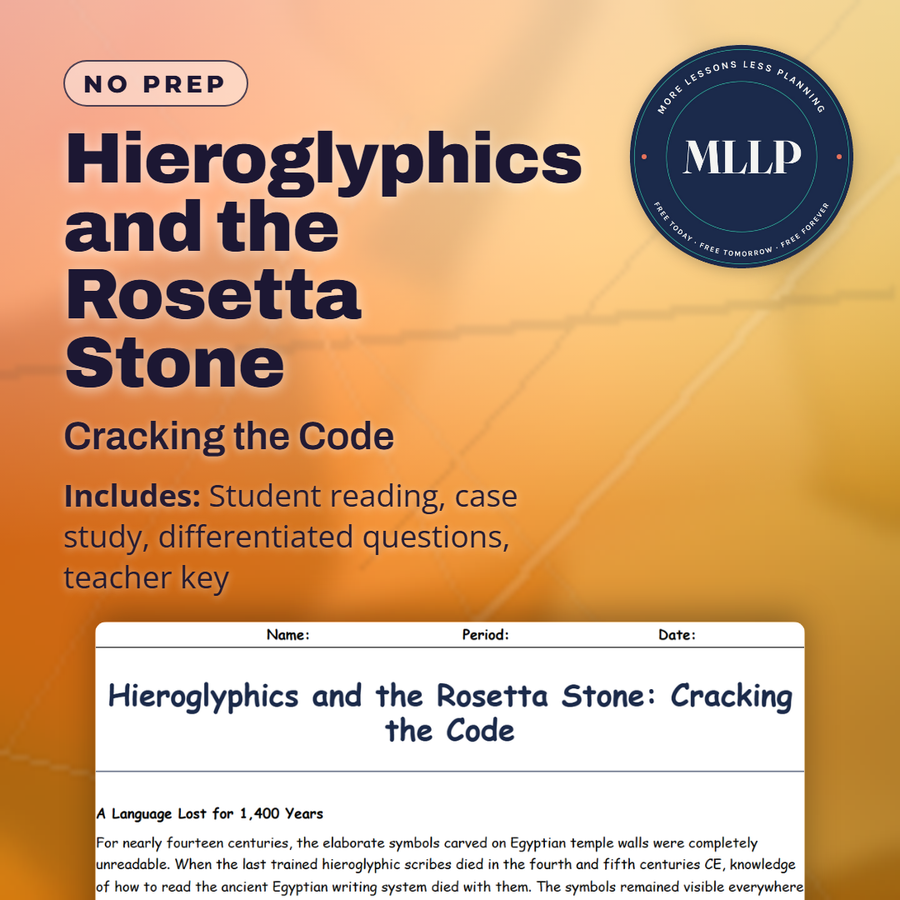
Hieroglyphics and the Rosetta Stone: Cracking the Code
Quality reviewed September 2026
Facts verified September 21, 2026
- Subject
- Social Studies
- Grades
- Grades 9-12
- Length
- 9-page student worksheet
- Time
- About one 50-minute class period
- Great for
- Sub plans and independent work
- Includes
- Reading passage, comprehension questions + full answer key
- Format
- Print-and-go PDF
What students do
- Hieroglyphics, hieratic, and demotic get sorted by who actually used each script and for what
- Match hieratic, demotic, the logogram, and the determinative to what each one does inside a written line
- Write out how Champollion's knowledge of Coptic let him crack a code centuries of scholars had missed
- A scribe apprentice named Kha-em-waset copies the same symbol a thousand times, and students explain why
What it covers
- The three Egyptian scripts and how the Rosetta Stone linked them
- Champollion's 1822 decipherment and the role Coptic played
- Why becoming a scribe meant real social mobility in Egypt
Start reading this worksheet
A Language Lost for 1,400 Years
For nearly fourteen centuries, the elaborate symbols carved on Egyptian temple walls were completely unreadable. When the last trained hieroglyphic scribes died in the fourth and fifth centuries CE, knowledge of how to read the ancient Egyptian writing system died with them. The symbols remained visible everywhere (on obelisks shipped to Rome, on temple carvings, on papyri in museums) but they were utterly silent. Medieval travelers assumed they were purely symbolic, perhaps religious icons. Some early European scholars proposed elaborate theories involving secret mystical meanings encoded in the symbols. The truth turned out to be more elegant: hieroglyphics worked, at its core, much like other writing systems. Ancient Egypt used three related scripts. Hieroglyphics (from the Greek words for 'sacred carvings') was the formal monumental script carved on temple walls, tombs, and public monuments. It was ornate, complex, and time-consuming to produce. For everyday use, Egyptian scribes developed hieratic, a cursive script written with a brush on papyrus, which simplified the hieroglyphic symbols into quicker strokes. Later still, an even simpler script called demotic developed for administrative and commercial use. All three scripts could represent the same Egyptian language: they were, in essence, different 'fonts' for the same system.
The Rosetta Stone: Three Languages, One Message
The key to deciphering hieroglyphics arrived not through a sudden flash of inspiration but through a lucky accident of Napoleon's Egyptian campaign. In 1799, French soldiers digging defensive fortifications near the town of Rosetta (Rashid) in the Nile Delta unearthed a large black granodiorite slab. Carved on its surface was a decree issued in 196 BCE by Egyptian priests honoring Pharaoh Ptolemy V. The same text appeared three times: once in hieroglyphics, once in demotic, and once in ancient Greek. Since ancient Greek was still a well-understood language, scholars immediately recognized the Rosetta Stone's potential as a translation key. The British captured the stone from the French in 1801, and it has been in the British Museum ever since. This has been a source of ongoing controversy, as Egypt has repeatedly requested its return. European scholars spent the following two decades trying to crack the hieroglyphic text using the Greek as a guide. They correctly identified proper names, including Ptolemy, by spotting them enclosed in oval cartouches (the oval rings that surrounded royal names). But the full decipherment required one more crucial insight.
Champollion's Breakthrough
Jean-Francois Champollion was a French scholar who had been obsessed with Egyptian writing since childhood. By the time he was a teenager, he had already taught himself Coptic: the liturgical language of Egyptian Christians, which descended directly from ancient Egyptian and was still used in church services. This knowledge of Coptic would prove decisive. While other scholars assumed hieroglyphics were purely symbolic, each symbol representing a concept, Champollion recognized that the system was partly phonetic: some symbols represented sounds, not just ideas. In September 1822, Champollion cracked the code. He compared cartouches from the Rosetta Stone and another bilingual inscription from Philae, identifying the names Ptolemy and Cleopatra in the hieroglyphic text. By matching shared letters between the two names, he established a phonetic alphabet for the script. His knowledge of Coptic allowed him to recognize that the sounds he was recovering matched ancient Egyptian word forms still preserved in the Coptic liturgy. On September 14, 1822, Champollion burst into his brother's office in Paris, shouted 'I've got it!' and promptly fainted from excitement. He had just deciphered 3,500 years of Egyptian texts.
Like what you read? The full reading, the case study, and every question set are in the free download below, along with the answer key.
Why this matters
When only one to three percent of a population can read, whoever holds that skill holds real power over everyone else, and this reading is blunt about it. Egyptian scribes controlled tax records, legal documents, and royal decrees, which meant ordinary Egyptians depended entirely on someone else to read the rules they lived under. That is not a purely ancient problem. Any specialized skill that gatekeeps access to information, legal language, medical records, computer code, creates a similar kind of power for the people who hold it and a similar dependency for the people who do not.
Champollion's breakthrough is also a reminder that knowledge nobody thinks to connect can turn out to be the missing piece. He solved a 1,400-year puzzle not with a new discovery but by knowing Coptic, a language most of his fellow scholars had dismissed as irrelevant to ancient Egypt. Students get a real example of how learning something that seems unrelated can end up mattering more than anyone expected.
From one teacher to another
For fourteen centuries, nobody on Earth could read a single hieroglyph, even though the symbols were carved everywhere from temple walls to Roman obelisks. This reading follows the language from that long silence through its recovery: three related Egyptian scripts, the Rosetta Stone's discovery by French soldiers in 1799, and Jean-Francois Champollion's breakthrough in September 1822, which depended on a language most Europeans had never studied, Coptic, still used in Egyptian church services. Once decoded, hieroglyphics turned out to be a mixed system of word-symbols, sound-symbols, and silent category markers, complicated enough that literacy topped out at maybe one to three percent of the population. Scribes who mastered it were exempt from manual labor and treated with real respect. The case study follows a twelve-year-old apprentice named Kha-em-waset copying the same water-ripple symbol for the thousandth time, for reasons his sandal-maker father explained to him every morning for two years.
What you get
Download
Where should I send the next one?
Everything here is free and it stays that way. Leave your email and I'll send you the new lessons as they go up. You can unsubscribe from any one of them.
Related resources
Ancient Egypt: Land of the Pharaohs, An Overview
Building the Pyramids: Engineering Without Modern Technology
Daily Life in Ancient Egypt: Beyond the Pharaohs
Egyptian Religion and the Afterlife
Hatshepsut: The Woman Who Became Pharaoh
Modern Egyptology: Saving Egypt's Monuments Today
Every lesson on this site is free to download and use. If one of them saved you a prep period, you can chip in a few bucks toward my three kids' daycare fund. That's genuinely where tips go.