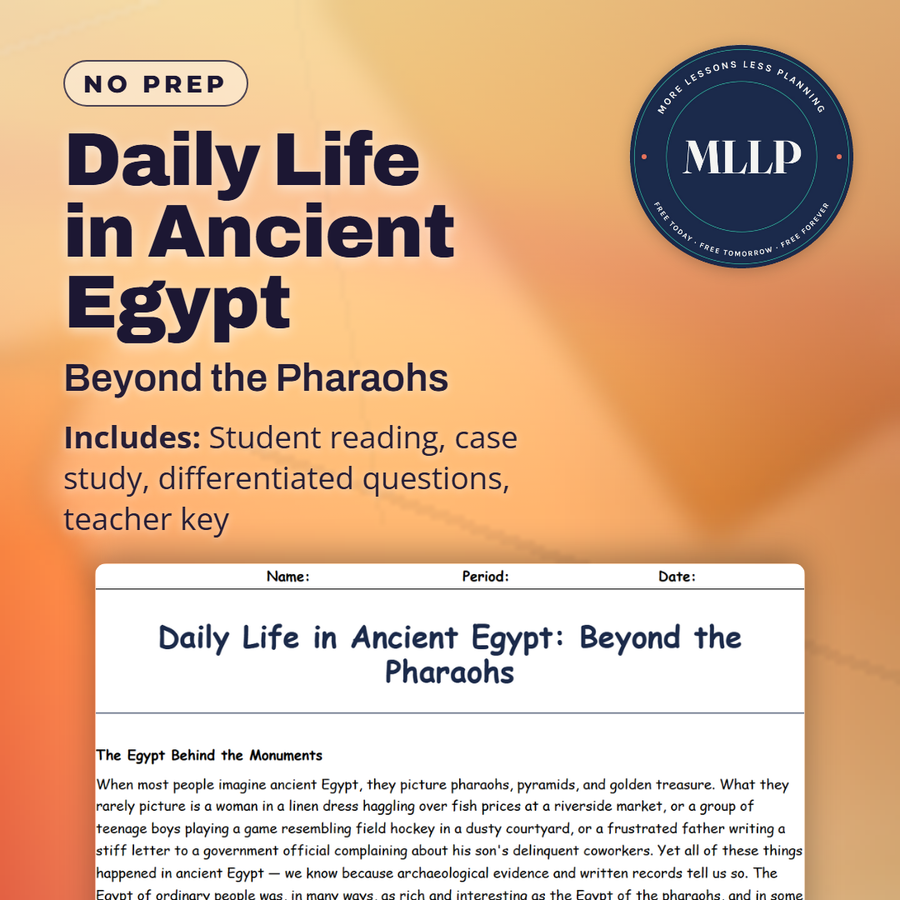
Daily Life in Ancient Egypt: Beyond the Pharaohs
Quality reviewed September 2026
Facts verified September 21, 2026
- Subject
- Social Studies
- Grades
- Grades 9-12
- Length
- 9-page student worksheet
- Time
- About one 50-minute class period
- Great for
- Sub plans and independent work
- Includes
- Reading passage, comprehension questions + full answer key
- Format
- Print-and-go PDF
What students do
- Deir el-Medina's workers walk off the job around 1157 BCE, and students explain why from the reading's evidence
- Match ostraca complaints, a stolen blouse, an unpaid debt, to the legal rights Egyptian women actually held
- Merit's letter accusing her neighbor of theft gets tested against what the reading says about women in court
- Explain how bread, beer, and linen showed up across every Egyptian social class, just at different quality
What it covers
- Daily food, clothing, and housing across Egyptian social classes
- The Deir el-Medina strike and how workers were paid
- Egyptian women's legal rights to property, contracts, and testimony
Start reading this worksheet
The Egypt Behind the Monuments
When most people imagine ancient Egypt, they picture pharaohs, pyramids, and golden treasure. What they rarely picture is a woman in a linen dress haggling over fish prices at a riverside market, or a group of teenage boys playing a game resembling field hockey in a dusty courtyard, or a frustrated father writing a stiff letter to a government official complaining about his son's delinquent coworkers. Yet all of these things happened in ancient Egypt. We know because archaeological evidence and written records tell us so. The Egypt of ordinary people was, in many ways, as rich and interesting as the Egypt of the pharaohs, and in some ways more relatable across the millennia. Ancient Egyptian society was organized into a clear hierarchy. At the top stood the pharaoh, followed by the royal family, high priests, viziers (chief ministers), nobles, and military commanders. Below them were the scribes and lower officials, then skilled craftsmen and merchants, then farmers and manual laborers. At the bottom were enslaved people, often war captives from Egypt's military campaigns. But within this hierarchy, there was more economic and social mobility than the rigid structure might suggest, especially for scribes and skilled craftsmen whose talents were in constant demand.
Deir el-Medina: The Workers Who Built the Royal Tombs
The most detailed picture of ordinary Egyptian life comes from an extraordinary archaeological site called Deir el-Medina, a workers' village near Luxor where the craftsmen who built and decorated the royal tombs in the Valley of the Kings lived with their families from around 1550 to 1080 BCE. Because the villagers were literate (scribal skills were necessary for the tomb inscriptions), they left behind an astonishing archive of written records on broken pottery shards called ostraca. These records reveal a community that feels startlingly modern. The workers of Deir el-Medina went on strike around 1157 BCE, one of the first recorded labor strikes in history, when the government failed to deliver their rations of grain, fish, and vegetables for several weeks. They marched to nearby temples and sat in protest, refusing to return to work until they were fed. Records show that wages were paid in kind: a skilled worker received a monthly ration of approximately 5.5 sacks of emmer wheat and 2 sacks of barley, plus regular deliveries of fish, vegetables, and sometimes firewood and salt. One ostracon contains a woman's formal complaint that her husband's colleague had stolen her blouse. Another records a man suing his neighbor over an unpaid debt of three copper deben. The concerns were familiar: work, wages, theft, and neighbors who owed you money.
Food, Clothing, and Housing
The Egyptian diet was built around bread and beer, both made from grain and both consumed daily at every social level. Bread came in dozens of varieties; archaeologists have identified at least forty different types from bread molds and carbonized loaves. Beer was thick and nutritious, more like a liquid bread than the clear beverages we associate with the word today, and it served as a caloric staple as well as a social lubricant. Wealthier Egyptians added meat (beef, pork, duck, and goose), fish, vegetables (onions, leeks, lettuce, beans), fruit (dates, figs, pomegranates), and honey to their diets. Most Egyptians wore linen, a fabric woven from flax, which grew abundantly in the Nile Valley. Linen was lighter and cooler than wool in Egypt's climate and could be bleached pure white or dyed in muted colors. The elite wore fine pleated linen of extraordinary quality; ordinary Egyptians wore coarser cloth in simple styles. Both men and women wore makeup: kohl (black eye paint) was applied by everyone, as it was believed to protect the eyes from the sun's glare as well as from evil. Housing ranged from the mudbrick one- and two-room homes of laborers to the multi-room villas of wealthy officials, most built around an internal courtyard that provided shade and ventilation.
Like what you read? The full reading, the case study, and every question set are in the free download below, along with the answer key.
Why this matters
The Deir el-Medina strike happened about 3,200 years ago, and it looked like the strikes workers still organize today: a group of people who did not get paid and who stopped working until someone fixed it. That continuity matters. It shows that organizing around fair pay is not a modern invention but a response that shows up whenever the people doing the labor are treated as replaceable.
Merit's legal complaint matters for a different reason. Ancient Egyptian women could own property, sign contracts, and testify in court at a level many women elsewhere in the ancient world could not, and Merit's letter shows what that looked like in practice, a woman filing a formal complaint in her own name over her husband's objections. Comparing that standing to the legal rights women hold today, where they gained ground and where the fight is still going, gives students a way to see legal history as something still moving instead of settled.
From one teacher to another
Pharaohs get all the attention, so this reading spends its time with everyone else: the craftsmen of Deir el-Medina who staged one of history's first recorded labor strikes, the women who owned property and sued their neighbors, and the families who ate bread and beer at every income level. The village of Deir el-Medina left behind ostraca, broken pottery used as scrap paper, recording debts, thefts, and marital complaints that read like they could have been written last week. Students also work through Egyptian women's legal standing, the right to own property, sign contracts, and testify in court, rights most women elsewhere in the ancient world did not have. The case study puts a woman named Merit in the middle of a real dispute over a stolen tool chest, a reluctant husband, and a formal complaint she files herself, invoking both a god and Ma'at to back her claim.
What you get
Download
Where should I send the next one?
Everything here is free and it stays that way. Leave your email and I'll send you the new lessons as they go up. You can unsubscribe from any one of them.
Related resources
Ancient Egypt: Land of the Pharaohs, An Overview

Building the Pyramids: Engineering Without Modern Technology
Egyptian Religion and the Afterlife
Hatshepsut: The Woman Who Became Pharaoh
Hieroglyphics and the Rosetta Stone: Cracking the Code
Modern Egyptology: Saving Egypt's Monuments Today
Every lesson on this site is free to download and use. If one of them saved you a prep period, you can chip in a few bucks toward my three kids' daycare fund. That's genuinely where tips go.