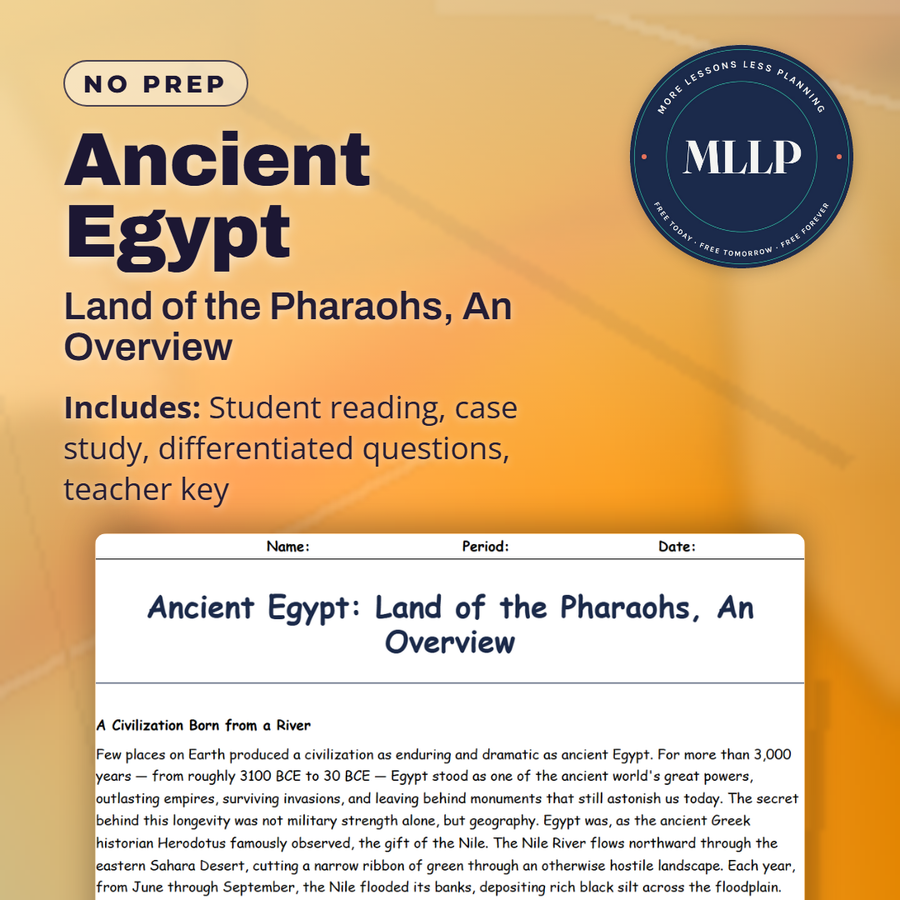
Ancient Egypt: Land of the Pharaohs, An Overview
Quality reviewed September 2026
Facts verified September 21, 2026
- Subject
- Social Studies
- Grades
- Grades 9-12
- Length
- 8-page student worksheet
- Time
- About one 50-minute class period
- Great for
- Sub plans and independent work
- Includes
- Reading passage, comprehension questions + full answer key
- Format
- Print-and-go PDF
What students do
- Khufu built the Great Pyramid in the Old Kingdom, while Hatshepsut and Tutankhamun both belong to the New Kingdom at the height of Egypt's power
- The Egyptians split their land into the fertile "Black Land" and the desert "Red Land," and students explain why
- A modern farmer's discovery of a carved stone block gets weighed against his family's need for the field
- Trace how the pharaoh's claim to divine status rested on maintaining Ma'at, order, truth, and justice
What it covers
- The three kingdoms and what set each one apart
- The Nile flood cycle and the Black Land versus Red Land split
- Ma'at as the working standard a pharaoh had to meet, not an abstract belief
Start reading this worksheet
A Civilization Born from a River
Few places on Earth produced a civilization as enduring and dramatic as ancient Egypt. For more than 3,000 years (from roughly 3100 BCE to 30 BCE), Egypt stood as one of the ancient world's great powers, outlasting empires, surviving invasions, and leaving behind monuments that still astonish us today. The secret behind this longevity was not military strength alone, but geography. Egypt was, as the ancient Greek historian Herodotus famously observed, the gift of the Nile. The Nile River flows northward through the eastern Sahara Desert, cutting a narrow ribbon of green through an otherwise hostile landscape. Each year, from June through September, the Nile flooded its banks, depositing rich black silt across the floodplain. Egyptian farmers called this land the 'Black Land' (Kemet) and contrasted it with the 'Red Land' (Deshret), the barren desert beyond. The flood cycle was so reliable that Egyptian farmers could plant their crops in October and harvest them by spring, year after year, for millennia. This agricultural surplus funded everything else: the pyramids, the temples, the armies, the scribes, and the art.
Kingdoms Rising: The Arc of Egyptian History
Historians divide ancient Egyptian history into three major periods of strength, separated by periods of instability called Intermediate Periods. The Old Kingdom (c. 2686–2181 BCE) was the age of pyramid building, the era when pharaohs commanded the resources of the entire Nile Valley to construct massive stone tombs on the Giza plateau. The pharaoh Khufu, who ruled around 2560 BCE, built the Great Pyramid, still the largest stone structure ever constructed. This period also saw the development of the hieroglyphic writing system and a sophisticated administrative bureaucracy run by scribes. The Middle Kingdom (c. 2055–1650 BCE) is sometimes called the Classical Age of Egyptian literature and art. After a period of regional fragmentation, pharaohs reunified Egypt and pushed its borders southward into Nubia. Trade flourished with Punt, Sinai, and the Levant. The New Kingdom (c. 1550–1070 BCE) brought Egypt to the height of its power and territory. This was the age of Hatshepsut, Akhenaten, Ramesses II, and Tutankhamun, pharaohs whose names still resonate 3,000 years later. Egypt's empire stretched from modern Sudan to the borders of Turkey.
The Pharaoh: God-King of the Nile
At the center of Egyptian civilization stood the pharaoh. The word 'pharaoh' comes from the Egyptian per-aa, meaning 'great house,' and originally referred to the royal palace before it came to mean the ruler himself. Egyptians believed their pharaoh was a living god: the earthly manifestation of Horus, falcon god of kingship, and upon death, the embodiment of Osiris, god of the dead. This divine status meant that everything in Egypt theoretically belonged to the pharaoh: the land, the labor of its people, the goods produced by its craftsmen.In practice, pharaohs depended on a vast network of officials, priests, scribes, and regional governors called nomarchs to administer the country. The pharaoh served as the link between the human world and the divine, performing rituals to maintain Ma'at, the Egyptian concept of cosmic order, truth, and justice. When the Nile flooded on schedule, when the harvests were good, when Egypt was at peace, it was because the pharaoh was fulfilling his sacred duty. When things went wrong (drought, famine, invasion), it threatened the pharaoh's legitimacy.
Like what you read? The full reading, the case study, and every question set are in the free download below, along with the answer key.
Why this matters
Hassan's dilemma in the case study is not invented drama. Egyptian farmers along the Nile still find ancient material under their fields today, and reporting a find can mean losing years of access to their most productive land. That tension between a family's income and a country's heritage is a live issue today, the same one the reading traces back three thousand years.
It also gives students a reason to think about how a belief system like Ma'at functioned as more than religion. It was the standard a pharaoh had to meet to keep his job, tied directly to whether the Nile flooded on time and the harvest came in. When students see that the reading connects drought and bad floods to real political consequences, ancient Egypt stops being a slideshow of gold and starts looking like a system with real stakes for real people, ancient and modern.
From one teacher to another
This one gives students the whole 3,000-year arc in a single sitting: the Nile's flood cycle that fed the fields, the three kingdoms from Khufu's pyramids through Hatshepsut and Tutankhamun, and the theology that made the pharaoh a working god rather than a decorative one. I like that it doesn't stop at "Egypt had pharaohs." It explains why the flood mattered enough to name the land after it, and why a bad harvest could shake a king's legitimacy. The case study drops students into the shoes of a modern Luxor farmer named Hassan, whose plow hits a carved stone block in his own field. Students have to hold his family's livelihood against Egypt's archaeological record, then decide what Ma'at, the reading's own concept of order and justice, would actually tell him to do. There's no clean answer, which is the point.
What you get
Download
Where should I send the next one?
Everything here is free and it stays that way. Leave your email and I'll send you the new lessons as they go up. You can unsubscribe from any one of them.
Related resources
Building the Pyramids: Engineering Without Modern Technology
Daily Life in Ancient Egypt: Beyond the Pharaohs
Egyptian Religion and the Afterlife
Hatshepsut: The Woman Who Became Pharaoh
Hieroglyphics and the Rosetta Stone: Cracking the Code
Modern Egyptology: Saving Egypt's Monuments Today
Every lesson on this site is free to download and use. If one of them saved you a prep period, you can chip in a few bucks toward my three kids' daycare fund. That's genuinely where tips go.