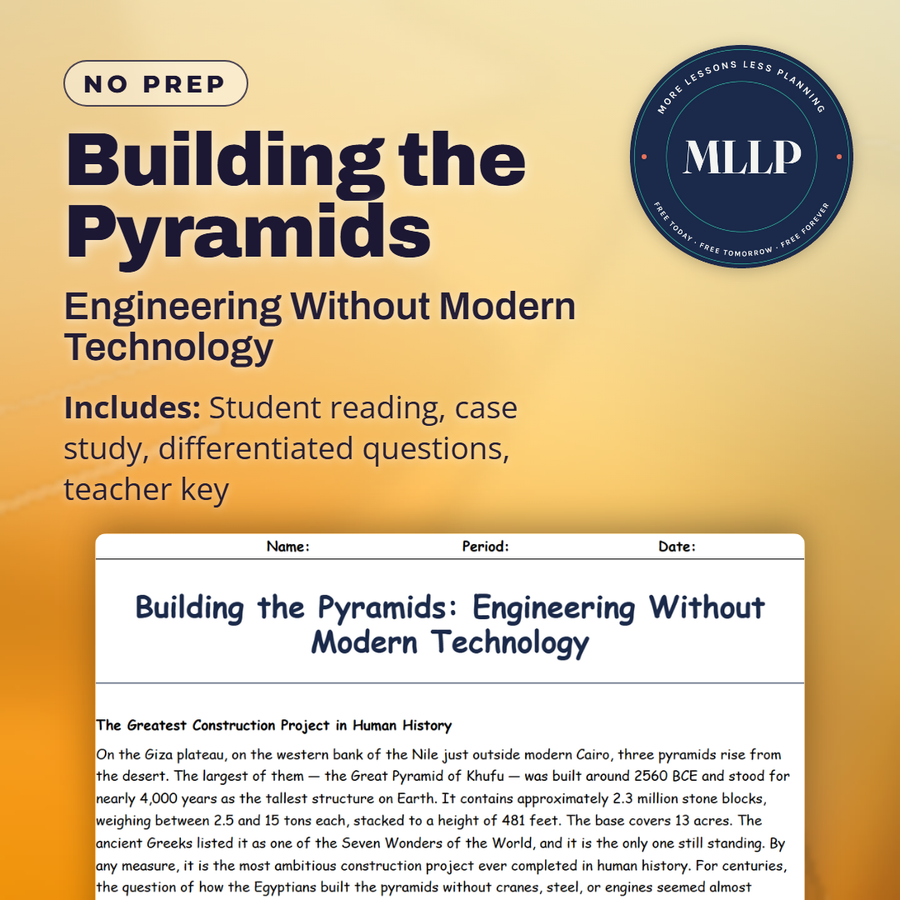
Building the Pyramids: Engineering Without Modern Technology
Quality reviewed September 2026
Facts verified September 21, 2026
- Subject
- Social Studies
- Grades
- Grades 9-12
- Length
- 9-page student worksheet
- Time
- About one 50-minute class period
- Great for
- Sub plans and independent work
- Includes
- Reading passage, comprehension questions + full answer key
- Format
- Print-and-go PDF
What students do
- The Great Pyramid's 2.3 million blocks get sorted by source, whether Giza bedrock, Tura quarries, or Aswan granite
- The workers' village evidence, bakeries, a medical facility, healed bones, answers the old myth of slave labor
- Explain what the 2013 discovery of the Merer papyrus told archaeologists that no artifact alone could
- Nebet's broken arm and her reassignment to the bakery show what the state actually did for hurt workers
What it covers
- How the pyramid's blocks were quarried, moved, and stacked into place
- Evidence that pyramid workers were paid laborers, not enslaved people
- The engineering precision behind the Great Pyramid's alignment
Start reading this worksheet
The Greatest Construction Project in Human History
On the Giza plateau, on the western bank of the Nile just outside modern Cairo, three pyramids rise from the desert. The largest of them, the Great Pyramid of Khufu, was built around 2560 BCE and stood for nearly 4,000 years as the tallest structure on Earth. It contains approximately 2.3 million stone blocks, weighing between 2.5 and 15 tons each, stacked to a height of 481 feet. The base covers 13 acres. The ancient Greeks listed it as one of the Seven Wonders of the World, and it is the only one still standing. By any measure, it is the most ambitious construction project ever completed in human history. For centuries, the question of how the Egyptians built the pyramids without cranes, steel, or engines seemed almost unanswerable, which is why it fueled so many wild theories, including the persistent and entirely unfounded claim that aliens built them. Modern archaeology has replaced these fantasies with something more impressive: evidence of extraordinary human organization, engineering ingenuity, and sustained collective effort. We now know more about how the pyramids were built than at any point in the past 3,000 years, and the answer is both humbling and inspiring.
Quarrying and Moving Stone
The pyramid's core blocks came from limestone quarried nearby, on the Giza plateau itself. Workers used copper chisels and stone hammers to cut blocks from the bedrock, then wooden sleds to move them across the desert. Recent archaeological discoveries have confirmed the use of ramps: long, gently sloping earthworks that allowed workers to drag stones upward as the pyramid rose. The exact design of these ramps remains debated: a single straight ramp would have become impractically long, so archaeologists favor designs incorporating spiral ramps around the pyramid's outer face or internal zigzag passages. The pyramid's outer casing stones, white Tura limestone that would have gleamed brilliantly in the Egyptian sun, came from quarries on the opposite bank of the Nile, requiring a massive boat transport operation. The granite used for the king's burial chamber and its massive ceiling beams came from Aswan, nearly 500 miles upstream. A remarkable papyrus discovered in 2013 at the Red Sea port of Wadi el-Jarf, the world's oldest papyrus, contains the diary of an official named Merer who supervised teams transporting Tura limestone to Giza by boat. This document gave archaeologists a direct firsthand account of pyramid construction logistics for the first time.
Who Built the Pyramids? Definitely Not Slaves
One of the most persistent myths about pyramid construction is that they were built by enslaved workers, perhaps tens of thousands of Israelite slaves, as depicted in the 1956 film The Ten Commandments. Archaeological evidence has completely demolished this claim. The workers' village excavated near Giza since the 1990s by archaeologist Mark Lehner and his team reveals a very different picture. The site contains bakeries, breweries, fish-processing facilities, and a large medical facility. The diet of the workers, analyzed from animal bones, included beef, sheep, and goat, proteins normally reserved for higher-status Egyptians. Skeletal remains from the workers' cemetery show healed fractures, indicating that injured workers received medical care and were allowed to recover rather than being discarded. Graffiti left by the workers refers to their teams with names like 'Friends of Khufu' and 'Drunkards of Menkaure', the kind of team nicknames you would not expect from enslaved people. Current estimates suggest the pyramid workforce consisted of roughly 20,000–30,000 workers at peak construction, divided between a permanent core of skilled craftsmen and a rotating labor force of farmers who worked on the pyramids during the agricultural off-season as a form of tax payment.
Like what you read? The full reading, the case study, and every question set are in the free download below, along with the answer key.
Why this matters
The idea that enslaved people built the pyramids has shaped movies, textbooks, and internet conspiracy theories for generations, and the archaeological record says otherwise. A workers' village with bakeries, a medical facility, and a cemetery showing healed injuries gives students a real case study in how physical evidence can overturn a story that feels obviously true just because it has been repeated so often.
Nebet's case also raises a question students meet in their own lives eventually: what happens to a worker who gets hurt on the job. The reading shows a system that reassigned an injured worker to lighter tasks instead of discarding her, a choice that reveals something about how a society values labor. Whether the same question comes up around a part-time job, a parent's workplace, or a policy debate about injured workers, it's worth asking why some systems choose to retain people and others do not.
From one teacher to another
Nothing about this reading treats the pyramids as a puzzle nobody can solve. It walks through how Khufu's builders quarried, hauled, and stacked 2.3 million blocks using ramps, copper chisels, and boats loaded with Tura limestone, then backs the process up with real evidence: the Merer papyrus found at Wadi el-Jarf in 2013, and the workers' village Mark Lehner has excavated near Giza since the 1990s. Students spend real time with the myth that enslaved people built the pyramids and the archaeology that dismantles it, bakeries, medical care, healed fractures, and team names like Friends of Khufu scratched onto the stone. The case study follows a young transport worker named Nebet whose arm is crushed on the ramp, and what her foreman and the site physician do next. It answers the question students actually want answered: who built this thing, and how they were treated while they did it.
What you get
Download
Where should I send the next one?
Everything here is free and it stays that way. Leave your email and I'll send you the new lessons as they go up. You can unsubscribe from any one of them.
Related resources
Ancient Egypt: Land of the Pharaohs, An Overview
Daily Life in Ancient Egypt: Beyond the Pharaohs
Egyptian Religion and the Afterlife
Hatshepsut: The Woman Who Became Pharaoh
Hieroglyphics and the Rosetta Stone: Cracking the Code
Modern Egyptology: Saving Egypt's Monuments Today
Every lesson on this site is free to download and use. If one of them saved you a prep period, you can chip in a few bucks toward my three kids' daycare fund. That's genuinely where tips go.