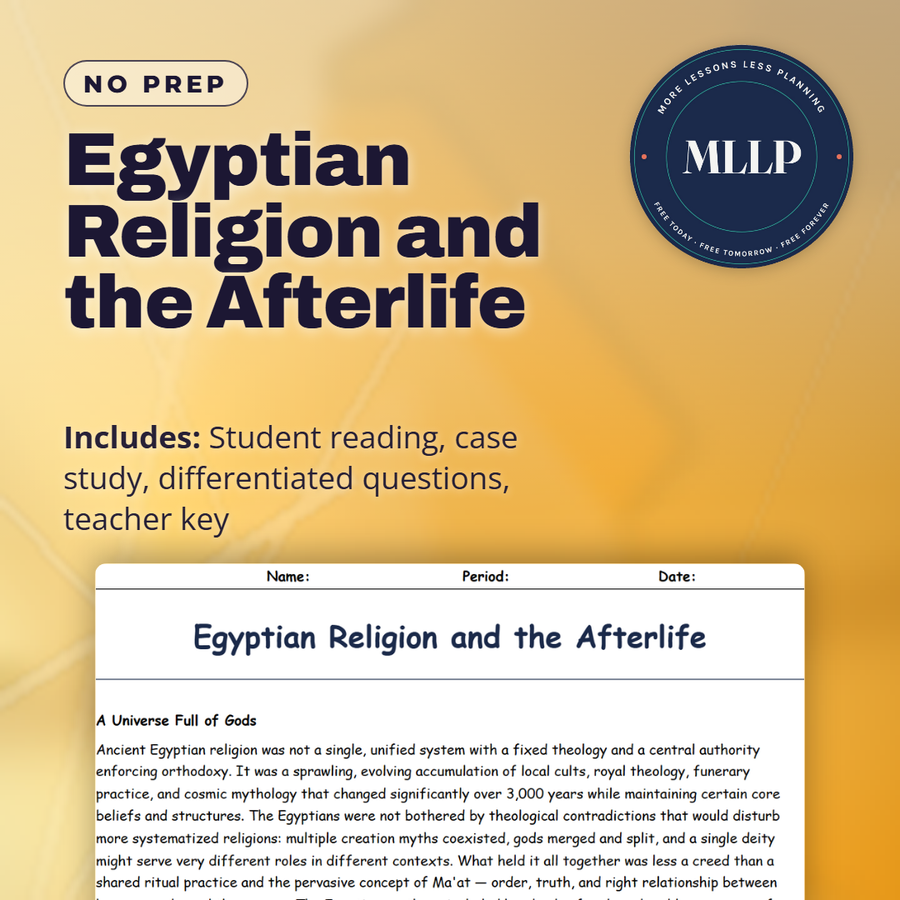
Egyptian Religion and the Afterlife
Quality reviewed September 2026
Facts verified September 21, 2026
- Subject
- Social Studies
- Grades
- Grades 9-12
- Length
- 10-page student worksheet
- Time
- About one 50-minute class period
- Great for
- Sub plans and independent work
- Includes
- Reading passage, comprehension questions + full answer key
- Format
- Print-and-go PDF
What students do
- Ra, Osiris, Isis, and Horus get sorted by the role each one plays in the Osiris myth
- The daily temple ritual, waking, feeding, and dressing a god's statue, gets mapped out step by step
- Answer why ordinary Egyptians could never enter a temple's inner sanctuary
- A priest's dawn ritual at Karnak shows what he actually believed was happening inside that shrine
What it covers
- The Osiris, Isis, and Horus myth and its link to kingship
- How Egyptian temples functioned as homes for the gods
- Public festivals versus private household religion
Start reading this worksheet
A Universe Full of Gods
Ancient Egyptian religion was not a single, unified system with a fixed theology and a central authority enforcing orthodoxy. It was a sprawling, evolving accumulation of local cults, royal theology, funerary practice, and cosmic mythology that changed significantly over 3,000 years while maintaining certain core beliefs and structures. The Egyptians were not bothered by theological contradictions that would disturb more systematized religions: multiple creation myths coexisted, gods merged and split, and a single deity might serve very different roles in different contexts. What held it all together was less a creed than a shared ritual practice and the pervasive concept of Ma'at: order, truth, and right relationship between humans, gods, and the cosmos. The Egyptian pantheon included hundreds of gods and goddesses, many of them associated with specific places, natural phenomena, or human activities. Some were represented as fully human, others as animals, and many as composite figures: part human, part animal. Ra, the sun god, was typically depicted as a man with a falcon's head topped by a solar disc. Osiris, god of the dead and resurrection, was shown as a mummified king wearing the white crown of Upper Egypt. His wife Isis was a great magician and protector, often shown with wings spread. Their son Horus, the falcon god, was the model for every living pharaoh. Thoth, ibis-headed god of writing and wisdom, recorded the results of the judgment of the dead. Anubis, jackal-headed god of embalming, presided over mummification.
The Myth That Explains Everything: Osiris and Isis
The most important mythology in ancient Egyptian religion was the story of Osiris and Isis, which provided the theological framework for both kingship and the afterlife. In the myth, Osiris was the first king of Egypt, a wise and just ruler who was murdered by his jealous brother Set (god of chaos and storms). Set cut Osiris's body into pieces and scattered them across Egypt. Isis, grief-stricken, searched the entire country and reassembled all but one piece of her husband's body. She used her magical powers to temporarily reanimate Osiris, conceive their son Horus, and then watched as Osiris became the ruler of the dead, the first to die and be resurrected. Horus grew up to avenge his father, defeating Set in a series of battles and becoming the rightful king of Egypt. Every living pharaoh was identified with Horus, the divine son who had defeated chaos and restored order. When a pharaoh died, he became Osiris, joining the realm of the dead as its ruler. His successor became the new Horus. This theological framework made the transition of power between pharaohs a cosmic event, not just a political one, and gave every royal burial the significance of a divine resurrection narrative. Every mummy was, in symbolic terms, another Osiris, undergoing the same transformation that the god had undergone.
Temples: Houses of the Gods
Egyptian temples were not primarily places of public worship in the way that Christian churches, Jewish synagogues, or Islamic mosques are understood today. They were understood as the literal dwelling places of the gods: the houses where divine statues were fed, clothed, and attended as if they were living royalty. The general public was not permitted in the inner sanctuaries. Each day, a small team of priests performed rituals in the inner chamber: breaking the seal on the naos (the shrine containing the divine statue), waking the deity, offering food and drink, dressing the statue in fresh linen, applying cosmetics, and finally closing and resealing the shrine. The great temple complexes at Karnak and Luxor, built over many centuries and expanded by successive pharaohs, represent the scale of this divine household concept taken to its logical extreme. Karnak, the main temple of Amun-Ra at Thebes, covers over 100 acres and includes multiple temples, sacred lakes, obelisks, processional avenues lined with sphinx statues, and pylons (massive gateway towers) added over 2,000 years of construction. The hypostyle hall at Karnak (a forest of 134 massive columns, the largest of them 70 feet high and wide enough for a hundred people to stand on top) remains one of the most extraordinary interior spaces from the ancient world.
Like what you read? The full reading, the case study, and every question set are in the free download below, along with the answer key.
Why this matters
Nebwenenef's morning ritual was not simple religious observance to him. The reading is clear that Egyptians believed the ritual itself kept the god present, and losing that presence risked cosmic disorder. That idea, that repeated ritual can hold a community together even without one central authority enforcing belief, still shows up whenever a family keeps the same holiday tradition for generations without anyone writing down why, or a school keeps a graduation ceremony that feels important even if no one could explain its full history.
The Osiris myth also shows students something about political power that outlasts ancient Egypt. Societies still wrap the handover of power in ceremony, an inauguration, a coronation, an oath of office, to make a purely political event feel bigger than politics. Seeing how directly the Egyptians tied kingship to a resurrection myth makes that pattern easier to spot everywhere else.
From one teacher to another
A temple in ancient Egypt was not a place ordinary people worshipped inside, and this reading opens with that surprise before explaining why. Priests treated the divine statue in the inner sanctuary as a living king, waking it at dawn, feeding it, dressing it in fresh linen, then sealing the shrine again until the next morning. Students work through the Osiris and Isis myth that explained every pharaoh's succession, a murder, a reassembly, and a resurrection turned into the story a new king reenacted every time an old one died. They also see how ordinary Egyptians reached the gods anyway, through household shrines, oracles that answered yes or no, and the massive public procession of the Opet Festival. The case study follows a priest named Nebwenenef through his dawn ritual and the answer he gives his son about whether the statue is actually alive.
What you get
Download
Where should I send the next one?
Everything here is free and it stays that way. Leave your email and I'll send you the new lessons as they go up. You can unsubscribe from any one of them.
Related resources
Ancient Egypt: Land of the Pharaohs, An Overview
Building the Pyramids: Engineering Without Modern Technology
Daily Life in Ancient Egypt: Beyond the Pharaohs
Hatshepsut: The Woman Who Became Pharaoh
Hieroglyphics and the Rosetta Stone: Cracking the Code
Modern Egyptology: Saving Egypt's Monuments Today
Every lesson on this site is free to download and use. If one of them saved you a prep period, you can chip in a few bucks toward my three kids' daycare fund. That's genuinely where tips go.