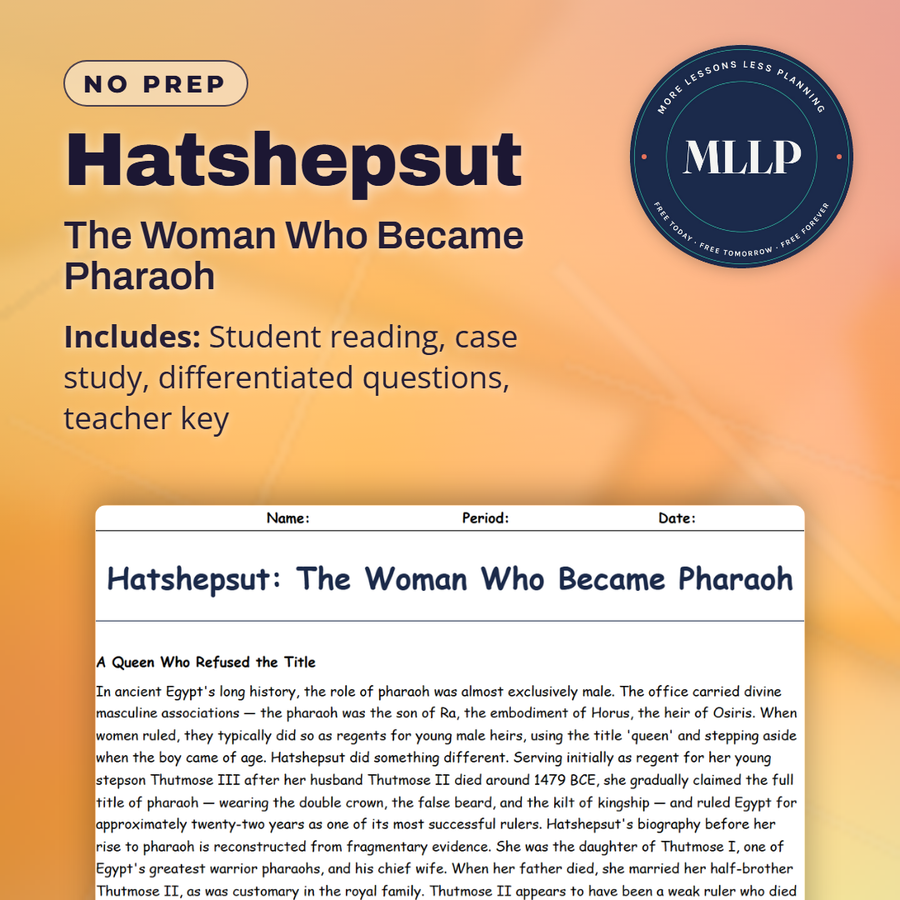
Hatshepsut: The Woman Who Became Pharaoh
Quality reviewed September 2026
Facts verified September 21, 2026
- Subject
- Social Studies
- Grades
- Grades 9-12
- Length
- 10-page student worksheet
- Time
- About one 50-minute class period
- Great for
- Sub plans and independent work
- Includes
- Reading passage, comprehension questions + full answer key
- Format
- Print-and-go PDF
What students do
- Trace how Hatshepsut moved from regent to full pharaoh, false beard and all
- The Punt expedition brought back myrrh trees, gold and ivory, and students work out what that meant for Egypt
- A mason named Seti chisels away her cartouche, and students weigh what he is thinking as he does it
- Answer why Thutmose III waited twenty years before erasing Hatshepsut's name from her own monuments
What it covers
- Hatshepsut's rise from regent to full pharaoh
- The Punt trade expedition and her building program at Deir el-Bahri
- Thutmose III's erasure and how her identity was recovered
Start reading this worksheet
A Queen Who Refused the Title
In ancient Egypt's long history, the role of pharaoh was almost exclusively male. The office carried divine masculine associations: the pharaoh was the son of Ra, the embodiment of Horus, the heir of Osiris. When women ruled, they typically did so as regents for young male heirs, using the title 'queen' and stepping aside when the boy came of age. Hatshepsut did something different. Serving initially as regent for her young stepson Thutmose III after her husband Thutmose II died around 1479 BCE, she gradually claimed the full title of pharaoh (wearing the double crown, the false beard, and the kilt of kingship) and ruled Egypt for approximately twenty-two years as one of its most successful rulers. Hatshepsut's biography before her rise to pharaoh is reconstructed from fragmentary evidence. She was the daughter of Thutmose I, one of Egypt's greatest warrior pharaohs, and his chief wife. When her father died, she married her half-brother Thutmose II, as was customary in the royal family. Thutmose II appears to have been a weak ruler who died after a short reign, leaving his young son, born to a secondary wife, as heir. Hatshepsut was appointed regent. Within a few years, she had made herself pharaoh in every sense of the word.
Running Egypt: Two Decades of Achievement
Hatshepsut's reign was marked by prosperity, ambitious building, and expanded trade rather than military conquest, though she was not passive in defense of Egypt's borders. Her most famous achievement was a trade expedition to the mysterious land of Punt (probably located in the Horn of Africa, possibly modern Eritrea or Somalia), which returned with thirty-one living myrrh trees, gold, ebony, ivory, incense, and exotic animals. The expedition is depicted in remarkable detail on the walls of her mortuary temple at Deir el-Bahri, providing one of the most complete records of an ancient trade mission in existence. Her building program was equally impressive. The mortuary temple at Deir el-Bahri (a colonnaded structure built into the limestone cliffs on the Nile's west bank near Luxor) is considered one of the finest examples of ancient Egyptian architecture, startlingly modern in its clean horizontal lines. She erected dozens of obelisks, including two enormous granite obelisks at Karnak temple, each standing over 29 meters high and capped with electrum (an alloy of gold and silver) that caught the morning sun. She commissioned statues of herself in every posture used by male pharaohs (seated, striding, as a sphinx), but with the face that artists and later archaeologists recognized as distinctly hers.
The Erasure: Thutmose III's Long Revenge
Hatshepsut died around 1458 BCE, probably of natural causes. Her stepson Thutmose III, who had been co-ruler with her during her reign and who would go on to become one of Egypt's greatest military pharaohs, outlived her by more than twenty years. Toward the end of his own reign, roughly twenty years after Hatshepsut's death, he undertook a systematic campaign to erase her from the historical record. Statues of her were smashed and buried. Her image was chiseled off temple walls. Her name in cartouches was replaced with the names of her husband Thutmose II, her father Thutmose I, or Thutmose III himself. Her obelisks at Karnak were not destroyed (they were too massive) but were encased in walls of masonry so that they could not be seen. The erasure was so thorough that Egyptologists of the 19th century, deciphering hieroglyphic inscriptions, initially assumed all the pharaoh references on these monuments referred to male rulers. It took decades of careful detective work to reconstruct Hatshepsut's identity. The motive for the erasure remains debated: some historians argue Thutmose III was angry at being sidelined during her long reign; others suggest the erasure was practical rather than personal, eliminating a female pharaoh from the succession record to prevent future challenges to male authority. The timing, twenty years after her death, suggests it was deliberate political calculation rather than immediate anger.
Like what you read? The full reading, the case study, and every question set are in the free download below, along with the answer key.
Why this matters
Erasing a person from the record did not start with a search engine or a court order. Thutmose III used the tools he had, a chisel and a wall of masonry, to try to make Hatshepsut's twenty-two years as pharaoh disappear from public memory. He came close. Nineteenth-century scholars reading her monuments assumed every reference was to a man, and it took decades of careful work to prove otherwise.
That story is worth sitting with because it is not unique to ancient Egypt. Anyone who studies how history gets written learns that those in power can shape what gets remembered and what gets left out, and Hatshepsut's recovery shows the limits of that power. A temple too large to tear down, statues buried instead of melted, and a single tooth in a jar outlasted a deliberate campaign to erase her. Physical evidence, it turns out, is harder to control than a story.
From one teacher to another
Hatshepsut did not settle for ruling as a queen behind a boy king. This reading follows her from regent for her stepson Thutmose III to a pharaoh in the full sense, wearing the false beard and double crown, for about twenty-two years of trade, building, and a famous expedition to the land of Punt that came home with myrrh trees, gold, and ivory. It also follows what happened after she died: her stepson waited two decades, then had her name chiseled off monuments, her statues smashed and buried, and her obelisks walled over. Students trace how Egyptologists rebuilt her identity anyway, from a temple too massive to demolish, buried statue fragments, and a tooth in a canopic jar matched to a mummy by DNA in 2007. The case study puts a mason named Seti at the base of her cartouche with a chisel in his hand, following orders he understands perfectly.
What you get
Download
Where should I send the next one?
Everything here is free and it stays that way. Leave your email and I'll send you the new lessons as they go up. You can unsubscribe from any one of them.
Related resources
Ancient Egypt: Land of the Pharaohs, An Overview
Building the Pyramids: Engineering Without Modern Technology
Daily Life in Ancient Egypt: Beyond the Pharaohs
Egyptian Religion and the Afterlife
Hieroglyphics and the Rosetta Stone: Cracking the Code
Modern Egyptology: Saving Egypt's Monuments Today
Every lesson on this site is free to download and use. If one of them saved you a prep period, you can chip in a few bucks toward my three kids' daycare fund. That's genuinely where tips go.