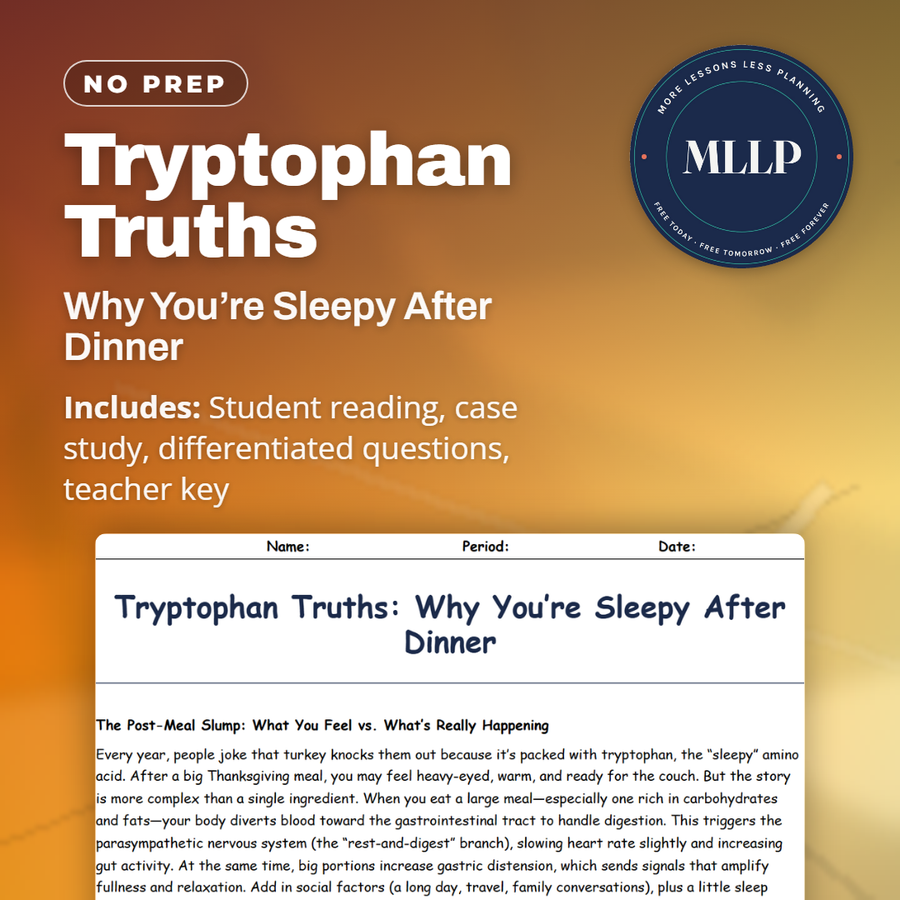
Tryptophan Truths: Why You’re Sleepy After Dinner
Quality reviewed September 2026
Facts verified September 9, 2026
- Subject
- Science
- Grades
- Grades 9-12
- Length
- 8-page student worksheet
- Time
- About one 50-minute class period
- Great for
- Sub plans and independent work
- Includes
- Reading passage, comprehension questions + full answer key
- Format
- Print-and-go PDF
What students do
- Explain how carbohydrate-driven insulin changes the tryptophan-to-LNAA ratio entering the brain
- Analyze which parts of Deja's first lunch made her drowsy and which parts of the second kept her alert
- Describe how fiber, portion size, and pacing change the post-meal energy curve
- Match tryptophan, serotonin, insulin, glycemic index, and the parasympathetic nervous system to their roles
What it covers
- The post-meal slump and what is really happening
- Tryptophan, insulin, and the blood-brain barrier
- Portions, pacing, light, and circadian timing
Start reading this worksheet
The Post-Meal Slump: What You Feel vs. What’s Really Happening
Every year, people joke that turkey knocks them out because it’s packed with tryptophan, the “sleepy” amino acid. After a big Thanksgiving meal, you may feel heavy-eyed, warm, and ready for the couch. But the story is more complex than a single ingredient. When you eat a large meal, especially one rich in carbohydrates and fats, your body diverts blood toward the gastrointestinal tract to handle digestion. This triggers the parasympathetic nervous system (the “rest-and-digest” branch), slowing heart rate slightly and increasing gut activity. At the same time, big portions increase gastric distension, which sends signals that amplify fullness and relaxation. Add in social factors (a long day, travel, family conversations), plus a little sleep debt, and you’ve built the perfect recipe for a post-meal slump. So where does tryptophan fit? Tryptophan is an essential amino acid, meaning you must get it from food. It’s also a biochemical precursor to serotonin and melatonin, both involved in mood and sleep regulation. But simply eating turkey doesn’t flood your brain with serotonin. The brain is protected by the blood-brain barrier (BBB), which selectively controls what gets in. Tryptophan has to compete with other large neutral amino acids (LNAAs) for transport into the brain. Whether more tryptophan reaches the brain depends on your overall meal composition, especially carbs that influence insulin and amino-acid uptake in muscles.
Tryptophan, Insulin, and the Brain: A Gatekeeping Story
When you eat carbohydrates such as mashed potatoes, rolls, and sweet pies, your blood glucose rises and your pancreas releases insulin. Insulin encourages muscle tissue to absorb many amino acids (like valine and leucine), which lowers their levels in the bloodstream. Tryptophan, however, is largely bound to albumin in blood and is less affected by this uptake. The result is a higher tryptophan-to-LNAA ratio in circulation. Because the BBB uses transporters that favor whichever amino acids are most available, a higher ratio nudges more tryptophan into the brain. Once inside, enzymes can convert tryptophan to serotonin, and eventually to melatonin. This biochemical pathway explains why people associate carb-heavy holiday meals with drowsiness: the carbs help tryptophan win the “entry competition.” Still, physiology isn’t destiny. The amount of tryptophan that actually becomes brain serotonin depends on many factors: your overall diet, timing, portion sizes, recent sleep, and even light exposure (bright light suppresses melatonin). Alcohol further complicates things by depressing the central nervous system and fragmenting sleep later in the night. In short, turkey provides tryptophan, but the sleepiness most people feel is a team effort: insulin dynamics, parasympathetic activation, meal size, and context work together far more than any single food.
The Plate Matters: Portions, Macros, and Pacing
If you build a plate with balanced macronutrients (moderate carbs, adequate protein, and some healthy fats), you’ll likely feel steadier than if you front-load with ultra-refined carbs and sugary desserts. Carbs aren’t the enemy; they’re a tool. A moderate carb load can support satiety and even mood, but a rapid spike and crash can leave you sluggish. Fiber-rich sides (roasted vegetables, whole-grain rolls) slow glucose absorption, reducing the dramatic insulin swing that can set up a later energy dip. Meanwhile, a reasonable portion of protein supports fullness without overwhelming digestion, and hydration helps stave off fatigue. Pacing also matters: eating quickly makes it easy to overshoot comfortable volume before the stomach’s stretch signals catch up to the brain. Students often ask whether switching from turkey to chicken or ham changes sleepiness. In practice, many common proteins contain similar ranges of tryptophan per serving. The more decisive variables are the sides, the timing (late-afternoon meals align with a natural circadian dip), and whether you add alcohol. Put differently: the casserole pan might be doing more than the bird.
Like what you read? The full reading, the case study, and every question set are in the free download below, along with the answer key.
Why this matters
Turkey does not make anyone sleepy. It has about as much tryptophan as chicken. The real cause is the plate itself: a heavy carbohydrate load spikes insulin, insulin clears out competing amino acids, and more tryptophan reaches the brain than usual.
Deja's two lunches, run like an actual experiment, are what make this stick. One eaten fast and heavy, one paced and balanced with a walk after, and her smartwatch data does the arguing. Most students can suddenly explain their own post-lunch slump, which is when I know the biology outlasted the myth.
From one teacher to another
Every student walks in believing turkey knocks people out, and the reading dismantles that in the first paragraph. Turkey has about as much tryptophan as chicken. The drowsiness comes from a big carb load raising insulin, which clears competing amino acids and lets more tryptophan into the brain, plus a full stomach, dim lighting, and an afternoon circadian dip. Deja's case study runs the experiment twice, one plate of mashed potatoes and pie eaten fast, one balanced plate eaten slowly with a walk after, and her smartwatch data does the arguing. I use this in biology because the mechanism is real chemistry students can test at their own table.
What you get
Download
Where should I send the next one?
Everything here is free and it stays that way. Leave your email and I'll send you the new lessons as they go up. You can unsubscribe from any one of them.
Related resources
Black Friday Forensics: Shoplifting, Organized Theft, and Crowd Violence
Black Friday Smart Shopper: Economics and Personal Finance in Action
Black Friday: Are the “Deals” Actually Good for Shoppers?
Black Friday’s Economic Impact: Who Gains, Who Pays, and What It Means for the Economy
Budget a Feast: Unit Prices, Deals, and Receipts
Colonial Foodways: Indigenous Knowledge and European Adaptation
Every lesson on this site is free to download and use. If one of them saved you a prep period, you can chip in a few bucks toward my three kids' daycare fund. That's genuinely where tips go.