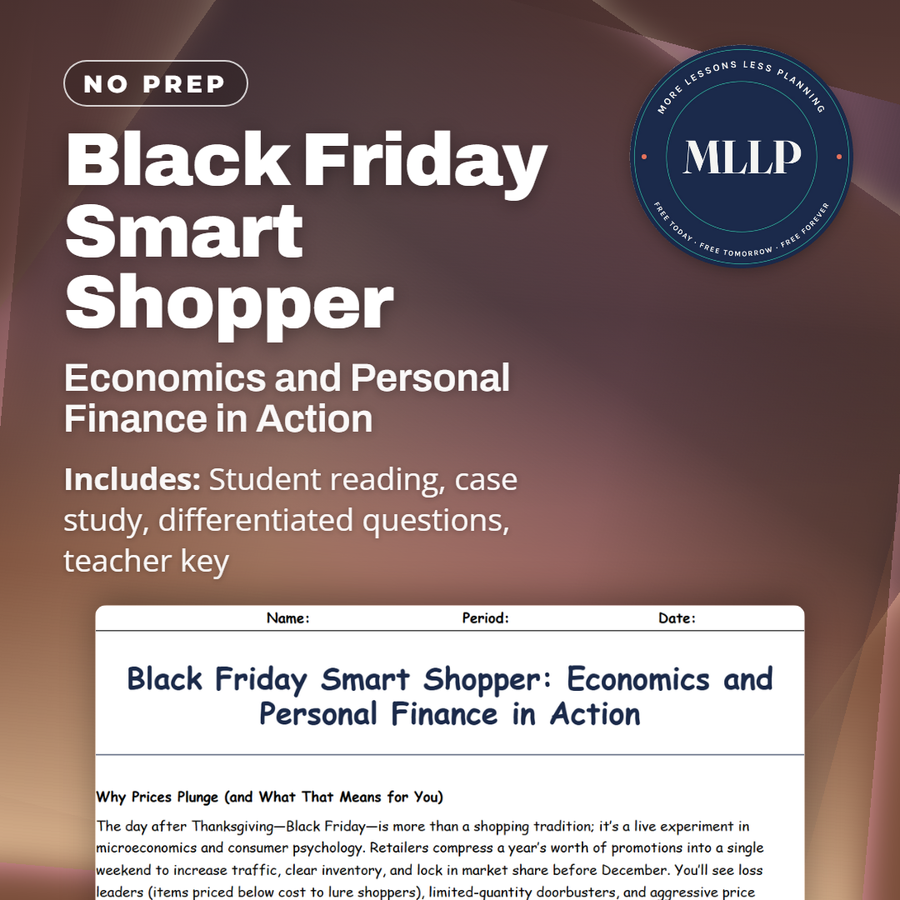
Black Friday Smart Shopper: Economics and Personal Finance in Action
Quality reviewed September 2026
Facts verified September 9, 2026
- Subject
- Career & Life Skills
- Grades
- Grades 9-12
- Length
- 8-page student worksheet
- Time
- About one 50-minute class period
- Great for
- Sub plans and independent work
- Includes
- Reading passage, comprehension questions + full answer key
- Format
- Print-and-go PDF
What students do
- Identify how retailers use bundling, anchoring, and dynamic pricing to shape choices
- Calculate opportunity cost by assigning value to time spent waiting and choosing
- Assess risk using BNPL terms, store card APR, and return policy friction
- Apply effective-price math to compare open-box, gift-card, and financing offers
What it covers
- Microeconomics of retail pricing and scarcity
- Personal finance and consumer psychology
- Opportunity cost and decision-making under constraints
Start reading this worksheet
Why Prices Plunge (and What That Means for You)
The day after Thanksgiving (Black Friday) is more than a shopping tradition; it’s a live experiment in microeconomics and consumer psychology. Retailers compress a year’s worth of promotions into a single weekend to increase traffic, clear inventory, and lock in market share before December. You’ll see loss leaders (items priced below cost to lure shoppers), limited-quantity doorbusters, and aggressive price anchoring (“WAS $199, NOW $79!”) designed to make discounts feel irresistible. From an economics standpoint, Black Friday is where demand spikes while capacity (registers, curbside slots, delivery windows) is constrained, creating scarcity that justifies queuing, clicking at midnight, and making rash choices. The personal finance lesson is to translate hype into opportunity cost: every hour in a line, every impulse buy, and every swipe on a credit card trades off against other goals, such as saving for a trip, paying down debt, or simply freeing up weekend time. A smart plan weighs total cost of ownership (price + tax + fees + interest + time) against the actual utility you’ll get from the purchase.
How Stores Steer You: Tactics You Can See (and Ones You Can’t)
Black Friday blends physical and digital choice architecture. In-store, endcaps place “hot” items along main aisles; decompression zones near entrances slow you down; limited stock displays manufacture urgency. Online, retailers deploy dynamic pricing, flash timers, and “only 3 left!” notices to trigger loss aversion. Bundles (e.g., console + controllers + games) raise basket size while obscuring unit price comparisons. Finance tools appear everywhere: store cards with instant discounts, buy now, pay later (BNPL) offers, and extended returns that reduce perceived risk. But the math matters: store cards can carry APRs above 25% if you revolve a balance; BNPL late fees and missed payments can hurt credit or future approvals; return mail can cost shipping or restocking. Meanwhile, price discrimination (different prices for different customers or times) happens through app-only deals, geo-targeted promotions, or email codes. Recognizing the tactic doesn’t mean refusing the deal; it means using the deal without being used: compare unit prices, set a cap for total spend, and avoid financing a want you’ll still be paying for next spring.
Like what you read? The full reading, the case study, and every question set are in the free download below, along with the answer key.
Why this matters
The same tablet bought three ways, store card, gift card, or open box, costs three different amounts once financing and fine print are counted, and the lowest sticker price does not win. A 15 percent discount on a 30 percent APR card can vanish inside one missed payment.
A discount reads as free money to most of my students, and "only 3 left" reads as fact instead of pressure tactic. Walking through the real spreadsheet math, opportunity cost included, teaches them that a deal requiring debt or a future fee is not cheaper, only deferred.
From one teacher to another
I borrowed this from a lesson on behavioral economics and it works because the case study is a real high school senior juggling college applications, gas money, and a tight budget. She has three paths to a tablet, store card, gift card bundle, or open-box, and students walk through her spreadsheet math to see why the lowest sticker doesn't win. They learn that a 15% discount on a 30% APR card can vanish in one month, that a gift card only counts if it's truly fungible (she was buying groceries there anyway), and that return friction (local or mail-only, restocking fees, window length) is a real cost. We also show how a flipped interest rate can turn a "win" into a loss, and how scarcity messaging ("Only 3 left!") triggers loss aversion instead of rational choice. By the end, students see that a deal that requires debt or future fees is not cheaper. It is deferred and risky.
What you get
Download
Where should I send the next one?
Everything here is free and it stays that way. Leave your email and I'll send you the new lessons as they go up. You can unsubscribe from any one of them.
Related resources
Black Friday Forensics: Shoplifting, Organized Theft, and Crowd Violence
Black Friday: Are the “Deals” Actually Good for Shoppers?
Black Friday’s Economic Impact: Who Gains, Who Pays, and What It Means for the Economy
Budget a Feast: Unit Prices, Deals, and Receipts
Colonial Foodways: Indigenous Knowledge and European Adaptation
Cranberries, Corn, and Trade: The Geography of Thanksgiving Foods
Every lesson on this site is free to download and use. If one of them saved you a prep period, you can chip in a few bucks toward my three kids' daycare fund. That's genuinely where tips go.