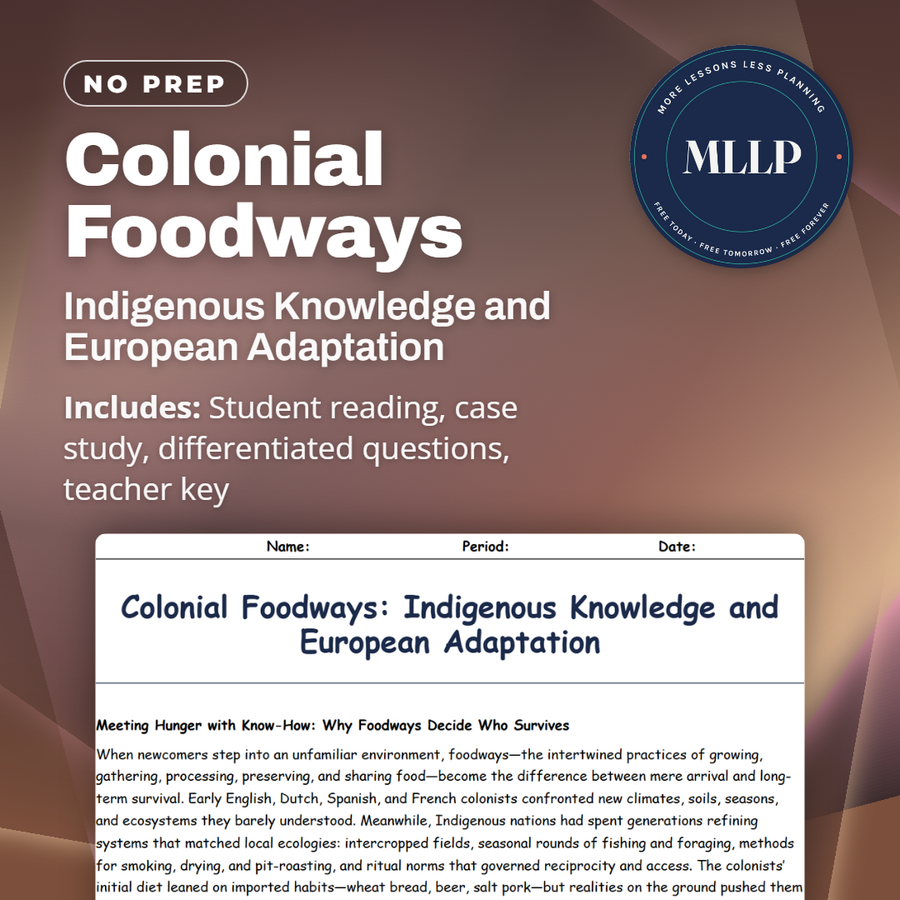
Colonial Foodways: Indigenous Knowledge and European Adaptation
Quality reviewed September 2026
Facts verified September 9, 2026
- Subject
- Social Studies
- Grades
- Grades 9-12
- Length
- 8-page student worksheet
- Time
- About one 50-minute class period
- Great for
- Sub plans and independent work
- Includes
- Reading passage, comprehension questions + full answer key
- Format
- Print-and-go PDF
What students do
- Explain how the Three Sisters system (maize, beans, squash) solved problems that monocultures couldn't
- Identify techniques like nixtamalization and smoking that transformed crops into storable nutrition
- Trace the difference between adopting food knowledge and adopting land-access rules
- Analyze how foodways show both exchange and dispossession in colonial encounters
What it covers
- Indigenous agricultural innovation and ecology
- Food processing and nutrient science
- Power dynamics in knowledge exchange and land use
Start reading this worksheet
Meeting Hunger with Know-How: Why Foodways Decide Who Survives
When newcomers step into an unfamiliar environment, foodways become the difference between mere arrival and long-term survival. Foodways are the intertwined practices of growing, gathering, processing, preserving, and sharing food. Early English, Dutch, Spanish, and French colonists confronted new climates, soils, seasons, and ecosystems they barely understood. Meanwhile, Indigenous nations had spent generations refining systems that matched local ecologies: intercropped fields, seasonal rounds of fishing and foraging, methods for smoking, drying, and pit-roasting, and ritual norms that governed reciprocity and access. The colonists’ initial diet leaned on imported habits such as wheat bread, beer, and salt pork, but realities on the ground pushed them toward knowledge exchange. Learning which foods to plant, when to plant them, how to store them through winter, and how to navigate lean seasons required not just tools but relationships. Foodways are never just recipes; they are technologies, agreements, and values carried in hands and stories. Thanksgiving’s familiar dishes, including cornbread, squash, beans, fish, and wild rice, trace back to these early and often unequal exchanges.
The “Three Sisters” and Beyond: Ecologies that Feed Communities
Across much of North America, Indigenous farmers practiced polyculture, most famously the Three Sisters system: maize, beans, and squash grown together. Corn provided a living trellis for climbing beans; beans fixed nitrogen in the soil; squash leaves shaded the ground to conserve moisture and suppress weeds. This design stabilized yields and buffered against drought and pests in ways single-crop fields could not. Colonists adapted elements of the system by planting maize and learning new storage practices, yet they often reverted to monocultures to mirror European markets and milling. Coastal nations paired agriculture with anadromous fish runs (e.g., shad, salmon) and shellfish gathering, using weirs, smoking racks, and drying frames to convert seasonal abundance into shelf-stable food. In forests and wetlands, wild rice harvesting, maple sugaring, and berry management complemented gardens. These practices were not random; they were landscape-scale strategies that linked soil fertility, nutrient cycles, and community labor. Colonists who observed closely gained a playbook for survival; those who dismissed local systems faced famine and dependency on costly imports.
Processing as Technology: Turning Crops into Meals
Food is only as useful as the methods that release its nutrients and flavors. Indigenous cooks transformed maize with nixtamalization, an alkaline treatment using wood ash or lime that loosened hulls, improved protein quality, and released niacin. The process produced doughs for masa, hominy, and porridges. Smokehouses and drying platforms rendered fish and meat safe for storage and trade. Clay ovens, earth pits, and stone boiling techniques cooked stews evenly and gently. Europeans brought iron pots, ovens, and fermentation knowledge for bread, ale, and cheese, while quickly adopting local ingredients: cornmeal breads, pumpkin puddings, and cranberry relishes. Over time, hybrid dishes such as johnnycakes, succotash, and ash-roasted squash emerged, layering Old World tools onto Indigenous ingredients. The culinary fusion was practical, not trendy: when sea crossings were slow and risky, the surest pantry was local. The result was a colonial cuisine that looked familiar in form (a loaf, a stew, a pie) but was powered by American plants and Indigenous methods.
Like what you read? The full reading, the case study, and every question set are in the free download below, along with the answer key.
Why this matters
A pot of corn soaking in ash and water looks like nothing more than dinner. It is nixtamalization, a technique that releases nutrients corn cannot deliver alone, part of the Three Sisters system that let maize, beans, and squash sustain communities no single crop could. Colonists learned it from the people already farming that land.
The exchange stops looking like simple generosity for my students once they meet the Wampanoag woman teaching colonists these methods firsthand. The crops and techniques traveled, but the agreements over who could plant where did not, and fields widened into land once shared. Students leave asking a harder question about a holiday table than they walked in with.
From one teacher to another
I teach this right before Thanksgiving to reframe what the holiday table actually represents. The case study features an older Wampanoag woman teaching colonists about the Three Sisters intercropping, nixtamalization, and seasonal storage, real survival knowledge that kept people alive. But the ledger didn't balance: the colonists learned the crops and techniques but widened fields into former berry grounds and fenced pathways that used to be shared. The unit asks students to see that foodways are never just recipes. They're technologies, agreements, and values about who gets to plant where. When we read about colonists adopting maize while ignoring the rules that had rationed river and forest for generations, students glimpse how knowledge can be separated from sovereignty. By the end, they're asking harder questions about the harvest table: whose land were these crops grown on, and who decided that?
What you get
Download
Where should I send the next one?
Everything here is free and it stays that way. Leave your email and I'll send you the new lessons as they go up. You can unsubscribe from any one of them.
Related resources
Black Friday Forensics: Shoplifting, Organized Theft, and Crowd Violence
Black Friday Smart Shopper: Economics and Personal Finance in Action

Black Friday: Are the “Deals” Actually Good for Shoppers?
Black Friday’s Economic Impact: Who Gains, Who Pays, and What It Means for the Economy
Budget a Feast: Unit Prices, Deals, and Receipts
Cranberries, Corn, and Trade: The Geography of Thanksgiving Foods
Every lesson on this site is free to download and use. If one of them saved you a prep period, you can chip in a few bucks toward my three kids' daycare fund. That's genuinely where tips go.