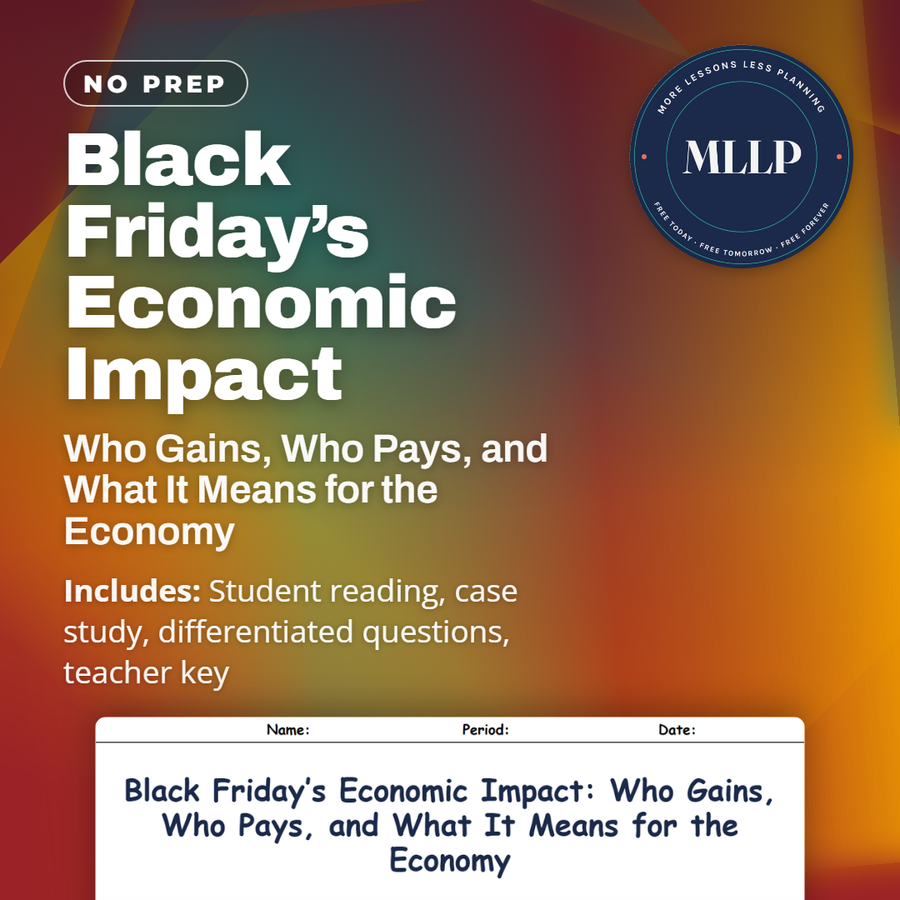
Black Friday’s Economic Impact: Who Gains, Who Pays, and What It Means for the Economy
Quality reviewed September 2026
Facts verified September 9, 2026
- Subject
- Social Studies
- Grades
- Grades 9-12
- Length
- 9-page student worksheet
- Time
- About one 50-minute class period
- Great for
- Sub plans and independent work
- Includes
- Reading passage, comprehension questions + full answer key
- Format
- Print-and-go PDF
What students do
- Trace how concentrated buying creates leverage for large retailers versus suppliers and workers
- Compare consumer surplus shifts when discounts transfer value from sellers to buyers
- Analyze how inventory concentrations and compressed timelines create logistics stress
- Evaluate regional effects on labor demand, trucking capacity, and warehouse burnout
What it covers
- Macroeconomic supply chain dynamics
- Market power and price competition effects
- Seasonal labor and logistics constraints
Start reading this worksheet
Why a Single Weekend Matters for the Economy
The Thanksgiving-to-Cyber Monday stretch is not just a shopping spree; it’s a concentrated shock to demand that ripples through labor markets, logistics, and tax revenues. Retailers design months of plans around this window because a large share of annual sales and profits can hinge on a few days. From a macro view, holiday spending shows up in consumption (C), the largest component of GDP. But the effect is not simply “more shopping = more growth.” Economists distinguish between incremental spending (new purchases that would not have occurred otherwise) and shifted spending (purchases pulled forward from December or later). Incremental dollars can lift output, trigger overtime, and raise temporary employment. Shifted dollars re-arrange the calendar without expanding the annual pie. Meanwhile, state and local tax collections benefit from concentrated transactions, while retailers manage cash flow and inventory risk. In short, the weekend is an efficiency test: businesses that convert foot traffic and clicks into fulfilled orders at sustainable margins add real value; others discover that deep discounts raised revenues but not profits.
Are Discounts Growing the Pie or Just Slicing It Differently?
To judge the true impact, follow where the dollars come from. Shoppers respond to price incentives (doorbusters, bundles), anchoring (“WAS $199, NOW $79!”), and convenience (free shipping, curbside pickup). These tactics can increase consumer surplus, the gap between what a buyer is willing to pay and what they actually pay, especially when sales make it possible to buy items that would otherwise be unaffordable. But some transactions merely cannibalize future sales: a TV bought on Black Friday might replace one that would have been purchased in December at a higher margin. At the household level, the weekend can reallocate budgets, swapping spending from services (dining out) to durables (electronics). Financing options like store cards or buy now, pay later (BNPL) can smooth consumption across months, but they also pull demand forward and add future interest or fee risks. The net economic gain is biggest when discounts convert latent demand into completed, paid-for orders without creating future distress or excessive returns. When returns spike due to impulsive buying or poor fit, the economy absorbs extra handling costs that don’t add much welfare.
How Firms Turn Hype into Payrolls, Profits, and Problems
Businesses translate demand into jobs and output. Leading up to the holiday, chains hire seasonal workers for stocking, checkout, delivery, and customer service. Distribution centers expand shifts, carriers add drivers, and third-party logistics firms book extra capacity. If promotions are well-targeted, retailers increase inventory turns and spread fixed costs over more units, lifting operating leverage. But the same tactics can compress gross margins if discount depth outruns vendor funding or if loss leaders don’t generate enough profitable add-ons. Operationally, the weekend stress-tests supply chains: cold chain for perishables, cross-docking for speed, website throughput, and last-mile delivery slots. Efficient execution creates measurable local impacts: overtime pay boosts household income; restaurants near malls see spillover traffic; ride-share and parcel delivery hours jump. Inefficiency, such as stockouts, website outages, or mis-forecasted sizes, destroys margin and can shift sales to competitors. The long-run winners invest in data, forecasting, and returns processing so that the surge converts to sustainable relationships, not just one-time spikes.
Like what you read? The full reading, the case study, and every question set are in the free download below, along with the answer key.
Why this matters
One closed pass on I-80 during Thanksgiving week can leave shelves empty hundreds of miles away, because Black Friday concentrates a year's worth of retail leverage and shipping into one window. Retailers gain leverage over suppliers, shoppers get lower prices, and warehouse workers absorb it in 60-hour weeks.
Cross-docking and buffer stock built months ahead all bend around a single week, reframing a one-day discount as a supply chain problem shoppers never see. Tracing who actually absorbs that cost, small suppliers, temporary workers, rising logistics bills, turns one shopping trip into a lesson on an entire economy.
From one teacher to another
I use this to show how one consumer holiday ripples through an entire economy. The reading asks who actually gains and who pays: big-box retailers gain leverage over suppliers who face concentrated demand one week a year; consumers get lower prices but supply-chain stress means tight delivery windows and workers pulling 60-hour warehouse weeks. We map inventory flows: how stores build buffer stock months early, how cross-docking transfers pallets rapidly but adds fragility, how a single closed pass on I-80 ripples to empty shelves. The worksheet asks students to trace causation: Why do small suppliers struggle? Why do temporary workers spike that week? What happens to logistics costs when everyone ships everything at once? It's macro through the lens of one American ritual, and it sticks because students suddenly see their own shopping choice as part of a continental web of decisions, contracts, and constraints.
What you get
Download
Where should I send the next one?
Everything here is free and it stays that way. Leave your email and I'll send you the new lessons as they go up. You can unsubscribe from any one of them.
Related resources
Black Friday Forensics: Shoplifting, Organized Theft, and Crowd Violence
Black Friday Smart Shopper: Economics and Personal Finance in Action
Black Friday: Are the “Deals” Actually Good for Shoppers?
Budget a Feast: Unit Prices, Deals, and Receipts
Colonial Foodways: Indigenous Knowledge and European Adaptation
Cranberries, Corn, and Trade: The Geography of Thanksgiving Foods
Every lesson on this site is free to download and use. If one of them saved you a prep period, you can chip in a few bucks toward my three kids' daycare fund. That's genuinely where tips go.