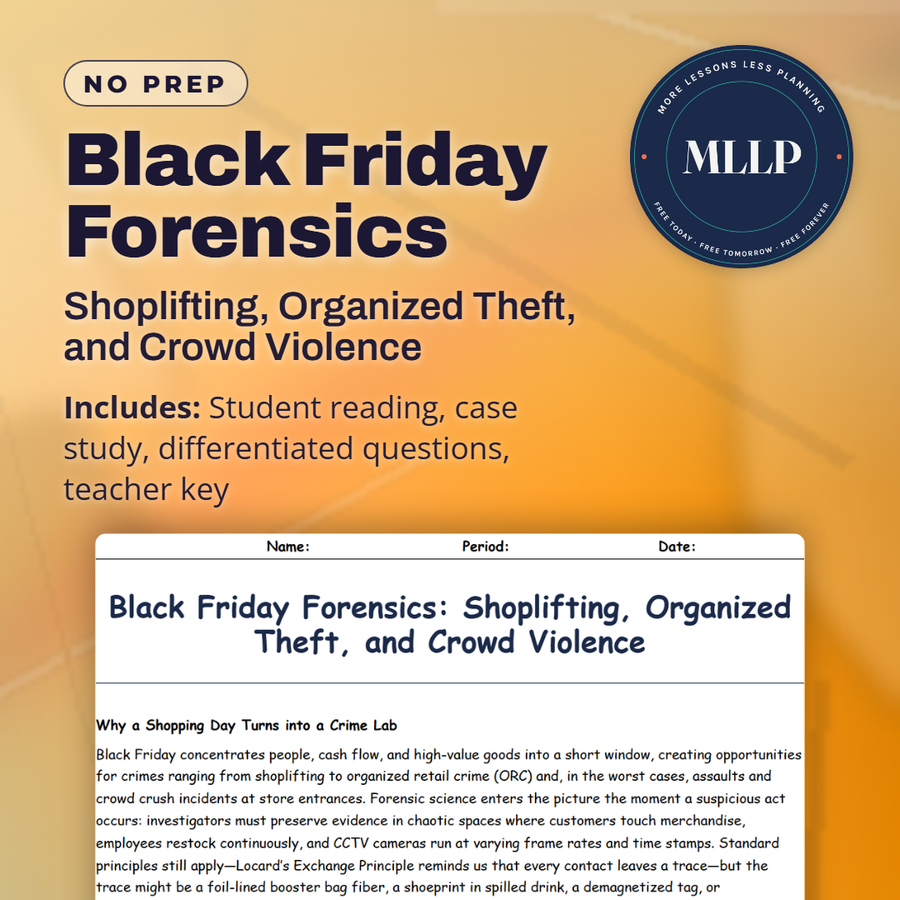
Black Friday Forensics: Shoplifting, Organized Theft, and Crowd Violence
Quality reviewed September 2026
Facts verified September 9, 2026
- Subject
- Science
- Grades
- Grades 9-12
- Length
- 8-page student worksheet
- Time
- About one 50-minute class period
- Great for
- Sub plans and independent work
- Includes
- Reading passage, comprehension questions + full answer key
- Format
- Print-and-go PDF
What students do
- Analyze CCTV footage and POS data to reconstruct a theft timeline and link suspects
- Compare physical evidence like footwear impressions and toolmarks across crime scenes
- Distinguish between systems failures and individual acts in a crowd incident
- Apply Locard's Exchange Principle to spot trace evidence in chaotic retail spaces
What it covers
- Forensic evidence collection and analysis
- Organized retail crime investigation techniques
- Crowd safety and incident reconstruction
Start reading this worksheet
Why a Shopping Day Turns into a Crime Lab
Black Friday concentrates people, cash flow, and high-value goods into a short window, creating opportunities for crimes ranging from shoplifting to organized retail crime (ORC) and, in the worst cases, assaults and crowd crush incidents at store entrances. Forensic science enters the picture the moment a suspicious act occurs: investigators must preserve evidence in chaotic spaces where customers touch merchandise, employees restock continuously, and CCTV cameras run at varying frame rates and time stamps. Standard principles still apply: Locard’s Exchange Principle reminds us that every contact leaves a trace. But the trace might be a foil-lined booster bag fiber, a shoeprint in spilled drink, a demagnetized tag, or microtransfers on a smashed display case. On the digital side, point-of-sale (POS) data and RFID readouts can corroborate witness accounts, showing sequences like “tag removed → item leaves zone → no sale.” The mix of routine activity theory (motivated offender, suitable target, lack of capable guardian) and opportunity structures (endcaps, poorly monitored exits, overwhelmed staff) explains why crime spikes during doorbusters. Forensic work doesn’t just identify suspects. It reconstructs modus operandi (MO) patterns so stores can redesign choice architecture (line queues, barriers, staffing) to prevent repeat harm.
From Pocketing Lipstick to Smashing Cases: What Investigators Look For
Simple shoplifting is often opportunistic: concealment in a bag or coat, package tamping, or barcode switching at self-checkout. ORC is different: coordinated teams use distraction, lookouts, getaway drivers, and signal jammers, targeting designer goods or small, high-value items (razor cartridges, electronics, fragrance). Forensically, teams leave a denser trail: multiple entry/exit points, synchronized phone pings in call detail records (CDRs), and repeated vehicle plates captured by cameras across sites. Investigators map spatiotemporal patterns: same crew hitting three stores along a freeway in 90 minutes, identical breaching tools, or distinct gait in the footage (step length, limb symmetry) that helps link cases when faces are masked. Toolmarks on pried cabinets, glass fracture patterns (radial vs. concentric cracks), and glove prints (fabric weave impressions) may persist even after a fast grab. Digital traces matter too: POS exception reports flag no-sale drawer opens, voids, and cart-swap anomalies; inventory deltas before/after a rush corroborate loss. The goal is to combine physical, digital, and behavioral evidence so probable cause doesn’t rest on one shaky eyewitness.
When Doors Open: Crowd Crush, Stampedes, and Assaults in the Rush
Not all Black Friday harm is theft. Door openings can trigger crowd crush: a high-density condition (often 5 to 6+ persons/m²) where people become mechanically asphyxiated as pressure builds and falls become unrecoverable. Media often says “stampede,” but forensically the issue is pressure and flow, not wild running. Investigators review entry choreography (barrier placement, number of doors), queuing plans, and staff briefings. Video forensics focuses on time-to-entry, bottleneck width, and wave dynamics (surges when the first shoppers hit a narrow turn). Audio captures screams or PA failures; lighting changes can impair depth perception. After an incident, injury patterns tell a story: compressive asphyxia shows petechiae and thoracic trauma, while fall cascades produce lower-limb fractures. Assaults over merchandise are more conventional crimes: battery, robbery, or menacing. Here, bloodstain pattern analysis (BPA) around knocked-down displays, trace DNA on torn packaging, and shoeprint directionality can establish who initiated force. The forensic mission is twofold: determine causation for criminal liability and extract lessons learned for prevention (door metering, staggered time slots, and real capacity limits grounded in life safety rather than marketing).
Like what you read? The full reading, the case study, and every question set are in the free download below, along with the answer key.
Why this matters
The busiest shopping morning of the year turns a line into a crowd crush the moment a store fails to meter its doors, and the danger turns out to be density itself, not any one person's panic. Reconstructing it means syncing drifting CCTV timestamps and reading POS logs showing a drawer opening with no sale rung up.
Most students expect forensics to mean one dramatic clue, so tracing a crew hitting three stores in one morning through vehicle plates and gait patterns shows them real evidence is cumulative. Locard's Exchange Principle, that every contact leaves a trace, applies to a coordinated crew as much as a lone shoplifter.
From one teacher to another
I use this one when we're covering forensic science and it lands right at Thanksgiving, so the context feels real. The case study goes past shoplifting to a crowd crush incident where a store's failure to meter the door properly meets forensic analysis of what the evidence actually says. Students walk through CCTV sync (correcting timestamp drift), footwear impressions lifted from soft mats, and POS exception logs that show no-sale drawer opens at exactly the moment a suspect was on camera. They learn that a crew hitting three stores in one morning leaves a forensic trail: vehicle plates, gait patterns in masked footage, and digital breadcrumbs. The worksheet builds from simple shoplifting (concealment in a bag) to organized retail crime (coordinated teams using distraction and lookouts) to group harm (mechanical asphyxia from density, not panic).
What you get
Download
Where should I send the next one?
Everything here is free and it stays that way. Leave your email and I'll send you the new lessons as they go up. You can unsubscribe from any one of them.
Related resources
Black Friday Smart Shopper: Economics and Personal Finance in Action

Black Friday: Are the “Deals” Actually Good for Shoppers?
Black Friday’s Economic Impact: Who Gains, Who Pays, and What It Means for the Economy

Budget a Feast: Unit Prices, Deals, and Receipts

Colonial Foodways: Indigenous Knowledge and European Adaptation

Cranberries, Corn, and Trade: The Geography of Thanksgiving Foods
Every lesson on this site is free to download and use. If one of them saved you a prep period, you can chip in a few bucks toward my three kids' daycare fund. That's genuinely where tips go.