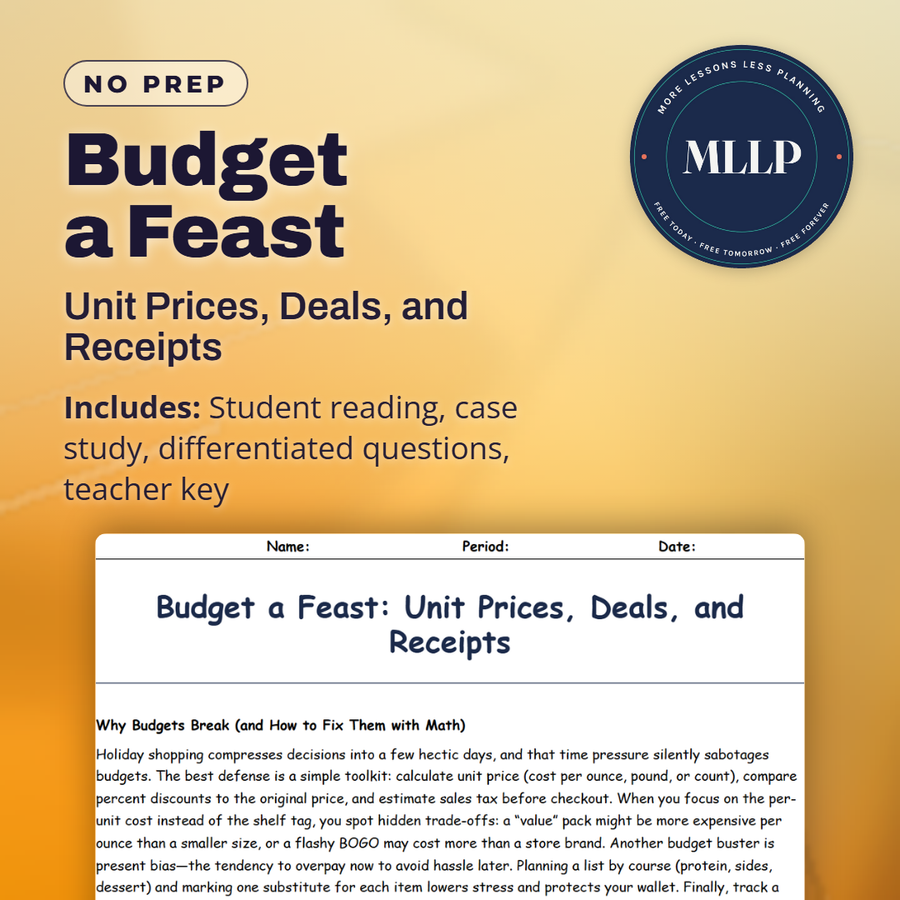
Budget a Feast: Unit Prices, Deals, and Receipts
Quality reviewed September 2026
Facts verified September 9, 2026
- Subject
- Career & Life Skills
- Grades
- Grades 9-12
- Length
- 7-page student worksheet
- Time
- About one 50-minute class period
- Great for
- Sub plans and independent work
- Includes
- Reading passage, comprehension questions + full answer key
- Format
- Print-and-go PDF
What students do
- Convert shelf prices to unit prices and compare across sizes, stores, and promotions
- Calculate the true cost of threshold promotions that force high-priced item bundles
- Detect shrinkflation by comparing package contents across years and brands
- Plan a multi-course meal within a budget by ranking needs, finding substitutes, and avoiding waste
What it covers
- Unit price calculation and comparison
- Promotional mathematics and hidden conditions
- Receipt verification and receipt fraud prevention
Start reading this worksheet
Why Budgets Break (and How to Fix Them with Math)
Holiday shopping compresses decisions into a few hectic days, and that time pressure silently sabotages budgets. The best defense is a simple toolkit: calculate unit price (cost per ounce, pound, or count), compare percent discounts to the original price, and estimate sales tax before checkout. When you focus on the per-unit cost instead of the shelf tag, you spot hidden trade-offs: a “value” pack might be more expensive per ounce than a smaller size, or a flashy BOGO may cost more than a store brand. Another budget buster is present bias: the tendency to overpay now to avoid hassle later. Planning a list by course (protein, sides, dessert) and marking one substitute for each item lowers stress and protects your wallet. Finally, track a realistic spending ceiling. If turkey, potatoes, and dessert are non-negotiables, designate other items as flexible so you can cut or swap when prices jump. These habits are not just good life skills; they’re core applications of ratios, percent change, and cost minimization you’ve learned in math class.
Decoding Deals: Percent Off, BOGO, and Loss Leaders
A holiday aisle is a maze of incentives. A loss leader is a product priced below cost to lure you into buying the rest of your basket at higher margins. “Spend $60, get turkey for 99¢/lb” sounds amazing until you notice that qualifying for the price also requires buying items with poor unit prices. BOGO (“buy one, get one”) demands attention to the fine print: is it truly free, or BOGO 50% off? If you only need one, the effective per-unit price might be worse than a smaller, cheaper alternative. Mix-and-match (e.g., “3 for $5”) is another trap unless the unit price beats your other options. The key is converting every offer to the same denominator: “cents per ounce” or “dollars per pound.” If a 32-oz stock is $3.20 and a 48-oz is $4.50, the first is 10¢/oz while the second is 9.375¢/oz. The second is a better buy if you’ll use it. But watch waste. Buying more only helps if you actually consume it before it expires; otherwise the true cost per eaten ounce rises. Finally, apply percent discount carefully: 25% off a $4.00 can saves $1.00; 15% off a $6.00 can saves $0.90. The higher percentage is not always the better total savings.
Like what you read? The full reading, the case study, and every question set are in the free download below, along with the answer key.
Why this matters
A turkey advertised at 99 cents a pound sounds like the whole meal is solved, until the fine print requires spending $60 on items that all carry weak unit prices. By the time a family hits that threshold, they've overpaid for everything around the bird, the entire point of a loss leader.
Percentages mislead constantly: 25 percent off a $4 item saves more than 15 percent off a $6 item, and shrinkflation, a pound of butter that quietly became 14 ounces, hides in the same blind spot. A real receipt checklist against a $60 ceiling teaches students to calculate before they trust a sign.
From one teacher to another
I use this when teaching ratios and percentages because a Thanksgiving grocery run is something every student faces eventually. The case study is a family trying to stay under a $60 ceiling: they chase a "99-cent per pound turkey" but the fine print requires a $60 spend on participating items that all carry weak unit prices. By the time they hit the threshold, they've overpaid for everything around the bird. Students learn to spot loss leaders, products priced below cost to lure you into expensive add-ons, and to calculate percent discounts correctly. A 25% off a $4 item saves more than 15% off a $6 item, but the percentage alone won't tell you that. We also cover shrinkflation (the pound of butter that's now 14 ounces) and the math of waste: a bulk buy only helps if you actually eat it before expiration. By the end, students have built a realistic meal plan and a receipt checklist, and they've internalized that math matters when groceries are tight.
What you get
Download
Where should I send the next one?
Everything here is free and it stays that way. Leave your email and I'll send you the new lessons as they go up. You can unsubscribe from any one of them.
Related resources
Black Friday Forensics: Shoplifting, Organized Theft, and Crowd Violence
Black Friday Smart Shopper: Economics and Personal Finance in Action
Black Friday: Are the “Deals” Actually Good for Shoppers?
Black Friday’s Economic Impact: Who Gains, Who Pays, and What It Means for the Economy
Colonial Foodways: Indigenous Knowledge and European Adaptation
Cranberries, Corn, and Trade: The Geography of Thanksgiving Foods
Every lesson on this site is free to download and use. If one of them saved you a prep period, you can chip in a few bucks toward my three kids' daycare fund. That's genuinely where tips go.