Tropical Climates: Warm and Wet Year-Round
Quality reviewed September 2026
Facts verified September 14, 2026
- Subject
- Social Studies
- Grades
- Grades 9-12
- Length
- 6-page student worksheet
- Time
- About one 50-minute class period
- Great for
- Sub plans and independent work
- Includes
- Reading passage, comprehension questions + full answer key
- Format
- Print-and-go PDF
What students do
- Match terms like Monsoon, Savanna, and Agroforestry to their correct descriptions
- Fill in the blank sentences on trade winds, tropical forests, and agroforestry farmland
- Answer multiple choice questions on tropical temperatures, nutrient-poor rainforest soil, and the tropical monsoon climate
- Write short answers on what makes tropical regions so biodiverse and why rainforest soils lose fertility quickly after trees are cleared
What it covers
- Tropical rainforest and monsoon climates, including year-round warmth, humidity, and rainfall patterns
- Biodiversity and human life in the tropics, from agriculture to disease risk and deforestation
- A case study on reforestation in a tropical watershed in Mawari Province
Start reading this worksheet
Constant Warmth and High Rainfall
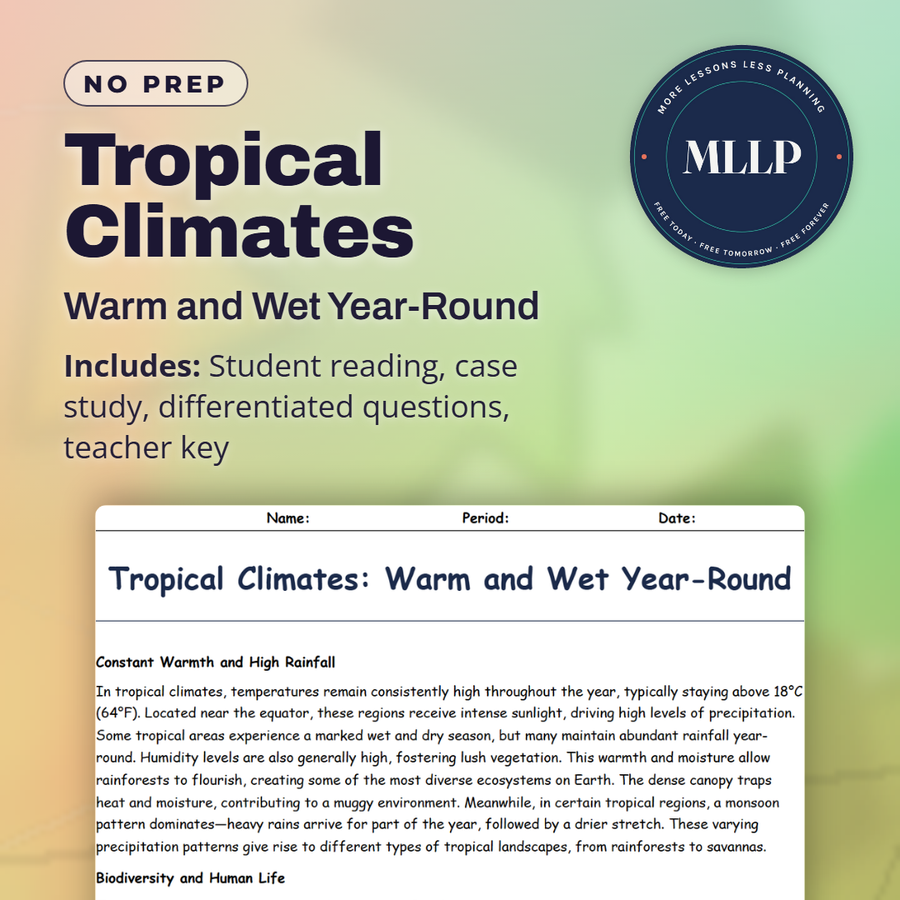
In tropical climates, temperatures remain consistently high throughout the year, typically staying above 18°C (64°F). Located near the equator, these regions receive intense sunlight, driving high levels of precipitation. Some tropical areas experience a marked wet and dry season, but many maintain abundant rainfall year-round. Humidity levels are also generally high, fostering lush vegetation. This warmth and moisture allow rainforests to flourish, creating some of the most diverse ecosystems on Earth. The dense canopy traps heat and moisture, contributing to a muggy environment. Meanwhile, in certain tropical regions, a monsoon pattern dominates: heavy rains arrive for part of the year, followed by a drier stretch. These varying precipitation patterns give rise to different types of tropical landscapes, from rainforests to savannas.
Biodiversity and Human Life
Tropical zones boast extraordinary biodiversity. Rainforests teem with plant and animal species, including insects, birds, mammals, and amphibians, many of which are found nowhere else. Fast decomposition rates in warm, wet conditions mean that nutrients cycle quickly through the ecosystem, though soils can be surprisingly thin or nutrient-poor once cleared of vegetation. Humans have thrived in tropical areas for millennia, developing agriculture based on crops like rice, bananas, cassava, and sugarcane. However, high disease prevalence (particularly mosquito-borne illnesses) poses health challenges. Traditional lifestyles often revolve around small-scale farming and fishing, although urbanization is rapidly transforming many tropical regions. Balancing economic growth with ecosystem conservation is a persistent concern, especially as deforestation escalates.
Like what you read? The full reading, the case study, and every question set are in the free download below, along with the answer key.
Why this matters
Rainforest floors look like they should have the richest soil on the planet, given how much grows on top of them, yet the truth runs the other way. Tropical rainforest, monsoon, and savanna climates share year-round warmth but support very different vegetation depending on rainfall and trade winds. The reforestation case study in Mawari Province shows what happens when a watershed loses its tree cover and how a community rebuilt it.
The guess that thick vegetation means thick, fertile soil is one of the most common wrong answers on this topic. Watching how fast rainforest soil loses fertility after the trees come down is what makes deforestation stop being abstract and start explaining why agroforestry matters in a tropical watershed.
From one teacher to another
This reading covers tropical rainforest, monsoon, and savanna climates without getting bogged down in jargon. Students see why rainforest soil is often nutrient-poor even though the vegetation above it is so dense. The case study on reforestation in Mawari Province gives a concrete example of what happens when a tropical watershed loses its tree cover and how a community brought it back. Works well alongside a broader climate or biome unit.
What you get
Download
Where should I send the next one?
Everything here is free and it stays that way. Leave your email and I'll send you the new lessons as they go up. You can unsubscribe from any one of them.
Related resources
Biomes & Ecosystems: Life Across Earth’s Habitats
Climate vs. Weather: Understanding the Difference

Convergent Boundaries: Where Plates Collide
Deserts: Survival in the Harshest Climates

Divergent Boundaries: Where Plates Pull Apart
Earth’s Layers: From Crust to Core
Every lesson on this site is free to download and use. If one of them saved you a prep period, you can chip in a few bucks toward my three kids' daycare fund. That's genuinely where tips go.