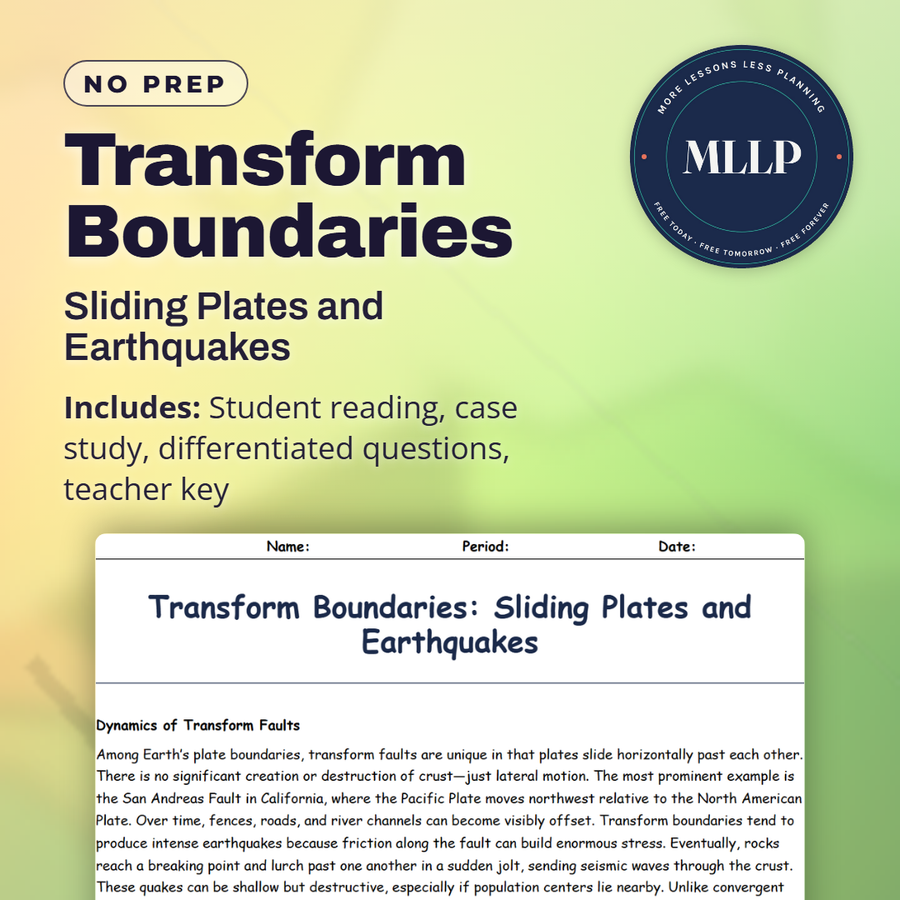
Transform Boundaries: Sliding Plates and Earthquakes
Quality reviewed September 2026
Facts verified September 14, 2026
- Subject
- Social Studies
- Grades
- Grades 9-12
- Length
- 6-page student worksheet
- Time
- About one 50-minute class period
- Great for
- Sub plans and independent work
- Includes
- Reading passage, comprehension questions + full answer key
- Format
- Print-and-go PDF
What students do
- Match terms like Strike-Slip Fault, Seismograph, and Base Isolator to their correct descriptions
- Fill in the blank sentences on the San Andreas Fault, S-waves, and fracture zones
- Answer multiple choice questions on how transform boundaries move and why the San Andreas Fault is significant
- Write short answers on why transform boundaries cause earthquakes without volcanoes and how building codes reduce quake damage
What it covers
- How transform faults work, including the San Andreas Fault and oceanic fracture zones
- Earthquake hazards and preparedness, from shear waves to early warning systems
- A case study on the North Anatolian Fault in Turkey and how officials responded to repeated earthquakes
Start reading this worksheet
Dynamics of Transform Faults
Among Earth’s plate boundaries, transform faults are unique in that plates slide horizontally past each other. There is no significant creation or destruction of crust, just lateral motion. The most prominent example is the San Andreas Fault in California, where the Pacific Plate moves northwest relative to the North American Plate. Over time, fences, roads, and river channels can become visibly offset. Transform boundaries tend to produce intense earthquakes because friction along the fault can build enormous stress. Eventually, rocks reach a breaking point and lurch past one another in a sudden jolt, sending seismic waves through the crust. These quakes can be shallow but destructive, especially if population centers lie nearby. Unlike convergent boundaries, transform faults don’t commonly spawn volcanoes, since there is no subduction or upwelling magma. However, they remain potent hazards.
Types of Transform Faults
Many transform boundaries exist on the ocean floor, linking segments of mid-ocean ridges. Known as fracture zones, these faults offset different parts of the ridge system that may spread at slightly different rates. On land, long transform faults can snake across continents. Their behavior depends on the rock types, the plate velocity, and the distribution of stress. Some transform faults move in small, frequent increments, while others remain locked for decades, triggering stronger earthquakes when they finally shift. Transform boundaries can also occur as “transfer zones” between segments of convergent or divergent boundaries. For instance, a transform fault may connect a spreading ridge with a subduction zone, transferring motion from one tectonic regime to another. Understanding these transitions is crucial for assessing the broader plate dynamics that shape a region.
Earthquake Hazards and Preparedness
Regions along transform boundaries must remain vigilant against earthquake risks. Cities built atop or near fault lines can suffer heavy damage when a quake hits. Shear waves can move buildings horizontally, toppling structures not designed for lateral stress. Water and gas lines can also rupture, igniting fires or disrupting essential services. Preparation strategies include retrofitting older buildings with stronger frames, using base isolators or shear walls in new constructions, and reinforcing infrastructure like bridges and dams. Early warning systems use sensors to detect initial P-waves, which travel faster than destructive S-waves. Though warnings may only precede the quake by seconds to minutes, that short lead time can help trains halt, factories shut down hazardous processes, and residents seek cover.
Like what you read? The full reading, the case study, and every question set are in the free download below, along with the answer key.
Why this matters
Not every earthquake shows up with a volcano nearby, which surprises students who assume the two always travel together. Transform boundaries like the San Andreas Fault produce earthquakes through plates grinding sideways past each other, not colliding or pulling apart, so no magma is involved. The North Anatolian Fault in Turkey shows that stress moving from one fault segment to the next as pressure releases along the line.
I use the Turkey case study to show a fault does not release all its stress in one earthquake. Watching stress move segment to segment connects the S-wave and seismograph vocabulary to base isolators and early warning systems, the parts that explain how officials reduce damage from a hazard they cannot prevent.
From one teacher to another
This one walks through transform boundaries in a way that makes the San Andreas Fault easy to picture, plates grinding past each other instead of colliding or pulling apart. I like that the case study on Turkey's North Anatolian Fault shows how stress passes from one fault segment to the next, since that domino effect is easy for students to visualize. The earthquake preparedness passage ties nicely into building codes and early warning systems. Good fit for a plate tectonics unit.
What you get
Download
Where should I send the next one?
Everything here is free and it stays that way. Leave your email and I'll send you the new lessons as they go up. You can unsubscribe from any one of them.
Related resources

Biomes & Ecosystems: Life Across Earth’s Habitats
Climate vs. Weather: Understanding the Difference
Convergent Boundaries: Where Plates Collide
Deserts: Survival in the Harshest Climates
Divergent Boundaries: Where Plates Pull Apart
Earth’s Layers: From Crust to Core
Every lesson on this site is free to download and use. If one of them saved you a prep period, you can chip in a few bucks toward my three kids' daycare fund. That's genuinely where tips go.