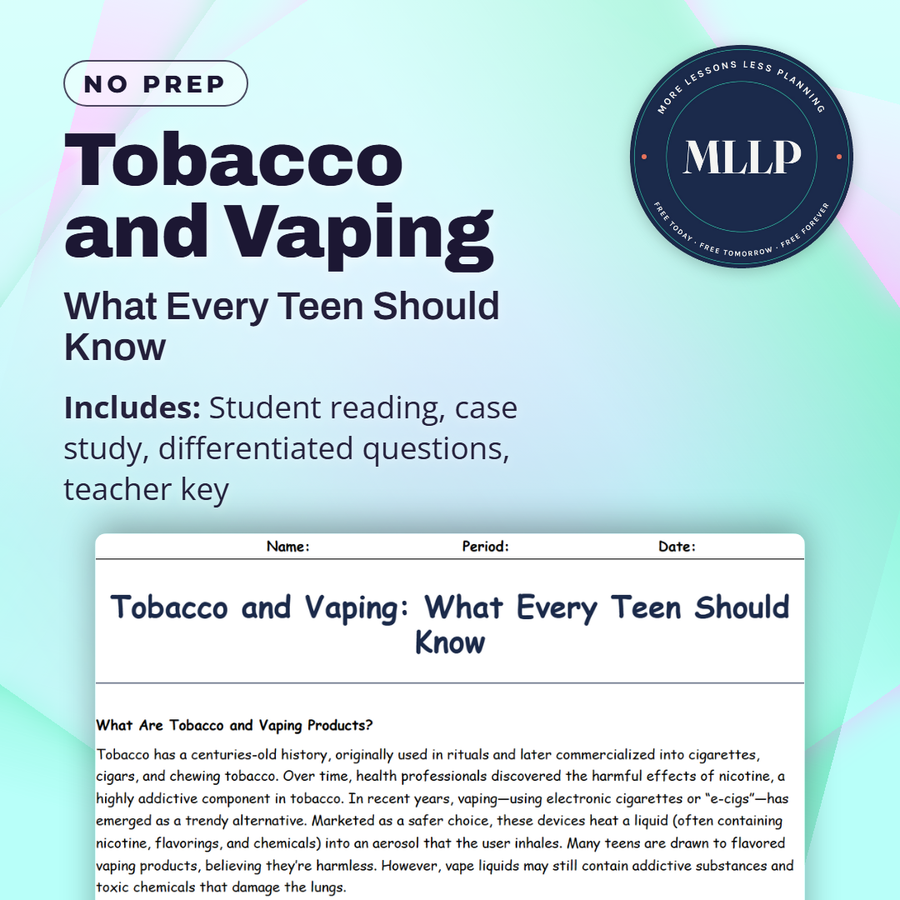
Tobacco and Vaping: What Every Teen Should Know
Quality reviewed September 2026
Facts verified September 21, 2026
- Subject
- Career & Life Skills
- Grades
- Grades 9-12
- Length
- 7-page student worksheet
- Time
- About one 50-minute class period
- Great for
- Sub plans and independent work
- Includes
- Reading passage, comprehension questions + full answer key
- Format
- Print-and-go PDF
What students do
- Match five terms - among them EVALI, nicotine, and withdrawal - to their definitions
- Fill in three blanks about the FDA's role, EVALI, and nicotine dependence
- Answer three multiple-choice questions comparing smoking and vaping risks
- Respond to three short-answer questions about vaping marketing and supporting someone who's quitting
What it covers
- Five sections on what vaping is, nicotine addiction, health risks, youth-targeted marketing, and quitting resources
- A comparison table lining up smoking and vaping by delivery method, risk, and advertising
- A case study following a freshman who starts vaping after his older cousins and tries to quit after a health workshop
Start reading this worksheet
What Are Tobacco and Vaping Products?
Tobacco has a centuries-old history, originally used in rituals and later commercialized into cigarettes, cigars, and chewing tobacco. Over time, health professionals discovered the harmful effects of nicotine, a highly addictive component in tobacco. In recent years, vaping (using electronic cigarettes or “e-cigs”) has emerged as a trendy alternative. Marketed as a safer choice, these devices heat a liquid (often containing nicotine, flavorings, and chemicals) into an aerosol that the user inhales. Many teens are drawn to flavored vaping products, believing they’re harmless. However, vape liquids may still contain addictive substances and toxic chemicals that damage the lungs.
Nicotine’s Addictive Nature
Nicotine is one of the primary reasons both smoking and vaping are so addictive. Once inhaled, nicotine rapidly enters the bloodstream and travels to the brain, triggering the release of dopamine, a neurotransmitter associated with pleasure. Over time, the brain starts to crave this rush, leading to repeated use and eventually dependence. Withdrawal symptoms like irritability, trouble focusing, and mood swings can occur if usage is stopped. For teens, whose brains are still developing, nicotine can interfere with essential neural pathways that govern attention and learning. It’s not just a “bad habit”; it rewires the brain to need more of the substance.
Health Risks: Beyond Just the Lungs
Traditional cigarette smoking has long been linked to lung cancer, heart disease, and respiratory illnesses such as bronchitis and emphysema. Vaping, while sometimes promoted as less harmful, can also pose significant risks. Some vaping liquids contain ultrafine particles, heavy metals like lead, or cancer-causing agents. Because vaping is relatively new, scientists are still studying its long-term impact. However, cases of lung damage (sometimes called EVALI: E-cigarette or Vaping Use-Associated Lung Injury) have already appeared among users, including teens. The cardiovascular system can also be affected. Nicotine increases heart rate and blood pressure, straining the heart. Prolonged use can contribute to the development of cardiovascular issues, and mixing nicotine with other substances can exacerbate the risks.
Like what you read? The full reading, the case study, and every question set are in the free download below, along with the answer key.
Why this matters
Vaping was built and marketed specifically for a teenage audience, from the flavors down to the packaging, which makes it a different problem than a cigarette a student's grandparent might have smoked. Most students have a classmate who vapes, if they don't already themselves, so the gap between what companies imply and what nicotine does to a developing brain is one this reading closes with information instead of a warning label. That distinction is worth having before the next vape gets passed around at a party or in a parking lot.
If you or someone you know is struggling, call or text 988 (Suicide & Crisis Lifeline, US) or talk to a trusted adult right away.
From one teacher to another
Vaping shows up in this reading as something more complicated than the flavored packaging suggests, and I wanted students to see nicotine's path through the brain before they reach the comparison table. Freshman year is when Damien starts vaping, copying his older cousins, and he doesn't notice how anxious and distracted he's become without his vape pen until a local health workshop connects the dots for him. That workshop, and what it taught him about EVALI, gives the health-risks and quitting-resources sections a face.
What you get
Download
Where should I send the next one?
Everything here is free and it stays that way. Leave your email and I'll send you the new lessons as they go up. You can unsubscribe from any one of them.
Related resources
Choosing a Drug-Free Lifestyle: Health, Goals, and You
Cocaine and the Teenage Brain
Crack Cocaine: Fast High, Harsh Consequences
Heroin and Teens: Understanding the Risks and Realities
How Addiction Changes the Brain: Science for Students
How to Handle Peer Pressure and Say No with Confidence
Every lesson on this site is free to download and use. If one of them saved you a prep period, you can chip in a few bucks toward my three kids' daycare fund. That's genuinely where tips go.