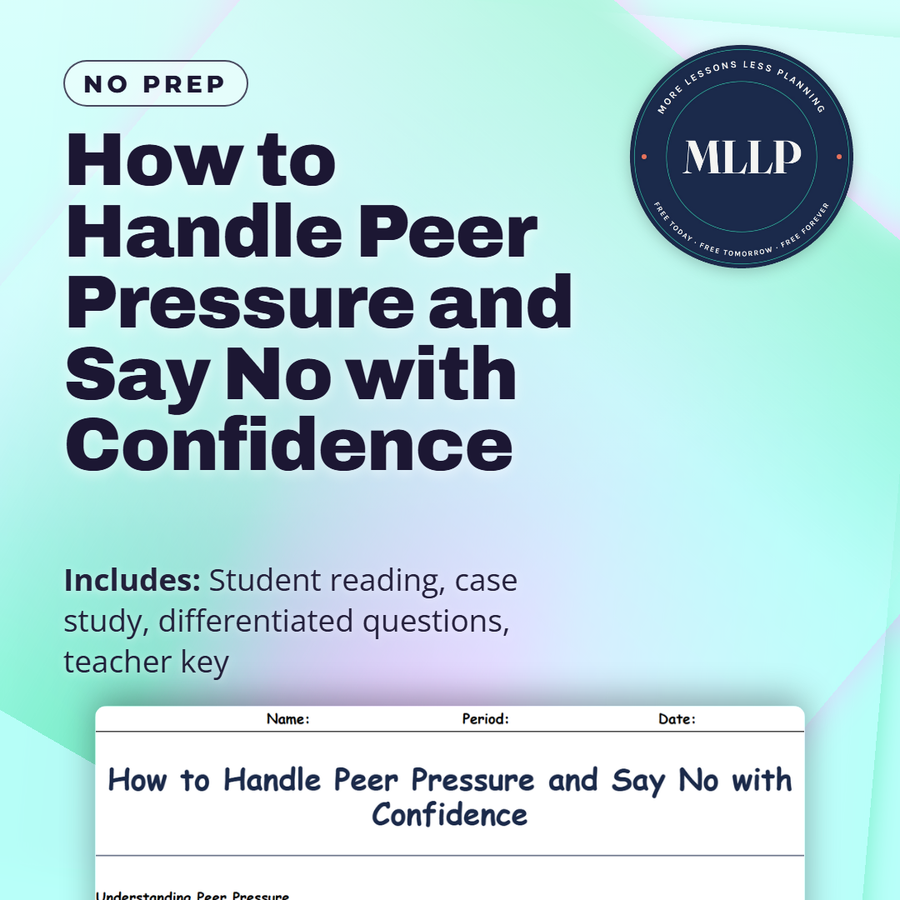
How to Handle Peer Pressure and Say No with Confidence
Quality reviewed September 2026
Facts verified September 21, 2026
- Subject
- Career & Life Skills
- Grades
- Grades 9-12
- Length
- 8-page student worksheet
- Time
- About one 50-minute class period
- Great for
- Sub plans and independent work
- Includes
- Reading passage, comprehension questions + full answer key
- Format
- Print-and-go PDF
What students do
- Match terms like broken record, assertive body language, and direct peer pressure to what each looks like in a real moment
- Fill in blanks distinguishing indirect pressure from direct pressure and naming what builds real confidence
- Answer multiple-choice questions on refusal techniques and the difference between positive and negative peer pressure
- Write short answers on why supportive friends make it easier to say no and what to do when pressure feels overwhelming
What it covers
- The difference between direct and indirect peer pressure, and how social media can amplify both
- Clarissa's case study: chasing a popular friend group at a new school until the cost to her own interests became clear
- Refusal strategies like the broken record technique, plus how confidence and supportive friendships make saying no easier
Start reading this worksheet
Understanding Peer Pressure
Peer pressure arises when individuals feel compelled—directly or indirectly—to conform to the behaviors, values, or actions of their friends, classmates, or social circles. Teens often face peer pressure in subtle ways, such as fearing rejection if they decline an invitation to a party where underage drinking will occur. In other cases, the pressure is overt: friends might tease someone for not “joining in” or label them as boring. At this stage of life, when fitting in can be a major concern, it’s challenging to go against the group. However, developing the ability to stand by one’s principles, even when it’s uncomfortable, is an important step toward maturity and self-reliance. What makes peer pressure so potent is the natural teenage desire for acceptance. The impulse to feel connected to a group can outweigh the rational assessment of whether an action is truly in one’s best interest. Social media has amplified this effect by constantly broadcasting what peers are doing, making it seem as if everyone else is participating in potentially risky behaviors. Still, it’s crucial to recognize that people often present a highlight reel of their lives, and not every activity is as it appears. Learning to differentiate between genuine opportunities for positive social growth and harmful pressures is a skill that will serve teens well beyond high school.
Types of Peer Pressure
Peer pressure can be divided into two broad categories: direct and indirect. Direct peer pressure often involves explicit persuasion or coercion—someone may be handed a cigarette or vape pen and urged to “Just try it once.” Indirect peer pressure is subtler. A teen might notice everyone at lunch wearing a certain style of clothing, prompting them to buy similar items to fit in. Or perhaps a circle of friends frequently gossips or bullies other students, creating an unspoken expectation to participate. Whether blatant or understated, these influences can sway behaviors in both negative and positive directions. Understanding that peer pressure isn’t always negative is equally important. Positive peer pressure can push teens to try out for the school musical, join a study group, or volunteer. When friends encourage and challenge each other to grow academically, socially, or personally, it can be a powerful force for good. However, negative peer pressure can lead to harmful choices that might include substance use, cheating on exams, or skipping classes. Identifying the type of pressure at play helps a teen decide how to respond and what strategy to employ.
Refusal Skills and Saying No
Refusal skills are techniques that help individuals stand their ground and say no without alienating their social circle or compromising their self-respect. One effective method is the “broken record” technique, where you repeat your refusal in a calm, steady tone: “No, I’m not interested in doing that,” or “No, thanks. I’m good.” This consistent repetition conveys resolve. Another strategy involves giving a short reason or alternative: “I can’t stay late because I have practice early tomorrow,” or “No, I don’t drink, but I’ll still hang out with you.” In some situations, humor can also defuse tension: “I can’t afford to get in trouble—my parents will post embarrassing dance videos of me if I do.” Body language matters as well. Standing tall, maintaining eye contact, and speaking clearly often conveys confidence. If necessary, remove yourself from the situation. If a gathering is making you uncomfortable or if a friend’s car seems unsafe, it’s okay to call a trusted adult or arrange alternate transportation. These actions might feel awkward at first, but they reinforce personal boundaries and show others that you take your safety and values seriously. While it can be nerve-wracking to resist peers, it’s far worse to regret a harmful choice later.
Like what you read? The full reading, the case study, and every question set are in the free download below, along with the answer key.
Why this matters
Refusal skills come up in this unit because of substance use, but Clarissa is never offered a drug in her case study, only an invitation to skip a school event and spread rumors she was not comfortable with. That is closer to what actually tests most students: a slow drift into a group's habits rather than one dramatic offer to turn down. The broken record technique and the body-language tips in this reading are tools a student can use at a part-time job, in a group project, or at a family gathering long after this specific unit ends.
If you or someone you know is struggling, call or text 988 (Suicide & Crisis Lifeline, US) or talk to a trusted adult right away.
From one teacher to another
Clarissa spends the opening of her sophomore year chasing acceptance from a group that seems confident and popular, and the case study tracks exactly what she gives up to keep her spot with them. Students then learn to name two flavors of pressure: direct, like being handed a vape and told to try it, and indirect, like just noticing everyone else dressed or acting the same way. The refusal-skills section gives concrete lines students can actually use instead of only abstract advice to resist, and the matching activity turns broken record and assertive body language from vocabulary into something they can practice. I like starting the peer-pressure unit here because the case study never involves a dramatic offer, just a slow drift most students recognize.
What you get
Download
Where should I send the next one?
Everything here is free and it stays that way. Leave your email and I'll send you the new lessons as they go up. You can unsubscribe from any one of them.
Related resources
Choosing a Drug-Free Lifestyle: Health, Goals, and You
Cocaine and the Teenage Brain
Crack Cocaine: Fast High, Harsh Consequences
Heroin and Teens: Understanding the Risks and Realities
How Addiction Changes the Brain: Science for Students
Legal vs. Illegal Drugs: What Teens Need to Know
Every lesson on this site is free to download and use. If one of them saved you a prep period, you can chip in a few bucks toward my three kids' daycare fund. That's genuinely where tips go.