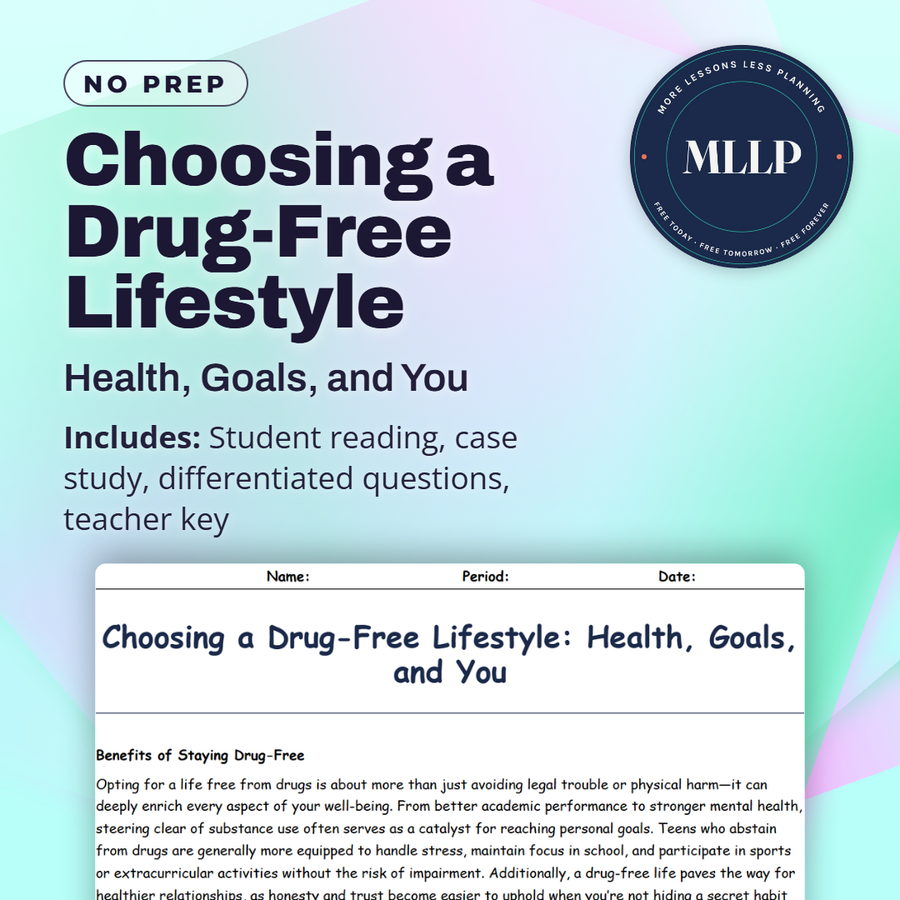
Choosing a Drug-Free Lifestyle: Health, Goals, and You
Quality reviewed September 2026
Facts verified September 21, 2026
- Subject
- Career & Life Skills
- Grades
- Grades 9-12
- Length
- 8-page student worksheet
- Time
- About one 50-minute class period
- Great for
- Sub plans and independent work
- Includes
- Reading passage, comprehension questions + full answer key
- Format
- Print-and-go PDF
What students do
- Match terms like long-term goal, short-term goal, and lifestyle choice to definitions grounded in daily habits and future plans
- Fill in blanks connecting goal-focus and supportive relationships to staying consistent and drug-free
- Answer multiple-choice questions on the benefits of a drug-free lifestyle and what positive influences look like
- Write short answers on why peer normalization makes staying drug-free hard and name one step a teen could take today
What it covers
- The academic, social, and confidence benefits of avoiding drugs, plus how to set and act on personal goals
- Trina's case study: turning down underage drinking to protect her plan to become a veterinarian
- How to build a circle of positive influences and hold onto personal values when a friend group pushes back
Start reading this worksheet
Benefits of Staying Drug-Free
Opting for a life free from drugs is about more than just avoiding legal trouble or physical harm: it can deeply enrich every aspect of your well-being. From better academic performance to stronger mental health, steering clear of substance use often serves as a catalyst for reaching personal goals. Teens who abstain from drugs are generally more equipped to handle stress, maintain focus in school, and participate in sports or extracurricular activities without the risk of impairment. Additionally, a drug-free life paves the way for healthier relationships, as honesty and trust become easier to uphold when you’re not hiding a secret habit or coping with substance-induced mood swings. Staying drug-free also bolsters self-confidence. Each time you navigate a challenging social or academic situation without leaning on substances, you prove to yourself that you possess resilience and resourcefulness. This self-assuredness can transfer to other areas, like pursuing leadership roles, trying out for a competitive sports team, or taking creative risks in art and music. Confidence becomes an ongoing cycle: the more you rely on your innate abilities, the less appealing quick-fix solutions like drugs seem.
Setting Personal Goals and Sticking to Them
A critical component of a drug-free lifestyle is having a clear sense of direction. When you have defined goals (be they academic, athletic, or personal development), it’s easier to weigh the consequences of substance use. For instance, if you dream of earning a college scholarship, you might recognize how drug use can derail your focus or jeopardize your eligibility. By identifying what’s at stake, you create internal motivation to say “no” when faced with temptation. Breaking goals down into actionable steps helps. Instead of saying, “I want to do well in school,” you might specify, “I will study math for 30 minutes daily, join a study group on Tuesdays, and ask my teacher for help when needed.” This clarity allows for self-monitoring and provides a direct reference point: “Does going to a party where there’s underage drinking support or hinder my objective?” Over time, you develop the discipline to make decisions that consistently align with your aspirations.
Positive Influences and Activities
Surrounding yourself with individuals who respect your choices can change you for the better. Friends, mentors, and coaches who share your commitment to healthy living create a supportive network that makes resisting peer pressure more manageable. Meanwhile, engaging in extracurricular activities, from sports teams to drama clubs, builds a sense of belonging. These communities often have shared goals, like winning championships or putting on a great performance, leaving less room for destructive behaviors. Activities that promote mental and emotional health (yoga, meditation, journaling) can also play a significant role. These practices enhance self-awareness and coping skills, which become invaluable when stress or anxiety spikes. By discovering what genuinely excites and motivates you, substances lose their allure. You might find joy in mastering a musical instrument, volunteering at an animal shelter, or organizing a charity fundraiser. Every hour spent invested in these passions is an hour not spent flirting with riskier alternatives.
Like what you read? The full reading, the case study, and every question set are in the free download below, along with the answer key.
Why this matters
Every teenager gets asked to trade a long-term plan for a short-term invitation at some point, whether that is a party, a dare, or just wanting to feel included. What makes Trina's story useful in class is that it skips the moralizing and shows a mechanism instead: alcohol interfering with her focus during the exact week she needed it most. That lets students see how one ordinary Monday morning can quietly threaten a goal they have spent years working toward, which lands differently than a general warning.
If you or someone you know is struggling, call or text 988 (Suicide & Crisis Lifeline, US) or talk to a trusted adult right away.
From one teacher to another
This reading asks students to work backward from a goal instead of starting with a lecture about risk. Trina's case study follows her decision to skip underage drinking after she noticed it was already costing her focus during exam week, and the questions push students to connect that choice to her long-term plan of becoming a veterinarian. I like that the reading treats refusal as a strategy tied to something specific a student wants, not an abstract rule handed down by an adult. The passages also walk through what a drug-free routine looks like day to day, from study blocks to the friend group a student chooses to keep around.
What you get
Download
Where should I send the next one?
Everything here is free and it stays that way. Leave your email and I'll send you the new lessons as they go up. You can unsubscribe from any one of them.
Related resources
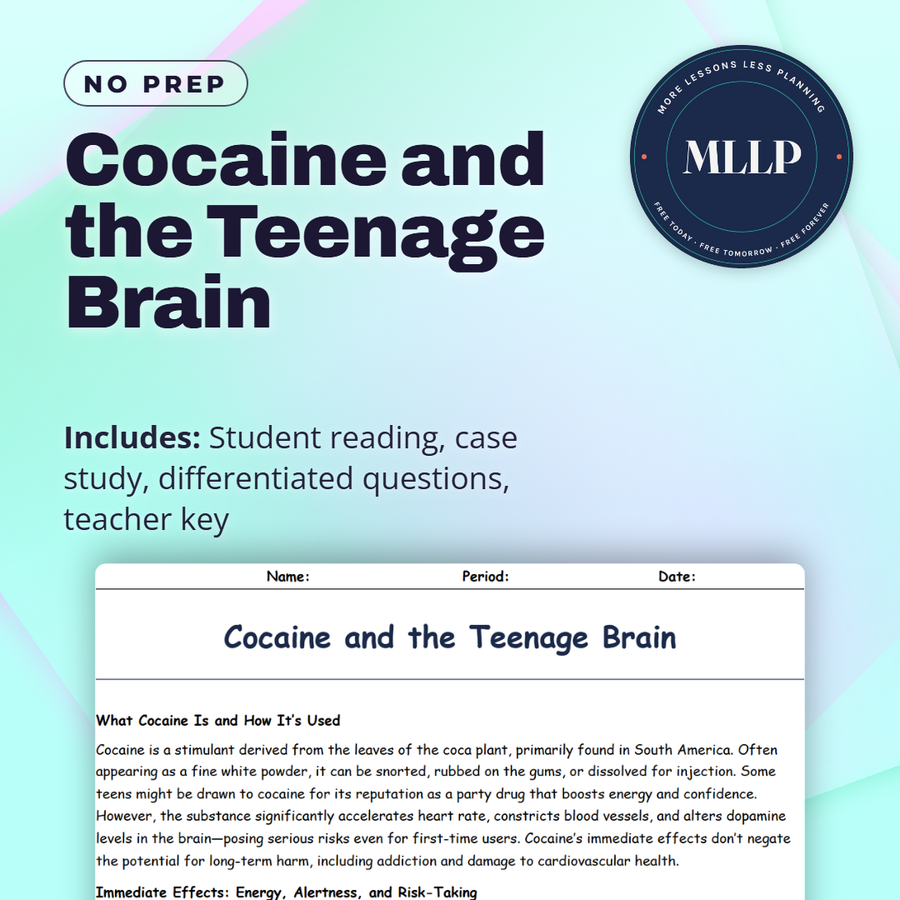
Cocaine and the Teenage Brain
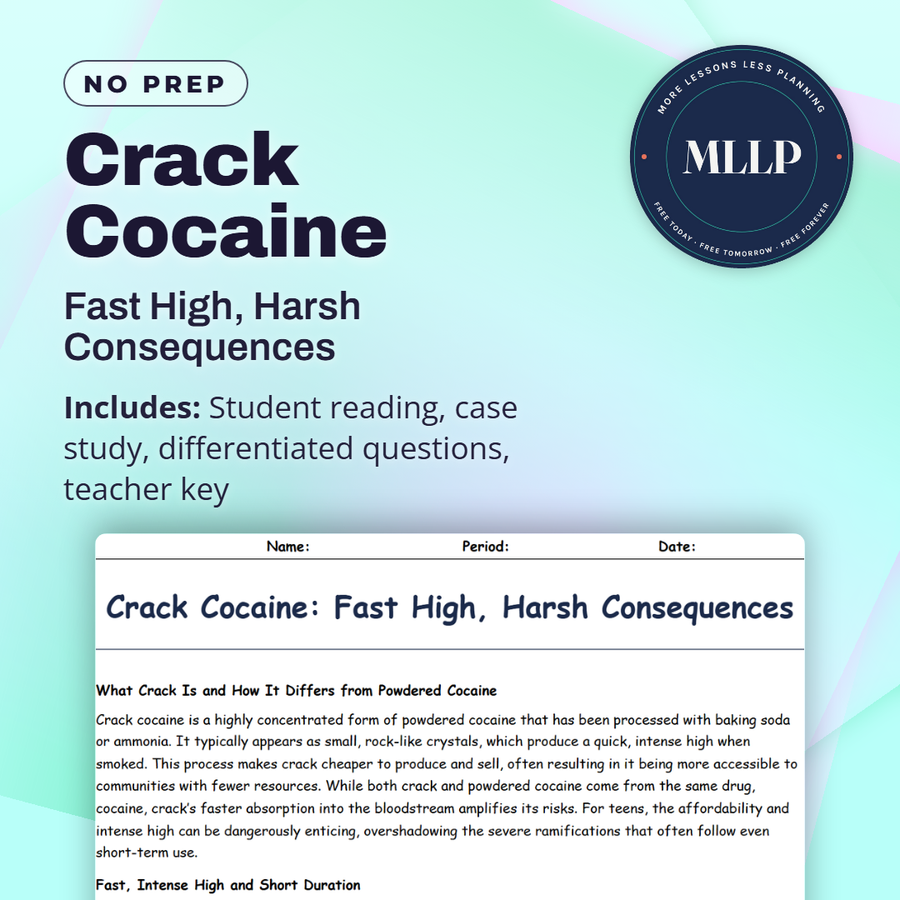
Crack Cocaine: Fast High, Harsh Consequences
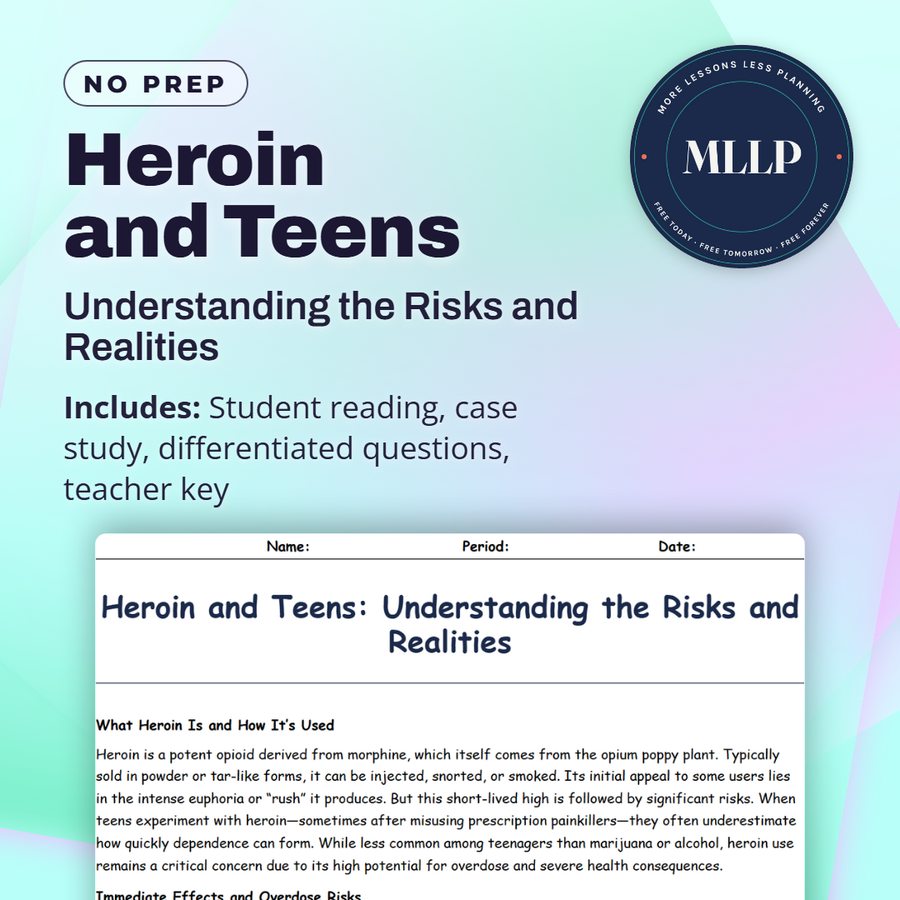
Heroin and Teens: Understanding the Risks and Realities
How Addiction Changes the Brain: Science for Students
How to Handle Peer Pressure and Say No with Confidence
Legal vs. Illegal Drugs: What Teens Need to Know
Every lesson on this site is free to download and use. If one of them saved you a prep period, you can chip in a few bucks toward my three kids' daycare fund. That's genuinely where tips go.