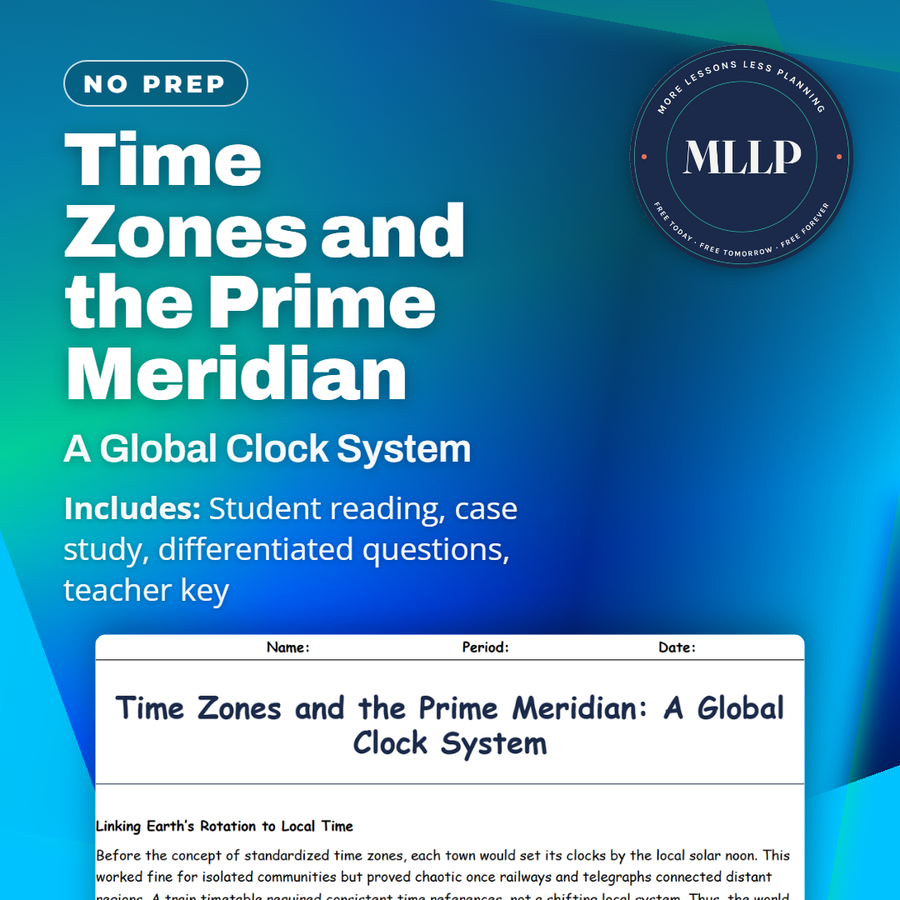
Time Zones and the Prime Meridian: A Global Clock System
Quality reviewed September 2026
Facts verified September 14, 2026
- Subject
- Social Studies
- Grades
- Grades 9-12
- Length
- 6-page student worksheet
- Time
- About one 50-minute class period
- Great for
- Sub plans and independent work
- Includes
- Reading passage, comprehension questions + full answer key
- Format
- Print-and-go PDF
What students do
- Match terms like GMT/UTC, local noon, time zone, daylight saving, and jet lag to their correct definitions
- Fill in the blank sentences on the Prime Meridian, the International Date Line, and the standard hour offsets that define time zones
- Answer multiple choice questions on which meridian anchors global time, what happens when you cross the International Date Line, and why time zones were standardized
- Write short answers on why some countries use half-hour offsets, how time zones affect international business, and how the date line affects travel plans
What it covers
- How time zones are tied to lines of longitude, anchored by the Prime Meridian at Greenwich
- The International Date Line and how crossing it shifts the calendar forward or backward a day
- A case study on organizers scheduling a global health conference across multiple time zones and the date line
Start reading this worksheet
Linking Earth’s Rotation to Local Time
Before the concept of standardized time zones, each town would set its clocks by the local solar noon. This worked fine for isolated communities but proved chaotic once railways and telegraphs connected distant regions. A train timetable required consistent time references, not a shifting local system. Thus, the world adopted time zones tied to lines of longitude, ensuring a more unified and predictable schedule. The anchor for this system is the Prime Meridian at 0° longitude, running through Greenwich, England. We often refer to the local time there as Greenwich Mean Time (GMT) or Coordinated Universal Time (UTC). From this baseline, each adjacent time zone typically shifts by one hour for every 15 degrees of longitude. Moving east generally adds an hour; moving west subtracts one. However, not all countries stick strictly to the 15-degree rule; some adopt half-hour or 45-minute offsets for convenience.
Why Time Zones Matter
Modern life depends on global coordination—whether organizing video conferences across continents or scheduling flights connecting multiple cities. When it’s noon in London (0°), it’s about 7:00 AM in New York (~75° W) and 4:00 PM in Dubai (~55° E). These differences force international businesses to negotiate meeting times that can accommodate everyone, often resulting in some participants joining very early or very late. Shipping and logistics companies also rely on time zone knowledge to manage port arrivals and departures. Weather forecasts, which shift by the hour, help meteorologists coordinate data globally. Even sports events, like the Olympics, must factor in time zones to televise competitions at viewer-friendly times around the world. Time zones, while sometimes inconvenient for travelers (jet lag, anyone?), maintain a semblance of order in a rotating world.
Like what you read? The full reading, the case study, and every question set are in the free download below, along with the answer key.
Why this matters
Get the time zone wrong and a meeting happens while everyone who was supposed to attend it is asleep. Time zones exist to prevent that, anchored to the Prime Meridian at Greenwich and shifted a full calendar day once you cross the International Date Line. Organizers of a global health conference ran into this directly, scheduling sessions across Asia, Europe, Africa, and the Americas at multiple times so delegates could attend live.
I use the half-hour offsets some countries keep to show the system was standardized for convenience, not neatness. Tracing how the date line forced that conference to adapt, an idea that felt like trivia starts to look like a logistics problem people solve every day.
From one teacher to another
This worksheet explains how time zones work, why they're anchored to the Prime Meridian, and what happens when you cross the International Date Line. The case study follows conference organizers trying to schedule meetings across Asia, Europe, Africa, and the Americas, landing on multiple session times so more delegates could attend live. Students work through the reasoning behind hour offsets and see why this system exists in the first place. I like that the case study makes an abstract topic feel like a real logistics problem. This pairs well with a unit on global geography or navigation.
What you get
Download
Where should I send the next one?
Everything here is free and it stays that way. Leave your email and I'll send you the new lessons as they go up. You can unsubscribe from any one of them.
Related resources
Cartography Basics: How Maps Are Made and Interpreted
Latitude and Longitude: How to Find Any Point on Earth
Map Projections and Distortions: Why the World Isn’t Flat
Political vs. Physical Maps: What They Show and Why It Matters
Spatial Thinking and Geographic Inquiry: Asking the Right Questions

The Five Themes of Geography: Making Sense of Our World
Every lesson on this site is free to download and use. If one of them saved you a prep period, you can chip in a few bucks toward my three kids' daycare fund. That's genuinely where tips go.