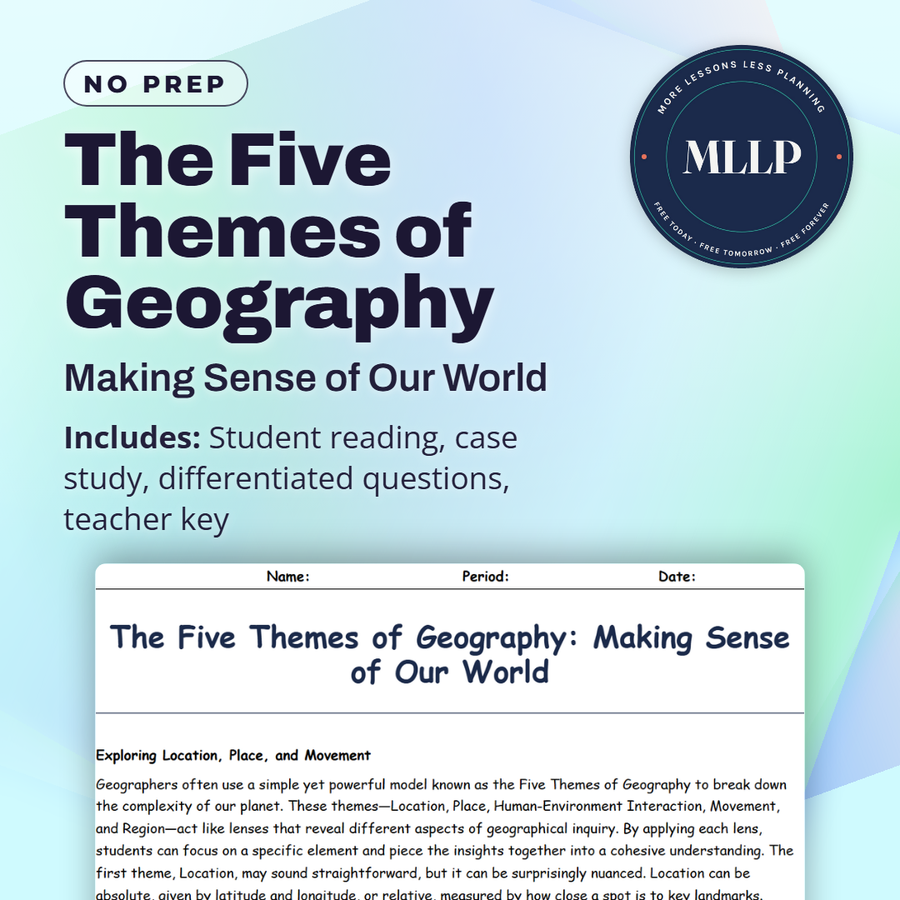
The Five Themes of Geography: Making Sense of Our World
Quality reviewed September 2026
Facts verified September 14, 2026
- Subject
- Social Studies
- Grades
- Grades 9-12
- Length
- 7-page student worksheet
- Time
- About one 50-minute class period
- Great for
- Sub plans and independent work
- Includes
- Reading passage, comprehension questions + full answer key
- Format
- Print-and-go PDF
What students do
- Match terms like absolute location, relative location, migration, place, and cultural diffusion to their correct definitions
- Fill in the blank sentences on physical and cultural regions, cultural diffusion, and identifying an absolute location by coordinates
- Answer multiple choice questions on which theme covers migration and trade routes, what defines a region, and which theme explains human-environment interaction
- Write short answers on how place differs from location, which theme explains isolated language development, and how regions simplify geographic study
What it covers
- The five themes of geography, including location, place, human-environment interaction, movement, and region
- How human-environment interaction shapes and is shaped by daily decisions like farming, dams, and resource use
- A case study on how reggae music's spread illustrates movement, region, place, and human-environment interaction together
Start reading this worksheet
Exploring Location, Place, and Movement
Geographers often use a simple yet powerful model known as the Five Themes of Geography to break down the complexity of our planet. These themes (Location, Place, Human-Environment Interaction, Movement, and Region) act like lenses that reveal different aspects of geographical inquiry. By applying each lens, students can focus on a specific element and piece the insights together into a cohesive understanding. The first theme, Location, may sound straightforward, but it can be surprisingly nuanced. Location can be absolute, given by latitude and longitude, or relative, measured by how close a spot is to key landmarks. Understanding location is often the starting point in any geographic study: you might ask, “Where is this happening?” Once you pinpoint location, the second theme, Place, adds layers of identity. Place includes the physical and cultural characteristics that make one area distinct from another. For example, a coastal city might be known for its seafood and maritime history, while a mountainous region might develop traditions around agriculture and tourism. Movement, the fourth theme, reveals how people, goods, and ideas shift from one area to another. History is filled with examples: the Silk Road carried silk and spices across continents, while social media now spreads memes and trends at lightning speed. Learning about these flows helps us see that many social, cultural, and economic changes happen through constant exchange. People migrate for jobs, goods move to markets, and ideas catch on when they resonate with distant audiences. Movement transforms local communities, sometimes leading to rapid urbanization, cultural blending, or even conflict over resources.
Human-Environment Interaction (HEI)
Perhaps the most pressing theme today is Human-Environment Interaction (HEI). This theme focuses on how humans shape their environment through building cities, damming rivers, or farming land, and how the environment in turn influences human life. HEI underlines why floods in a river valley can be devastating for farmers, or how deforestation might disrupt local weather patterns. By analyzing HEI, we also see why sustainable development and responsible resource use are crucial. It’s easy to observe HEI in everyday life. Consider a reservoir built to provide drinking water and power. That reservoir might alter local ecosystems, change fish migration patterns, and even force nearby populations to relocate. Conversely, living near fertile soil has historically spurred agricultural economies, whereas mountainous terrains might limit large-scale farming but encourage tourism. When geographers study these effects, they also consider cultural attitudes toward nature, local traditions of resource management, and modern policies aimed at conservation.
Like what you read? The full reading, the case study, and every question set are in the free download below, along with the answer key.
Why this matters
Tracing how a reggae song made its way from Jamaica around the world uses four of the five themes of geography at once. This reading builds the framework around that case study instead of handing students five separate definitions, so movement, region, place, and human-environment interaction show up together the way they actually do.
Absolute versus relative location is the pair I always check first, because students recite the difference but freeze when asked to apply it, a coordinate versus a written description. Once reggae's spread makes the other four themes concrete, the framework stops feeling like five things to memorize before the course starts.
From one teacher to another
This worksheet introduces the five themes of geography using a case study on how reggae music spread from Jamaica around the world. Students see movement, region, place, and human-environment interaction all show up in one real example instead of five disconnected definitions. The reading also covers absolute versus relative location and how regions can be physical, cultural, or perceptual. I like that the case study ties an abstract framework to something concrete students can follow. This works well as an introduction to a geography course.
What you get
Download
Where should I send the next one?
Everything here is free and it stays that way. Leave your email and I'll send you the new lessons as they go up. You can unsubscribe from any one of them.
Related resources
Cartography Basics: How Maps Are Made and Interpreted
Latitude and Longitude: How to Find Any Point on Earth
Map Projections and Distortions: Why the World Isn’t Flat
Political vs. Physical Maps: What They Show and Why It Matters
Spatial Thinking and Geographic Inquiry: Asking the Right Questions
Time Zones and the Prime Meridian: A Global Clock System
Every lesson on this site is free to download and use. If one of them saved you a prep period, you can chip in a few bucks toward my three kids' daycare fund. That's genuinely where tips go.