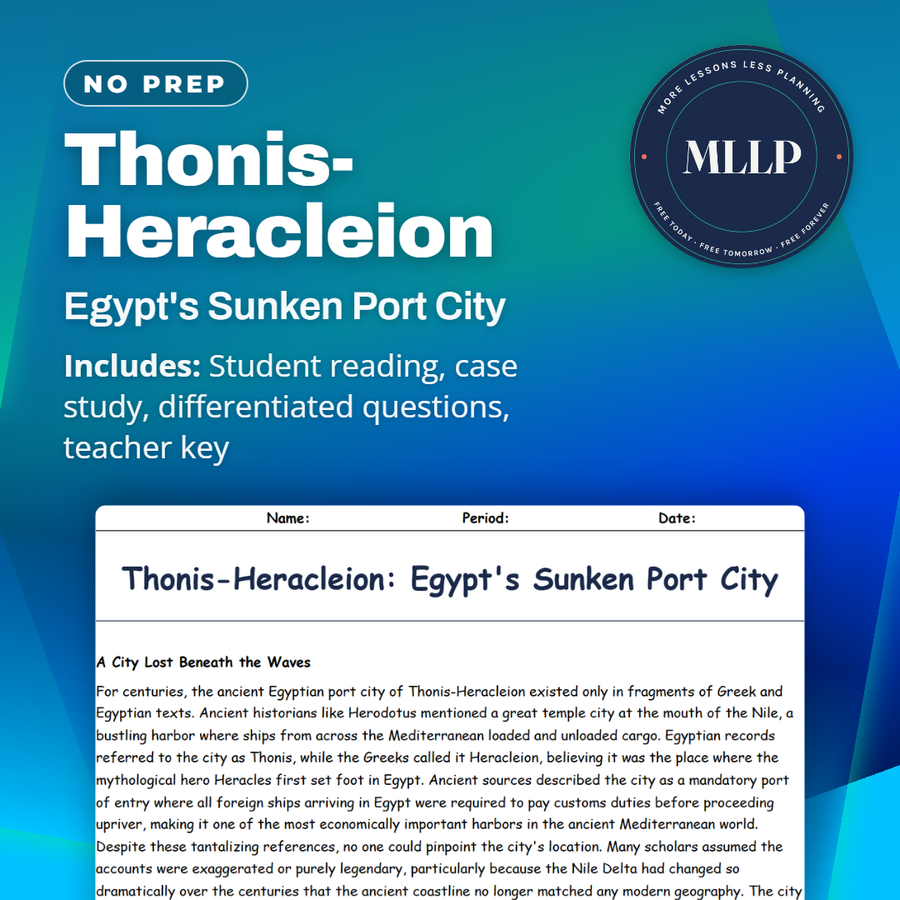
Thonis-Heracleion: Egypt's Sunken Port City
Quality reviewed September 2026
Facts verified September 21, 2026
- Subject
- Social Studies
- Grades
- Grades 9-12
- Length
- 9-page student worksheet
- Time
- About one 50-minute class period
- Great for
- Sub plans and independent work
- Includes
- Reading passage, comprehension questions + full answer key
- Format
- Print-and-go PDF
What students do
- Document a newly surfaced granite queen as marine archaeologist Dr. Laila Nassar, recording position and depth before anyone touches it
- Three fill-in-the-blank items check specifics from the reading, including the survey method Goddio used and the delta where the city sank
- Work out why a five-meter granite statue of the god Hapy survived over 2,000 years underwater in remarkable condition
- Match five terms, including stela and soil liquefaction, to their correct definitions
What it covers
- Franck Goddio's 2000 sonar discovery of an entire sunken city in Abu Qir Bay
- The soil liquefaction process that sank Thonis-Heracleion's temples over several centuries
- Dr. Laila Nassar's 2018 case study documenting a granite queen emerging from the silt
Start reading this worksheet
A City Lost Beneath the Waves
For centuries, the ancient Egyptian port city of Thonis-Heracleion existed only in fragments of Greek and Egyptian texts. Ancient historians like Herodotus mentioned a great temple city at the mouth of the Nile, a bustling harbor where ships from across the Mediterranean loaded and unloaded cargo. Egyptian records referred to the city as Thonis, while the Greeks called it Heracleion, believing it was the place where the mythological hero Heracles first set foot in Egypt. Ancient sources described the city as a mandatory port of entry where all foreign ships arriving in Egypt were required to pay customs duties before proceeding upriver, making it one of the most economically important harbors in the ancient Mediterranean world. Despite these tantalizing references, no one could pinpoint the city's location. Many scholars assumed the accounts were exaggerated or purely legendary, particularly because the Nile Delta had changed so dramatically over the centuries that the ancient coastline no longer matched any modern geography. The city was also confused with other ancient ports in the region, and without concrete archaeological evidence, it remained a mystery debated in academic circles for generations. Then, in the year 2000, French underwater archaeologist Franck Goddio made an announcement that stunned the archaeological world. Using advanced sonar scanning equipment and magnetometer surveys, Goddio and his team from the European Institute for Underwater Archaeology had located the remains of an enormous city submerged beneath Abu Qir Bay, about six and a half kilometers off the Egyptian coast near Alexandria. The discovery came after years of systematic surveying, during which Goddio's team methodically scanned large swaths of the bay floor, ruling out one grid section after another before finally detecting unmistakable signs of man-made structures beneath the sediment. The city lay under approximately ten meters of water, buried beneath layers of sand and sediment that had accumulated over more than a thousand years. Initial surveys revealed a site of extraordinary scale, stretching across an area of roughly eleven by fifteen kilometers on the seafloor. What Goddio had found was not a small settlement or a single shipwreck but an entire urban center, complete with temples, harbors, residential districts, and monumental statues, all preserved beneath the Mediterranean Sea. The discovery instantly became one of the most significant archaeological finds of the twenty-first century, drawing comparisons to the excavation of Pompeii and the opening of Tutankhamun's tomb.
Treasures Pulled from the Seabed
The excavations at Thonis-Heracleion have produced some of the most spectacular underwater archaeological discoveries ever made. Among the first major finds was a massive granite statue of the god Hapy, the Egyptian deity of the Nile flood. Standing over five meters tall and weighing approximately six tons, the red granite colossus was carefully raised from the seabed in a painstaking operation that required specialized lifting equipment and months of preparation. The statue had to be secured in a custom-built cradle underwater before being slowly winched to the surface by a crane barge, with divers monitoring every stage to prevent damage to the ancient stone. Alongside Hapy, the team recovered colossal statues of a pharaoh and a queen, each carved from pink granite and standing over five meters in height. These royal figures had toppled from their original positions when the city sank and lay face-down in the silt for centuries, their carved hieroglyphic inscriptions still sharp and legible despite more than two millennia submerged in saltwater. The oxygen-poor conditions of the thick sediment layer had created an almost airless seal around the sculptures, dramatically slowing the chemical weathering and biological erosion that would have destroyed exposed stone in open water. One of the most historically significant discoveries was a large black granite stela, a flat inscribed stone slab, nearly identical to the Decree of Naukratis found at the site of Naukratis in 1899. This stela confirmed beyond any doubt that the submerged ruins were indeed the legendary city of Thonis-Heracleion. The inscription established that Thonis and Heracleion were the same city, known by its Egyptian name and its Greek name simultaneously, and it detailed tax regulations on goods passing through the port, revealing the city's crucial role in Mediterranean trade. Divers also recovered hundreds of smaller artifacts including gold coins, bronze statues of Egyptian gods like Osiris and Isis, lead and stone anchors from ancient ships, ceramic vessels from Greece, Phoenicia, and other Mediterranean civilizations, jewelry crafted from gold and precious stones, and ritual objects used in religious ceremonies at the city's temples. More than seventy ancient shipwrecks have been identified scattered across the harbor area, some deliberately sunk to block enemy naval access during times of conflict. Many of these vessels were remarkably well preserved, their wooden hulls protected by the same oxygen-poor sediment that shielded the stone statues, offering rare insights into ancient Mediterranean shipbuilding techniques.
Like what you read? The full reading, the case study, and every question set are in the free download below, along with the answer key.
Why this matters
Thonis-Heracleion is a good check on the assumption that written records settle a question, since ancient historians described this city for centuries and scholars still doubted it was real until Goddio's team physically found it in 2000. That gap between a written claim and physical proof is worth naming directly, especially for students used to trusting whatever a textbook or a confident source states as fact. The soil liquefaction explanation also gives students a concrete, non-dramatic answer to a question they might otherwise assume had a single catastrophic cause, a slow-motion sinking playing out over centuries rather than one flood or one earthquake, which fits the pattern of gradual environmental change students are seeing across other readings in this unit.
From one teacher to another
A French archaeologist named Franck Goddio found an entire lost city in 2000, using sonar and magnetometer surveys to locate Thonis-Heracleion beneath ten meters of water and sediment in Abu Qir Bay, about 6.5 kilometers off the coast of Alexandria. For centuries the city existed only in scattered references from Herodotus and other ancient writers, known by two names at once, Thonis to the Egyptians and Heracleion to the Greeks, until a black granite stela pulled from the seabed confirmed both names belonged to the same place. A case study follows Dr. Laila Nassar through the summer of 2018 as she fans silt away from a stone face in near-zero visibility water and slowly exposes a nearly complete four-meter statue of a Ptolemaic queen. The reading also explains why the city sank in the first place, its temples and statues were built on unstable Nile Delta clay, and earthquakes over several centuries triggered a process called soil liquefaction that pulled entire neighborhoods underwater in stages rather than all at once.
What you get
Download
Where should I send the next one?
Everything here is free and it stays that way. Leave your email and I'll send you the new lessons as they go up. You can unsubscribe from any one of them.
Related resources
Angkor Wat: The Jungle Temple Complex

Doggerland: The Lost Land Beneath the North Sea
Lost Cities & Underwater Archaeology: An Overview
Machu Picchu to Gobekli Tepe: Sites That Rewrote the Textbooks
Petra: The Rose-Red City Carved in Stone
Pompeii and Herculaneum Revisited: New Discoveries Still Emerging
Every lesson on this site is free to download and use. If one of them saved you a prep period, you can chip in a few bucks toward my three kids' daycare fund. That's genuinely where tips go.