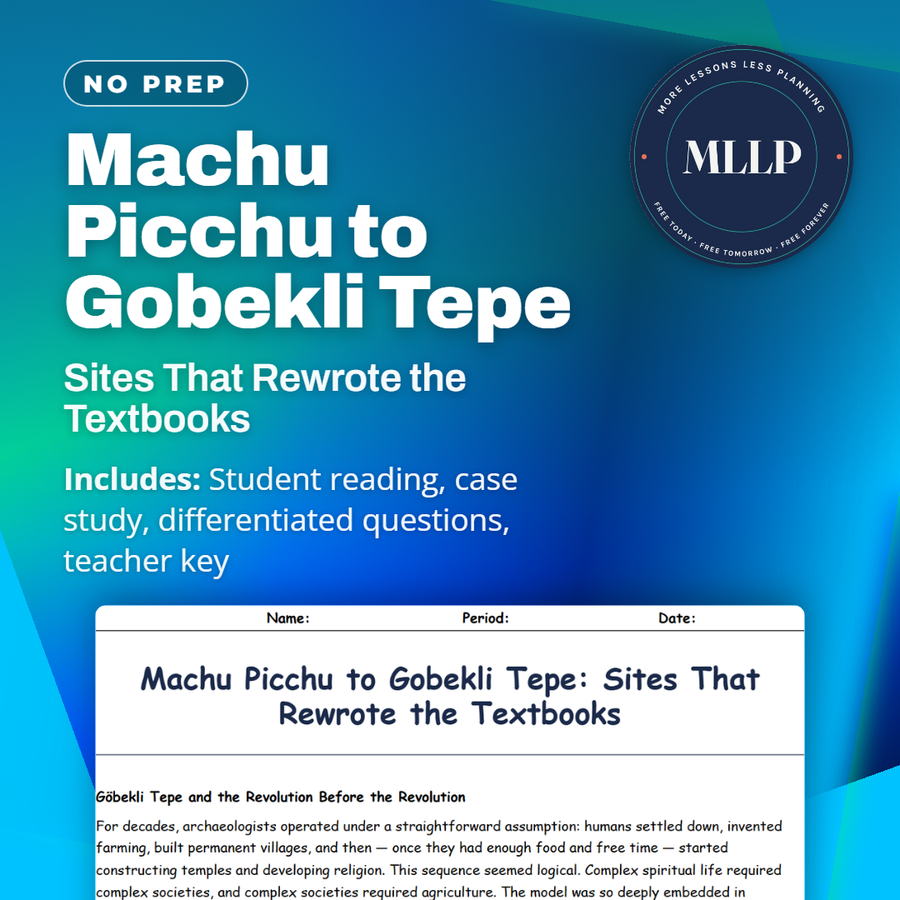
Machu Picchu to Gobekli Tepe: Sites That Rewrote the Textbooks
Quality reviewed September 2026
Facts verified September 21, 2026
- Subject
- Social Studies
- Grades
- Grades 9-12
- Length
- 9-page student worksheet
- Time
- About one 50-minute class period
- Great for
- Sub plans and independent work
- Includes
- Reading passage, comprehension questions + full answer key
- Format
- Print-and-go PDF
What students do
- Five terms, including paradigm shift and chronology, need matching to their correct definitions
- Rank Gobekli Tepe, Machu Picchu, and Poverty Point by how directly each one overturned a textbook assumption
- Follow Dr. Patricia Olsen's case study as one excavation forces her to rewrite a finished textbook chapter
- Three fill-in-the-blank items check specific numbers, how much older Gobekli Tepe is than Stonehenge, the Inca record-keeping system, and Mound A's possible construction time
What it covers
- Why Gobekli Tepe's hunter-gatherer builders reversed the assumed order of farming and religion
- How the Inca fit granite blocks at Machu Picchu so precisely that no mortar was needed
- Dr. Patricia Olsen's case study on rewriting a finished textbook chapter after one excavation
Start reading this worksheet
Göbekli Tepe and the Revolution Before the Revolution
For decades, archaeologists operated under a straightforward assumption: humans settled down, invented farming, built permanent villages, and then, once they had enough food and free time, started constructing temples and developing religion. This sequence seemed logical. Complex spiritual life required complex societies, and complex societies required agriculture. The model was so deeply embedded in academic thinking that it shaped everything from university textbooks to museum exhibits, and few researchers seriously questioned it. Then, in 1995, German archaeologist Klaus Schmidt began excavating a hilltop in southeastern Turkey called Göbekli Tepe, and that entire framework collapsed. What Schmidt uncovered were massive stone pillars arranged in circles, carved with elaborate animal reliefs (lions, foxes, vultures, scorpions) dating to roughly 9600 BCE. That makes Göbekli Tepe approximately 7,000 years older than Stonehenge and older than the earliest known farming communities in the region. The T-shaped pillars, some standing over 18 feet tall, appear to represent stylized human figures, with carved arms and hands visible on their sides. The people who built it were hunter-gatherers. They had no domesticated crops, no permanent villages, no pottery. Yet they organized the labor of hundreds of workers to quarry, transport, and erect limestone pillars weighing up to 20 tons each. Excavations revealed multiple enclosures, each containing rings of these pillars surrounding two larger central columns, suggesting repeated phases of construction and possibly ritual use spanning centuries. Geophysical surveys of the hilltop indicate that fewer than ten percent of the site's structures have been excavated, meaning dozens of additional enclosures may still lie buried beneath the surface. Stone tools and animal bones found at the site indicate that workers feasted on wild game — particularly gazelle and aurochs — during construction, and its first excavators found no evidence of permanent habitation, concluding that people came to Göbekli Tepe for a purpose, built and worshipped, and then left. More recent excavations have found buildings and water cisterns that suggest some people may have lived there. Intriguingly, many of the enclosures appear to have been deliberately buried after a period of use, with older rings filled in and new ones constructed nearby, a pattern that suggests ritual decommissioning rather than abandonment. The discovery forced a paradigm shift in archaeology. Instead of agriculture leading to religion, perhaps religion led to agriculture. The need to feed large groups of workers gathering for spiritual ceremonies may have pushed people toward cultivating wild grains nearby. Göbekli Tepe did not just add a new chapter to human history: it rearranged the table of contents.
Machu Picchu and the Complexity of the Inca
When American historian Hiram Bingham III reached the cloud-wrapped ruins of Machu Picchu in 1911, he believed he had found Vilcabamba, the legendary last refuge of the Inca resistance against Spanish conquest. He was wrong about that, but what he actually found was arguably more important. Machu Picchu turned out to be a royal estate built around 1450 CE for the Inca emperor Pachacuti, and its sophistication stunned researchers for generations. The site sits nearly 8,000 feet above sea level on a narrow ridge between two peaks in the Peruvian Andes, surrounded by steep cliffs that drop over 1,000 feet to the Urubamba River below. Estimates suggest that roughly 750 people lived at Machu Picchu at its peak, including servants, priests, and agricultural workers who maintained the estate year-round. Its construction required cutting and fitting massive granite blocks with such precision that no mortar was needed. A knife blade cannot fit between the stones. The Inca achieved this without iron tools, wheeled vehicles, or a written language. Workers shaped stones using a technique called pecking, in which harder rocks were used to pound and grind softer granite into exact forms. The process was painstaking but produced joints so tight that the structures have survived over five centuries of earthquakes in one of the most seismically active regions on Earth. The site also features the Intihuatana stone, a precisely carved granite pillar that functioned as a solar clock and calendar, casting shadows that marked the solstices and equinoxes with remarkable accuracy. The site's urban planning was equally sophisticated, with distinct residential, religious, and agricultural zones connected by more than one hundred stairways carved from single blocks of granite. Agricultural terraces cascading down the mountainside used an advanced drainage system that still functions today, preventing erosion on the steep slopes. These terraces created microclimates at different elevations, allowing the cultivation of diverse crops including maize, potatoes, and coca. A network of fountains channeled spring water through the entire complex, with sixteen separate water features serving both practical and ceremonial purposes. Machu Picchu rewrote assumptions about what societies without certain technologies could accomplish. Western scholars had long equated writing and metalworking with civilization itself. The Inca demonstrated that a vast empire spanning 2,500 miles could be administered through quipu (knotted string records) and built with stone-age tools to standards that rival modern engineering. The site challenged ethnocentric definitions of advancement and forced a broader understanding of human ingenuity.
Like what you read? The full reading, the case study, and every question set are in the free download below, along with the answer key.
Why this matters
Every one of these sites is really a story about how confidently wrong an expert can be while still following the evidence available at the time. Dr. Olsen's chapter was not sloppy scholarship; it reflected the best understanding available before 1995, and one excavation made it outdated within weeks of publication. That is a useful thing for students to sit with, especially the ones who assume that anything printed in a textbook is settled fact. It also connects to something students already notice in other subjects, that science and history both get revised as new evidence turns up, and being wrong in light of old evidence is different from being wrong on purpose.
From one teacher to another
Three sites here share one thing in common, each one proved that a group without some assumed prerequisite, agriculture, iron tools, or writing, built something monumental anyway. Gobekli Tepe in Turkey dates to roughly 9600 BCE and was built by hunter-gatherers who had no farming and no permanent villages, which flips the old assumption that agriculture had to come before organized religion. Machu Picchu shows Inca stonemasons fitting granite blocks so precisely that no mortar was needed, all without iron tools, wheels, or a written language. Poverty Point in Louisiana adds a third example much closer to home, a set of earthworks built by hunter-gatherer fishers who may have raised a 72-foot mound in as little as 90 days. A case study follows textbook author Dr. Patricia Olsen through the six months she spent rewriting a finished chapter after Gobekli Tepe's excavation made her original argument obsolete.
What you get
Download
Where should I send the next one?
Everything here is free and it stays that way. Leave your email and I'll send you the new lessons as they go up. You can unsubscribe from any one of them.
Related resources
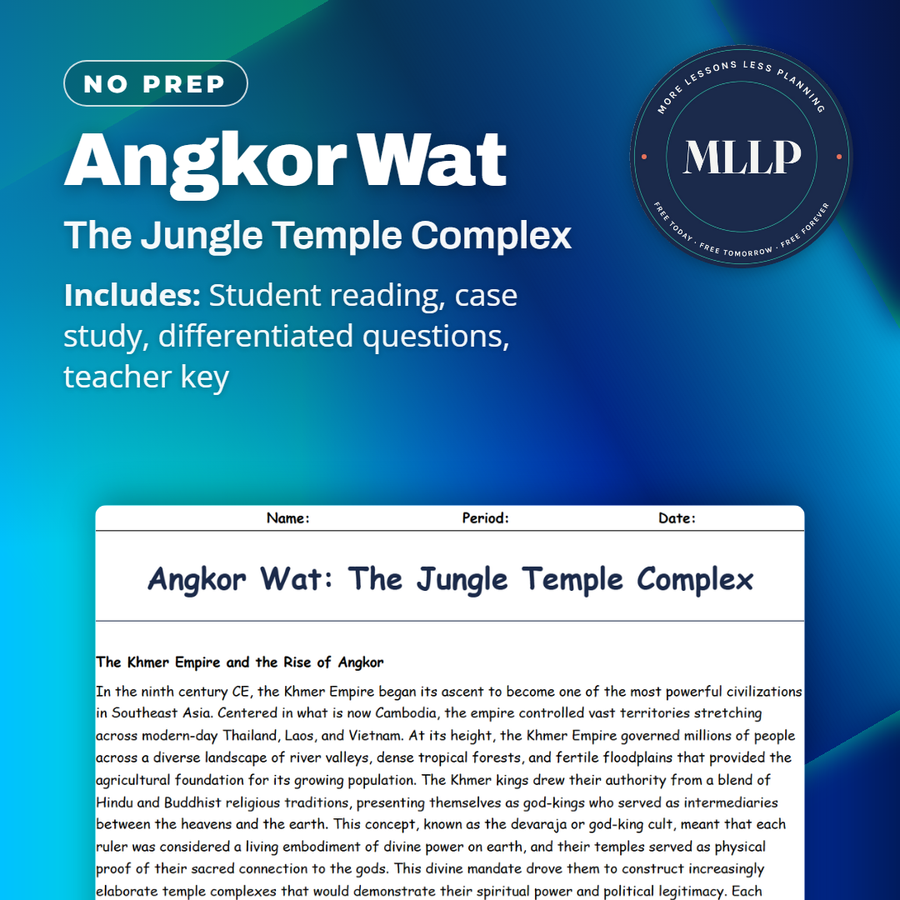
Angkor Wat: The Jungle Temple Complex

Doggerland: The Lost Land Beneath the North Sea
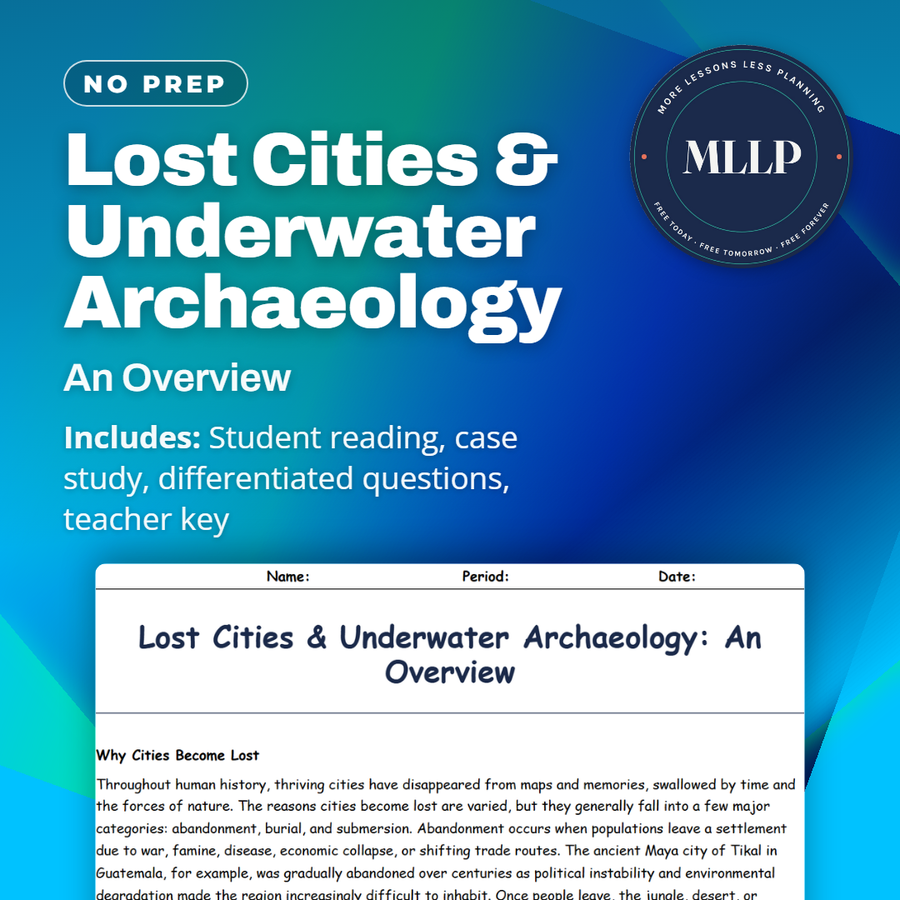
Lost Cities & Underwater Archaeology: An Overview
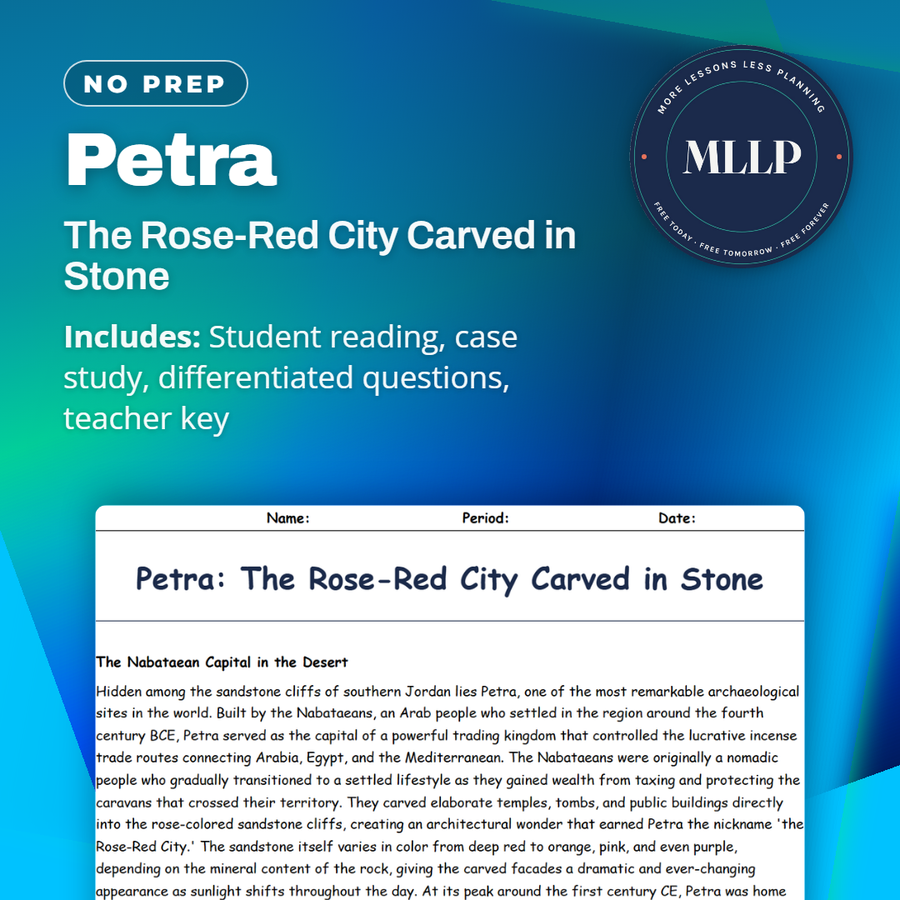
Petra: The Rose-Red City Carved in Stone
Pompeii and Herculaneum Revisited: New Discoveries Still Emerging
Shipwrecks of the Mediterranean: An Underwater Museum
Every lesson on this site is free to download and use. If one of them saved you a prep period, you can chip in a few bucks toward my three kids' daycare fund. That's genuinely where tips go.