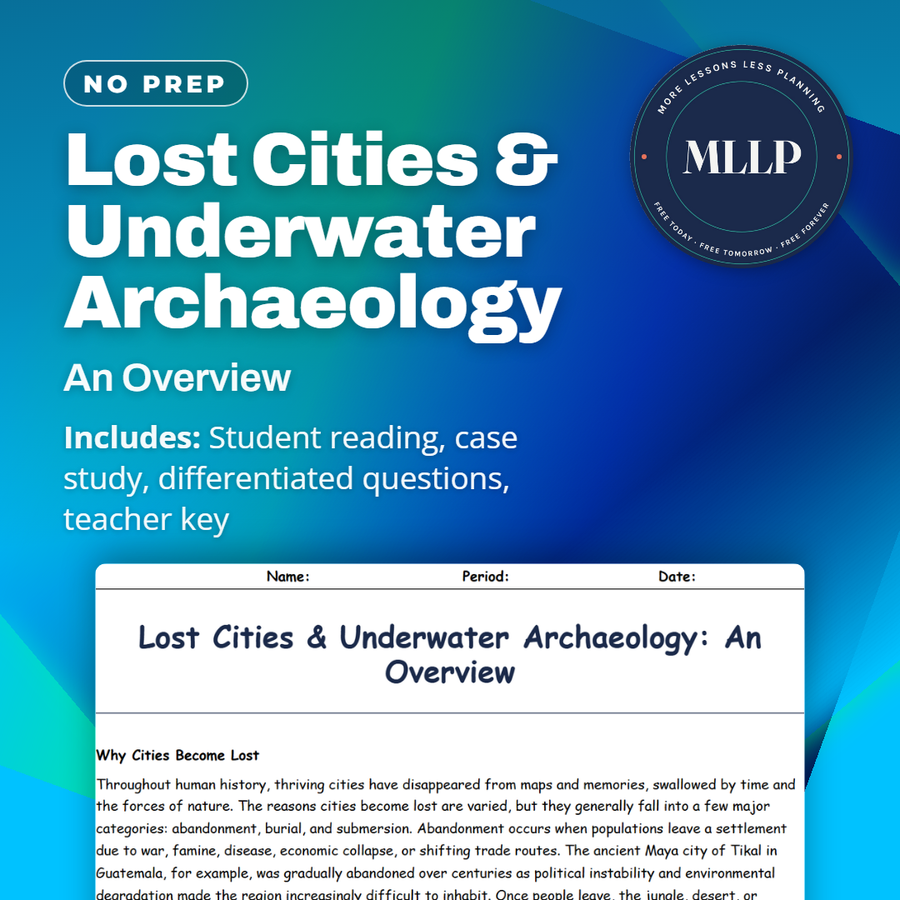
Lost Cities & Underwater Archaeology: An Overview
Quality reviewed September 2026
Facts verified September 21, 2026
- Subject
- Social Studies
- Grades
- Grades 9-12
- Length
- 9-page student worksheet
- Time
- About one 50-minute class period
- Great for
- Sub plans and independent work
- Includes
- Reading passage, comprehension questions + full answer key
- Format
- Print-and-go PDF
What students do
- Decide, as diving instructor Maria Chen, whether to let a client pocket pottery fragments spotted on a Turkish reef
- Sort the three ways cities disappear, abandonment, burial, and submersion, using real examples from Tikal to Shi Cheng
- Three short-answer questions ask why the lone-explorer myth misrepresents how sites like Machu Picchu were actually found
- Match five terms, including salvage and underwater archaeology, to their correct definitions
What it covers
- The difference between careful underwater archaeology and treasure-hunting salvage operations
- Real reasons cities disappear, from Pompeii's ash burial to Shi Cheng's deliberate flooding for a dam
- The UNESCO Convention of 2001 and why it protects shipwrecks from commercial exploitation
Start reading this worksheet
Why Cities Become Lost
Throughout human history, thriving cities have disappeared from maps and memories, swallowed by time and the forces of nature. The reasons cities become lost are varied, but they generally fall into a few major categories: abandonment, burial, and submersion. Abandonment occurs when populations leave a settlement due to war, famine, disease, economic collapse, or shifting trade routes. The ancient Maya city of Tikal in Guatemala, for example, was gradually abandoned over centuries as political instability and environmental degradation made the region increasingly difficult to inhabit. Once people leave, the jungle, desert, or grassland reclaims the land with startling speed. Within just a few generations, buildings crumble, roads vanish beneath vegetation, and local knowledge of the site fades from oral tradition. Angkor in Cambodia followed a similar pattern, its temples consumed by tropical forest after the empire's decline. The city of Great Zimbabwe in southern Africa was largely abandoned by the mid-fifteenth century, possibly due to overgrazing and political fragmentation, and its massive stone walls stood forgotten by outsiders until European explorers encountered them centuries later. Burial happens when natural processes such as volcanic eruptions, mudslides, sandstorms, or sediment accumulation physically cover a city. Pompeii was buried under meters of volcanic ash in 79 CE, preserving it in a time capsule that would not be rediscovered for nearly 1,700 years. In parts of Mesopotamia, ancient cities were buried under layers of windblown sand and new settlements built directly on top of them, creating artificial mounds called tells that archaeologists excavate layer by layer to read thousands of years of human occupation. Submersion is perhaps the most dramatic form of loss. Rising sea levels, earthquakes that cause coastal land to sink, and dam construction have all placed once-dry cities beneath lakes, rivers, and oceans. The ancient Egyptian city of Heracleion, which sank into the Mediterranean after the waterlogged ground beneath it gave way, is one example. The ancient port city of Dwarka off the coast of India and the submerged ruins of Pavlopetri near Greece are both examples of settlements now resting on the seafloor. Pavlopetri, dating to around 2800 BCE, is considered one of the oldest known submerged cities in the world and was only identified by archaeologists in 1967. In China, the ancient city of Shi Cheng was deliberately flooded in 1959 during the construction of a hydroelectric dam, and its preserved Ming Dynasty architecture now sits under forty meters of lake water. Understanding why cities disappear is the first step in knowing where to look for them and how to recover their stories.
The Romance vs. Reality of Discovery
Popular culture has long romanticized the discovery of lost cities. Movies, novels, and television shows depict daring adventurers hacking through jungles to stumble upon golden temples hidden for millennia. The reality of archaeological discovery, however, is far less glamorous and far more methodical. Most lost cities are not found by accident or by lone explorers following treasure maps. They are located through years of painstaking research involving historical documents, satellite imagery, aerial surveys, and ground-penetrating radar. Modern technology has transformed how archaeologists locate buried sites. LiDAR, which stands for Light Detection and Ranging, uses laser pulses fired from aircraft to penetrate dense forest canopy and map the ground surface beneath. In 2018, LiDAR surveys revealed over sixty thousand previously unknown Maya structures hidden beneath the jungle of northern Guatemala, fundamentally changing estimates of the civilization's overall size and complexity. Satellite imagery has proven equally powerful, with archaeologist Sarah Parcak using infrared satellite data to identify thousands of potential sites across Egypt, including buried pyramids and settlements invisible to the naked eye from ground level. When archaeologist Hiram Bingham arrived at Machu Picchu in 1911, he was guided there by local farmers who had always known about the ruins. His so-called discovery was really a matter of bringing international academic attention to a site that indigenous people had never truly lost. This pattern repeats throughout the history of archaeology: many famous finds were already known to local populations. The romance of discovery also masks the ethical complexities involved. Early explorers often removed artifacts without permission, damaged sites through careless excavation, and ignored the rights of descendant communities. Lord Elgin's removal of marble sculptures from the Parthenon in Athens in the early 1800s remains one of the most contentious examples, with Greece still demanding their return. Heinrich Schliemann's excavation of Troy in the 1870s caused enormous destruction to the site because he dug rapidly through multiple occupation layers in his rush to find Homeric treasure, obliterating centuries of archaeological evidence in the process. Today, professional archaeology operates under strict ethical codes that prioritize documentation, preservation, and collaboration with local stakeholders. The thrill of finding something ancient and untouched is real, but responsible archaeology demands patience, precision, and respect. Every broken potsherd and soil layer tells a story, and rushing through a site for headline-grabbing finds destroys the very context that gives those finds meaning.
Like what you read? The full reading, the case study, and every question set are in the free download below, along with the answer key.
Why this matters
The gap between how discovery gets portrayed and how it actually happens is worth slowing down on, because it shapes what students expect archaeology to feel like. Nobody stumbles onto a lost city; researchers narrow down a location using old documents, satellite scans, and years of patient survey work, and plenty of famous finds were never lost to the people who already lived nearby. The reef case study does similar work with looting. Removing a pottery fragment from where it rests seems harmless to someone on vacation, but it erases the spatial information that turns an object into evidence. That distinction between an artifact and a souvenir is one students can apply the next time they see someone bring home a piece of coral or an old coin found on a beach.
From one teacher to another
Cities disappear in three basic ways, according to this reading: people abandon them, nature buries them, or the water rises over them. Tikal, Angkor, and Great Zimbabwe cover abandonment. Pompeii and the buried tells of Mesopotamia cover burial. Heracleion, Pavlopetri, and the deliberately flooded city of Shi Cheng in China cover submersion. The second passage takes on the pop-culture image of the lone adventurer stumbling onto a golden temple, using Hiram Bingham's 1911 arrival at Machu Picchu, a site local farmers already knew about, and Heinrich Schliemann's careless dig through Troy as evidence that real discovery looks nothing like the movies. A case study puts students alongside diving instructor Maria Chen, who has to decide what to do when a client wants to pocket pottery fragments off a Turkish reef. The last passage separates underwater archaeology from treasure hunting and explains what protections exist for sites like the Uluburun wreck.
What you get
Download
Where should I send the next one?
Everything here is free and it stays that way. Leave your email and I'll send you the new lessons as they go up. You can unsubscribe from any one of them.
Related resources

Angkor Wat: The Jungle Temple Complex

Doggerland: The Lost Land Beneath the North Sea
Machu Picchu to Gobekli Tepe: Sites That Rewrote the Textbooks
Petra: The Rose-Red City Carved in Stone
Pompeii and Herculaneum Revisited: New Discoveries Still Emerging
Shipwrecks of the Mediterranean: An Underwater Museum
Every lesson on this site is free to download and use. If one of them saved you a prep period, you can chip in a few bucks toward my three kids' daycare fund. That's genuinely where tips go.