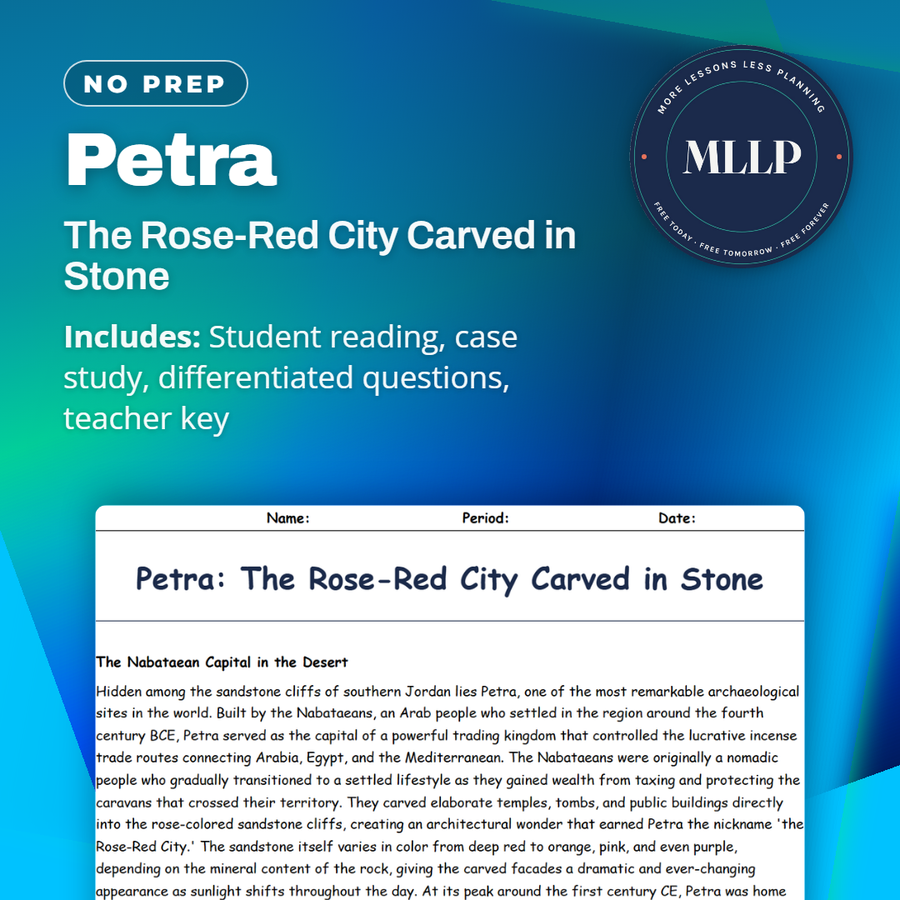
Petra: The Rose-Red City Carved in Stone
Quality reviewed September 2026
Facts verified September 21, 2026
- Subject
- Social Studies
- Grades
- Grades 9-12
- Length
- 8-page student worksheet
- Time
- About one 50-minute class period
- Great for
- Sub plans and independent work
- Includes
- Reading passage, comprehension questions + full answer key
- Format
- Print-and-go PDF
What students do
- Design a gravity-fed water channel as Nabataean engineer Khalid, keeping its slope precise enough to avoid both erosion and standing water
- Three short-answer questions ask how Petra's water system let a desert trading capital support tens of thousands of people
- Match five terms, including Siq and Al-Khazneh, to their correct definitions
- Work out how Johann Ludwig Burckhardt talked his way past a guide in 1812 by claiming he wanted to sacrifice a goat
What it covers
- How the Nabataeans engineered over 200 cisterns and channels to survive a near-rainless desert
- Why Petra's Treasury facade was almost certainly a royal tomb, not the storehouse its name implies
- Burckhardt's 1812 disguise and the goat-sacrifice story that got him past a local guide
Start reading this worksheet
The Nabataean Capital in the Desert
Hidden among the sandstone cliffs of southern Jordan lies Petra, one of the most remarkable archaeological sites in the world. Built by the Nabataeans, an Arab people who settled in the region around the fourth century BCE, Petra served as the capital of a powerful trading kingdom that controlled the lucrative incense trade routes connecting Arabia, Egypt, and the Mediterranean. The Nabataeans were originally a nomadic people who gradually transitioned to a settled lifestyle as they gained wealth from taxing and protecting the caravans that crossed their territory. They carved elaborate temples, tombs, and public buildings directly into the rose-colored sandstone cliffs, creating an architectural wonder that earned Petra the nickname 'the Rose-Red City.' The sandstone itself varies in color from deep red to orange, pink, and even purple, depending on the mineral content of the rock, giving the carved facades a dramatic and ever-changing appearance as sunlight shifts throughout the day. At its peak around the first century CE, Petra was home to an estimated 20,000 to 30,000 people and served as a crossroads for caravans carrying spices, silk, frankincense, myrrh, and other luxury goods. Merchants from as far away as China, India, and sub-Saharan Africa passed through the city, making it one of the most cosmopolitan centers in the ancient world. The Nabataeans also developed their own distinctive alphabet and written language, which linguists consider a key link in the evolution of the Arabic script used across the Middle East today. The city's location in a narrow desert canyon made it naturally defensible, as the surrounding cliffs created walls that no army could easily scale, while the Nabataeans' engineering genius transformed the arid landscape into a habitable urban center with paved streets, public markets, and religious sanctuaries. The kingdom maintained diplomatic relationships with both Rome and Egypt, skillfully balancing its independence between these two superpowers for over a century. After the Roman Empire annexed the Nabataean kingdom in 106 CE, Petra gradually declined as trade routes shifted northward toward the city of Palmyra in modern-day Syria. Earthquakes in 363 and 551 CE caused further structural damage to many of the carved facades and freestanding buildings, and by the early medieval period, the city was largely abandoned and forgotten by the Western world, known only to local Bedouin communities who continued to live among the ancient ruins and used some of the carved tombs as shelters for their livestock and families.
Rediscovery and the Famous Facades
In 1812, a young Swiss explorer named Johann Ludwig Burckhardt became the first European in centuries to lay eyes on Petra. Burckhardt was a remarkable figure in his own right, having spent years studying Arabic and Islamic culture in preparation for his travels across the Middle East and North Africa. Disguised as an Arab traveler and speaking fluent Arabic, Burckhardt convinced a local guide to lead him through the Siq, the narrow gorge that serves as Petra's main entrance, by claiming he wished to sacrifice a goat at a nearby tomb. The Siq stretches for over a kilometer, with towering sandstone walls rising nearly 80 meters on either side, and its floor still shows the remains of an ancient paved road and water channels carved by the Nabataeans. Along the walls, visitors can still see carved niches that once held small religious statues or offerings left by travelers seeking divine protection before entering the city. The gorge opens dramatically to reveal Al-Khazneh, known as the Treasury. This iconic facade, carved directly into a cliff face and standing nearly 40 meters tall, features elaborate Hellenistic columns, friezes, and sculptures that blend Greek, Egyptian, and Nabataean artistic traditions. The level of detail in the carvings is extraordinary, with figures of eagles, Amazons, and the mythological twins Castor and Pollux flanking the central entrance. Bullet holes pockmark the facade, left by Bedouin who fired at the carved urns hoping to release treasure they believed was hidden inside. Despite its name, the Treasury was likely a royal tomb rather than a storehouse, and recent archaeological work beneath its floor has revealed burial chambers containing skeletal remains and grave goods. Beyond the Treasury, Petra contains over 800 carved structures, including the massive Monastery (Ad-Deir), which stands even taller than the Treasury at 47 meters, a Roman-style theater carved into the rock that seated 4,000 spectators, and rows of elaborate royal tombs known as the Royal Tombs whose facades display a range of architectural styles. Burckhardt's account of his discovery electrified European scholars and launched decades of exploration and romantic fascination with the lost city. However, systematic archaeological excavation did not begin until the twentieth century, and researchers estimate that only about 15 percent of Petra has been excavated so far, meaning the vast majority of this ancient city remains buried beneath centuries of sand and debris.
Like what you read? The full reading, the case study, and every question set are in the free download below, along with the answer key.
Why this matters
Petra is a strong example of engineering as survival rather than decoration, since every dam and cistern in the city existed because a desert trading capital simply could not function without one. Khalid's case study forces students to work through a real constraint, a channel slope so precise that a small error means either flooding or a dry cistern, which is a more honest picture of ancient engineering than most students expect. The Burckhardt story is worth pairing with that, since it is a reminder that a site being unknown to European scholars never meant it was actually lost. Bedouin communities lived among Petra's tombs the entire time; Burckhardt just needed a convincing enough excuse to get past the person guarding the entrance.
From one teacher to another
Petra's builders carved an entire capital city into rose-colored sandstone cliffs in a part of southern Jordan that gets less than 15 centimeters of rain a year, and the reading spends real time on how the Nabataeans pulled that off. More than 200 documented dams, cisterns, and channels captured every flash flood and turned it into a year-round water supply, enough to support fountains, gardens, and a population that may have reached 30,000 people at its peak. A case study puts students in the sandals of Khalid, a Nabataean water engineer designing a gravity-fed channel that has to hold a nearly exact slope over two kilometers of sandstone. The second passage covers the 1812 rediscovery by Swiss explorer Johann Ludwig Burckhardt, who talked his way past a local guide by claiming he wanted to sacrifice a goat at a nearby tomb, and the famous Treasury facade that greets visitors at the end of the Siq. Archaeologists estimate that only about 15 percent of Petra has been excavated so far.
What you get
Download
Where should I send the next one?
Everything here is free and it stays that way. Leave your email and I'll send you the new lessons as they go up. You can unsubscribe from any one of them.
Related resources
Angkor Wat: The Jungle Temple Complex

Doggerland: The Lost Land Beneath the North Sea
Lost Cities & Underwater Archaeology: An Overview
Machu Picchu to Gobekli Tepe: Sites That Rewrote the Textbooks
Pompeii and Herculaneum Revisited: New Discoveries Still Emerging
Shipwrecks of the Mediterranean: An Underwater Museum
Every lesson on this site is free to download and use. If one of them saved you a prep period, you can chip in a few bucks toward my three kids' daycare fund. That's genuinely where tips go.