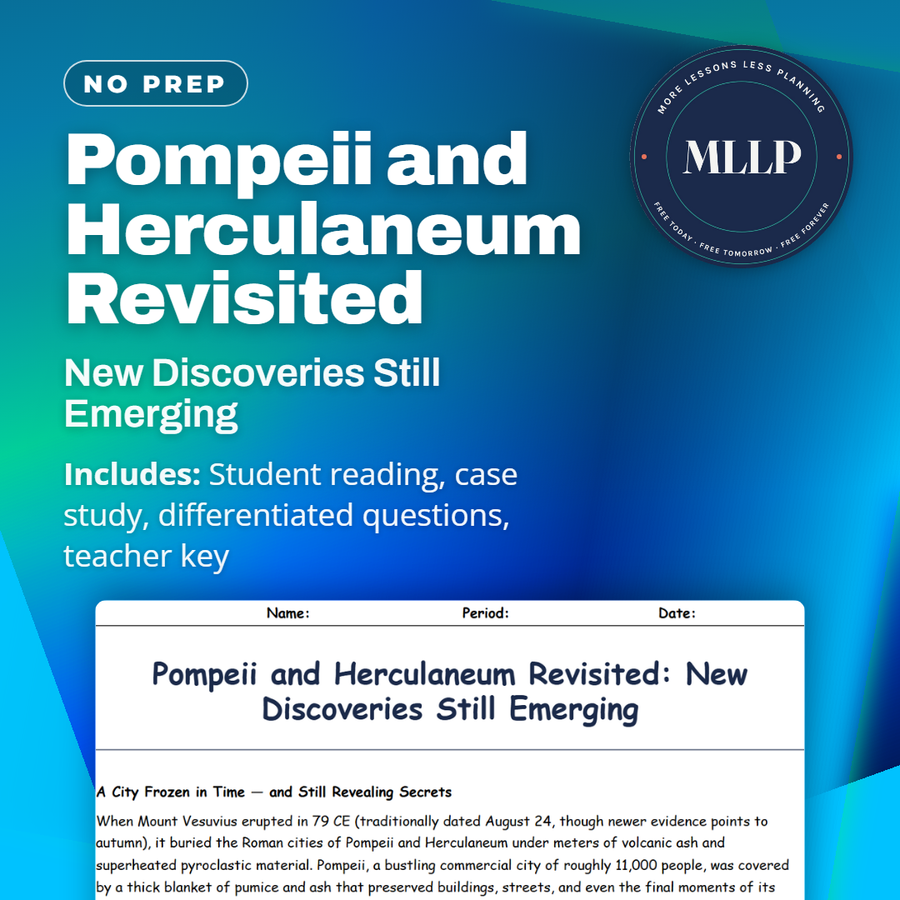
Pompeii and Herculaneum Revisited: New Discoveries Still Emerging
Quality reviewed September 2026
Facts verified September 21, 2026
- Subject
- Social Studies
- Grades
- Grades 9-12
- Length
- 9-page student worksheet
- Time
- About one 50-minute class period
- Great for
- Sub plans and independent work
- Includes
- Reading passage, comprehension questions + full answer key
- Format
- Print-and-go PDF
What students do
- Weigh whether Dr. Lucia Ferraro's team should open a sealed Regio V room or leave it buried for future technology
- Three fill-in-the-blank items check details from the 2023-2024 Regio V discoveries, from the Trojan War frescoes to annual visitor numbers
- Consider why archaeologists have deliberately left about one-third of Pompeii unexcavated
- Match five terms, including thermopolium and pyroclastic material, to their correct definitions
What it covers
- Why archaeologists deliberately leave roughly a third of Pompeii buried and unexcavated
- The 2023-2024 Regio V frescoes, lararium, and thermopolium with food still inside its containers
- The tourism paradox: three million annual visitors fund preservation and accelerate decay
Start reading this worksheet
A City Frozen in Time, and Still Revealing Secrets
When Mount Vesuvius erupted in 79 CE (traditionally dated August 24, though newer evidence points to autumn), it buried the Roman cities of Pompeii and Herculaneum under meters of volcanic ash and superheated pyroclastic material. Pompeii, a bustling commercial city of roughly 11,000 people, was covered by a thick blanket of pumice and ash that preserved buildings, streets, and even the final moments of its residents in extraordinary detail. Herculaneum, a smaller and wealthier seaside town nearby, was buried under a much denser layer of volcanic mud that hardened into rock, creating different but equally remarkable preservation conditions. The eruption unfolded in two main phases. First, a towering column of pumice and ash rose into the sky and rained down on Pompeii for hours, collapsing roofs and filling streets. Then came the pyroclastic surges, superheated clouds of gas and volcanic debris traveling at speeds exceeding one hundred kilometers per hour, which killed anyone still remaining and sealed the city in a thick, hardened layer. Pliny the Younger, a Roman author who witnessed the eruption from across the Bay of Naples, wrote detailed letters describing the towering ash column and the panic of fleeing residents, providing one of the earliest eyewitness accounts of a volcanic disaster in Western literature. What many people do not realize is that despite nearly three centuries of excavation, approximately one-third of Pompeii remains completely unexcavated. Entire neighborhoods, shops, temples, and homes still lie beneath the surface, waiting to be studied. The decision to leave large portions of the city buried is deliberate. Modern archaeologists recognize that future generations will have better technology, better methods, and better questions to ask of the evidence. Excavating too quickly with current tools risks destroying information that more advanced techniques could recover. Herculaneum presents an even more complex challenge. Much of the ancient city lies beneath the modern town of Ercolano, making large-scale excavation logistically and politically difficult. The portions that have been uncovered, however, have yielded stunning finds including intact wooden furniture, carbonized scrolls from a private library known as the Villa of the Papyri, and multi-story buildings preserved to their original roof lines. Researchers are currently using advanced X-ray imaging technology to read the carbonized scrolls without unrolling them, a process that could recover lost works of ancient Greek and Roman literature. Together, these two sites remain among the most important archaeological laboratories in the world.
Regio V and the New Excavations of 2023-2024
Beginning in 2018, the Pompeii Archaeological Park launched a major new excavation campaign in Regio V, a previously unexplored section of the city located in the northern quarter. This project was partly motivated by the need to stabilize the boundaries between excavated and unexcavated areas, where exposed walls were at risk of collapse. What the team found exceeded all expectations. In 2023 and 2024, archaeologists uncovered a series of rooms decorated with remarkably well-preserved frescoes depicting mythological scenes, including images of the Trojan War and figures from Greek mythology. One room featured elaborate blue walls with finely painted panels that scholars believe belonged to a wealthy homeowner's private reception hall. The level of artistic detail was remarkable, with individual brush strokes still visible and pigments retaining much of their original vibrancy after two millennia beneath the ash. Another room contained a lararium, a household shrine dedicated to the protective spirits of the home, with small painted figures of gods and offerings still visible on its surface, revealing how deeply religious practice was woven into everyday Roman domestic life. The excavations also revealed a thermopolium, or ancient fast-food counter, complete with painted decorations of animals and food on its front surface. Traces of food were still found inside the deep terracotta containers set into the counter, including remnants of duck, goat, fish, and snails. Chemical analysis of these food residues has allowed scientists to reconstruct specific recipes and understand the dietary habits of working-class Romans, who often lacked private kitchens and relied on these street vendors for daily meals. This was not the first thermopolium found in Pompeii, but its exceptional state of preservation made headlines worldwide. The skeletal remains of several individuals were also discovered during these campaigns, including a man and woman found in a small room, likely killed by the collapsing roof during the eruption. Analysis of their bones and personal items has provided new insights into the demographics and daily lives of ordinary Pompeians. DNA analysis and isotopic studies of the skeletal remains have revealed details about diet, geographic origin, family relationships, and disease patterns that written records from the period never captured. Each season of excavation continues to produce discoveries that challenge and refine our understanding of Roman urban life.
Like what you read? The full reading, the case study, and every question set are in the free download below, along with the answer key.
Why this matters
Pompeii's tourism paradox gives students a specific, unresolved trade-off instead of a settled answer, the three million visitors a year that fund conservation are also the foot traffic wearing down the mosaics and frescoes those funds are meant to protect. There is no clean fix for that, which is closer to how real preservation decisions actually work than a tidy classroom example. The decision to leave a third of the city buried on purpose is another angle on patience as a form of expertise, since it means admitting that the tools available right now are not good enough yet, and that digging anyway would destroy information a future archaeologist could have recovered.
From one teacher to another
Pompeii keeps surprising archaeologists nearly 2,000 years after Vesuvius buried it, and this reading focuses on why. The Regio V excavations of 2023 and 2024 uncovered frescoes of the Trojan War with brushstrokes still visible, a household shrine, and a thermopolium, an ancient fast-food counter, with traces of duck, goat, fish, and snails still sitting inside its serving containers. Chemical analysis of that food is now revealing what working-class Romans actually ate day to day, information no written source ever recorded. A case study drops students into a sealed room Dr. Lucia Ferraro's team just broke into, one that has not been opened since the eruption, and asks what should happen to a room where every minute of exposure to modern air starts degrading frescoes that have survived intact for two millennia. The reading also explains why roughly a third of the city remains deliberately unexcavated, a decision made on purpose so that future archaeologists with better tools can study it properly.
What you get
Download
Where should I send the next one?
Everything here is free and it stays that way. Leave your email and I'll send you the new lessons as they go up. You can unsubscribe from any one of them.
Related resources

Angkor Wat: The Jungle Temple Complex

Doggerland: The Lost Land Beneath the North Sea
Lost Cities & Underwater Archaeology: An Overview
Machu Picchu to Gobekli Tepe: Sites That Rewrote the Textbooks
Petra: The Rose-Red City Carved in Stone
Shipwrecks of the Mediterranean: An Underwater Museum
Every lesson on this site is free to download and use. If one of them saved you a prep period, you can chip in a few bucks toward my three kids' daycare fund. That's genuinely where tips go.