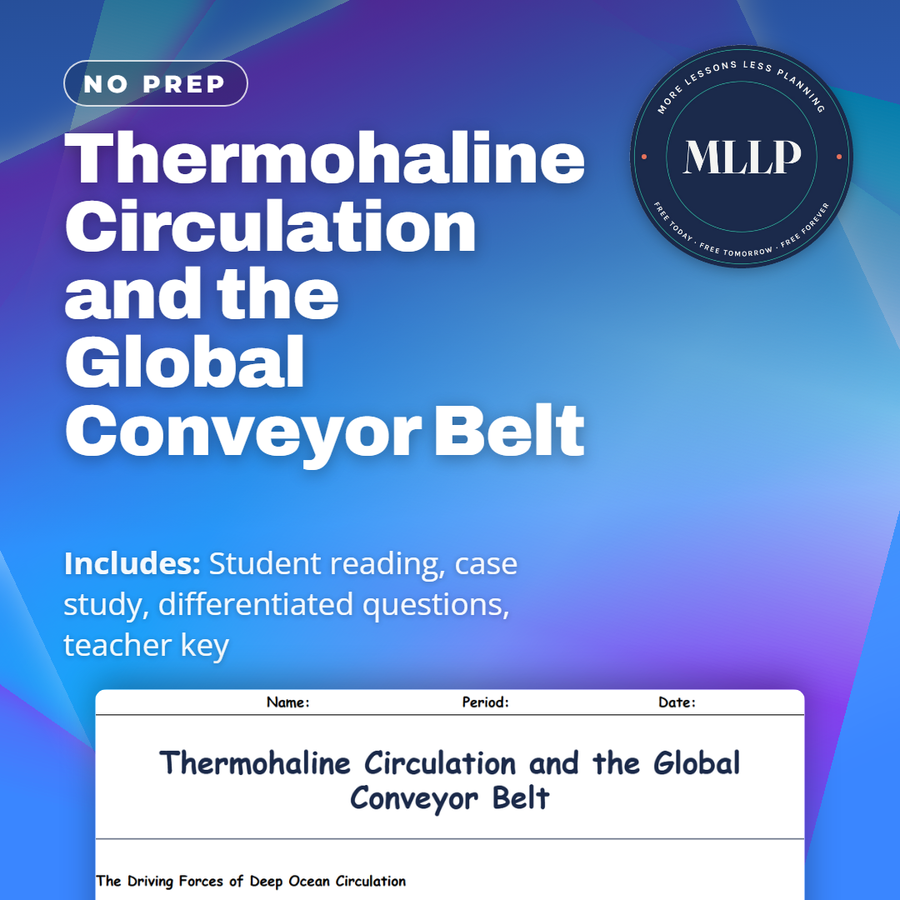
Thermohaline Circulation and the Global Conveyor Belt
Quality reviewed September 2026
Facts verified September 14, 2026
- Subject
- Science
- Grades
- Grades 9-12
- Length
- 6-page student worksheet
- Time
- About one 50-minute class period
- Great for
- Sub plans and independent work
- Includes
- Reading passage, comprehension questions + full answer key
- Format
- Print-and-go PDF
What students do
- Match terms like thermohaline circulation, the global conveyor belt, the Younger Dryas, upwelling, and ice formation to their correct definitions
- Fill in the blank sentences on thermohaline circulation, deep ocean carbon storage, and the global conveyor belt
- Answer multiple choice questions on what makes seawater dense enough to sink in the North Atlantic, what upwelling does for the conveyor belt, and why the Younger Dryas matters to climate science
- Write short answers on how melting ice sheets could disrupt circulation, why the conveyor belt matters for marine ecosystems, and how deep ocean circulation connects to climate on land
What it covers
- How temperature and salinity combine to sink dense water in the North Atlantic and drive the global conveyor belt
- How the conveyor belt redistributes heat, nutrients, and carbon across every ocean basin
- A case study on the Younger Dryas cooling event, when a flood of freshwater stalled deep ocean circulation
Start reading this worksheet
The Driving Forces of Deep Ocean Circulation
The ocean is always in motion. While surface currents are shaped by winds and Earth’s rotation, the deep ocean follows a different rhythm. Thermohaline circulation, named for temperature (“thermo”) and salinity (“haline”), is the great engine of deep-sea movement. It forms the backbone of the global conveyor belt, a planetary system that links the oceans into a single, interconnected circulation network. At its heart, thermohaline circulation is powered by density differences. Cold water is denser than warm water, and salty water is denser than fresh water. When seawater becomes both cold and salty, as it does near the poles, it sinks to great depths and begins a slow journey across the world’s ocean basins. This deep flow may take centuries to complete its cycle, but it shapes climate, nutrient distribution, and the health of ecosystems worldwide.
Sinking Waters and the Conveyor Belt
The process begins most dramatically in the North Atlantic Ocean. During winter, cold winds cool the surface and sea ice formation increases salinity, making the water dense enough to sink. This creates a current of deep water that moves southward, hugging the seafloor. A similar process occurs in the Southern Ocean around Antarctica. As these waters travel, they gradually rise back to the surface through upwelling, completing the conveyor belt. This circulation redistributes heat, helping keep regions like Western Europe warmer than other places at the same latitude. It also moves nutrients from the deep sea into surface waters, fueling plankton growth that supports the marine food web. Disruptions to this system can be serious. If freshwater from melting ice dilutes the North Atlantic, the sinking process may slow. This could weaken the conveyor belt and change rainfall, storm tracks, and global climate patterns.
Like what you read? The full reading, the case study, and every question set are in the free download below, along with the answer key.
Why this matters
About 12,000 years ago, the Northern Hemisphere was plunged back into near-glacial conditions and stayed there for over a thousand years. The cause traces to the North Atlantic, where a surge of glacial meltwater diluted the salty water that normally sinks there, stalling the global conveyor belt that carries heat, nutrients, and carbon between every ocean basin.
What gets students is the mismatch in timescales: one surge of meltwater diluting the salt flipped the climate for over a thousand years afterward. I use the Younger Dryas to show that ocean circulation is not background plumbing, it is a switch, and one that has already flipped once from fresh water alone.
From one teacher to another
Deep beneath the surface, cold and salty water sinks near the poles and takes centuries to circulate through every ocean basin. This worksheet covers how that sinking water powers thermohaline circulation and the global conveyor belt, moving heat, nutrients, and carbon between ocean basins along the way. The case study on the Younger Dryas cooling event looks at what happened roughly 12,000 years ago when a surge of glacial meltwater diluted the North Atlantic, stalled the conveyor belt, and plunged the Northern Hemisphere back into near-glacial conditions for over a thousand years.
What you get
Download
Where should I send the next one?
Everything here is free and it stays that way. Leave your email and I'll send you the new lessons as they go up. You can unsubscribe from any one of them.
Related resources
Coastal Processes: Erosion, Deposition, Barrier Islands, and Estuaries
El Niño and La Niña: Ocean-Atmosphere Climate Connections
Ocean Tides: Gravitational Forces of the Moon and Sun
Properties of Seawater: Salinity, Temperature, and Density
Surface Currents and Wind Patterns: The Coriolis Effect and Gyres
The Role of Oceans in Weather and Climate Systems
Every lesson on this site is free to download and use. If one of them saved you a prep period, you can chip in a few bucks toward my three kids' daycare fund. That's genuinely where tips go.