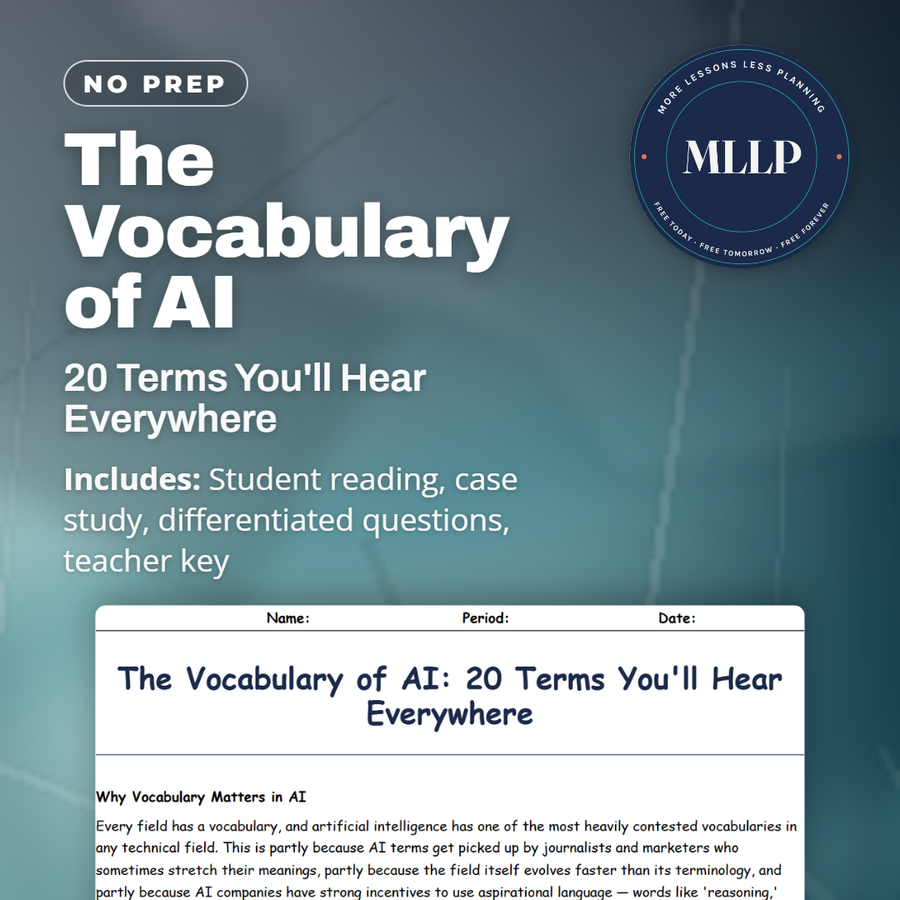
The Vocabulary of AI: 20 Terms You'll Hear Everywhere
Quality reviewed September 2026
Facts verified September 20, 2026
- Subject
- Career & Life Skills
- Grades
- Grades 9-12
- Length
- 9-page student worksheet
- Time
- About one 50-minute class period
- Great for
- Sub plans and independent work
- Includes
- Reading passage, comprehension questions + full answer key
- Format
- Print-and-go PDF
What students do
- Write short answers explaining the difference between hallucination and overfitting using the four classmates' debate
- Twenty AI terms, from fine-tuning to foundation model, are grouped into how AI learns, generates output, goes wrong, and gets governed
- Trace how Kwame, Elena, Dev, and Tasha work out the real difference between hallucination and lying
- Three multiple-choice questions test temperature, RLHF, and a real example of failed AI alignment
What it covers
- Twenty AI vocabulary terms grouped into how AI learns, generates output, goes wrong, and gets governed
- The difference between hallucination and overfitting, worked out through a four-student classroom debate
- Why marketing language like "reasoning" and "understanding" can overstate what an AI system is actually doing
Start reading this worksheet
Why Vocabulary Matters in AI
Every field has a vocabulary, and artificial intelligence has one of the most heavily contested vocabularies in any technical field. This is partly because AI terms get picked up by journalists and marketers who sometimes stretch their meanings, partly because the field itself evolves faster than its terminology, and partly because AI companies have strong incentives to use aspirational language (words like 'reasoning,' 'understanding,' and 'thinking') that make their products sound more impressive and more human-like than they technically are. Learning the precise meanings of key terms is not just an academic exercise. It is the difference between being impressed by a magic trick and understanding how the trick works. This reading covers twenty terms you will encounter constantly in discussions of AI, organized into five categories: how AI learns, how it generates output, how it can go wrong, how we describe its capabilities, and how we govern it. You do not need to memorize technical definitions. You need to understand what each concept means in plain English, well enough to recognize when someone is using a term accurately versus loosely.
How AI Learns: Five Core Terms
Training is the process of exposing an AI model to a large dataset so it can adjust its internal parameters to get better at a task. Think of it like studying: the model sees millions of examples, gets feedback on its mistakes, and gradually improves. Training a large language model can take weeks on thousands of GPU chips and cost millions of dollars. Parameters are the adjustable numerical values inside a neural network that are modified during training. A large language model might have hundreds of billions of parameters. Each parameter is a tiny weight that influences how the model responds to a particular input. More parameters generally means more capacity to learn complex patterns, but also more risk of the model learning spurious correlations in the training data. Fine-tuning is a second round of training that takes a general pre-trained model and trains it further on a more specific dataset. A company might take a general language model and fine-tune it on medical literature to create a healthcare AI. Fine-tuning is cheaper than training from scratch because the base model already understands language; the fine-tuning just specializes it. Reinforcement Learning from Human Feedback (RLHF) is a training technique where human raters evaluate the model's outputs and the model learns to produce outputs that human raters prefer. This is how ChatGPT, Claude, and other chatbots were trained to have conversational behavior and to decline certain types of requests. It is currently the dominant technique for aligning large language models with human preferences. Embeddings are mathematical representations of words, phrases, or other data as vectors (lists of numbers) in a high-dimensional space. Words with similar meanings end up close together in this space. This allows AI models to reason about meaning and relationships between concepts by doing math on these vectors. When an AI correctly identifies that 'king - man + woman = queen,' it is because the embeddings for these words have that mathematical relationship.
How AI Generates Output: Four Key Terms
A prompt is the input you give to an AI system: the question, instruction, or text you type in. Prompt engineering is the skill of crafting prompts that get better results from AI systems. A well-crafted prompt specifies the task clearly, provides relevant context, and sometimes gives examples of the desired output format. Prompt engineering has become a valuable professional skill as organizations integrate AI into their workflows. Tokens are the basic units AI models use to process text. A token is roughly equivalent to three-quarters of a word in English. The sentence 'Artificial intelligence is fascinating' is approximately five or six tokens. Token limits determine how much text a model can process in one session: a model with a 128,000-token context window can process roughly 96,000 words at once. Token counts also determine cost for API users, since most AI services charge per token processed. Temperature is a setting that controls how random or creative an AI's outputs are. A low temperature (close to zero) makes the model always choose the most statistically likely next token; responses are predictable and consistent. A high temperature makes the model more likely to choose less probable options, producing more creative but also less reliable outputs. You will not usually see this setting in consumer interfaces, but it is a key variable in how AI developers tune their systems. A context window is the amount of text an AI model can 'see' and remember at once during a single conversation. If the conversation exceeds the context window, the model loses access to earlier content. Early language models had very small context windows (a few thousand tokens), which limited their usefulness for long documents. Modern models have much larger windows, and some can process entire books in a single session.
Like what you read? The full reading, the case study, and every question set are in the free download below, along with the answer key.
Why this matters
A student who can tell the difference between hallucination and bias, or between a foundation model and fine-tuning, can follow an actual AI news story instead of a simplified version of it, and can push back when a company's marketing language claims more than the technology delivers. The classmates' debate in this reading models exactly the kind of precise thinking this vocabulary is supposed to produce, since getting the definitions right is what let them figure out an answer none of them started with. That habit of demanding a precise term instead of a vague one is useful well beyond this unit, in any subject where technical language gets thrown around loosely.
From one teacher to another
Twenty terms show up constantly in AI conversations, and this worksheet organizes them into five groups: how AI learns, like training and fine-tuning; how it generates output, like tokens and temperature; how it goes wrong, like hallucination and bias; and how we describe and govern it, like alignment and the EU AI Act. Students follow a case study about four classmates, Kwame, Elena, Dev, and Tasha, arguing over whether hallucination is the same thing as lying or the same thing as overfitting, and reach the distinction themselves by the end of the debate. The reading is explicit that AI companies often use words like "reasoning" and "understanding" in marketing that overstate what is actually happening inside these systems, so precise vocabulary becomes a defense against being misled.
What you get
Download
Where should I send the next one?
Everything here is free and it stays that way. Leave your email and I'll send you the new lessons as they go up. You can unsubscribe from any one of them.
Related resources
A Short History of AI: From Turing to ChatGPT
AI Hype vs. AI Reality: Cutting Through the Noise
How AI Got Smart So Fast: The 2022-2026 Boom
Meet the Big AI Tools: ChatGPT, Gemini, Claude, Copilot
Narrow AI vs. General AI: What Today's Tools Can and Can't Do
The Difference Between AI, Machine Learning, and Algorithms
Every lesson on this site is free to download and use. If one of them saved you a prep period, you can chip in a few bucks toward my three kids' daycare fund. That's genuinely where tips go.