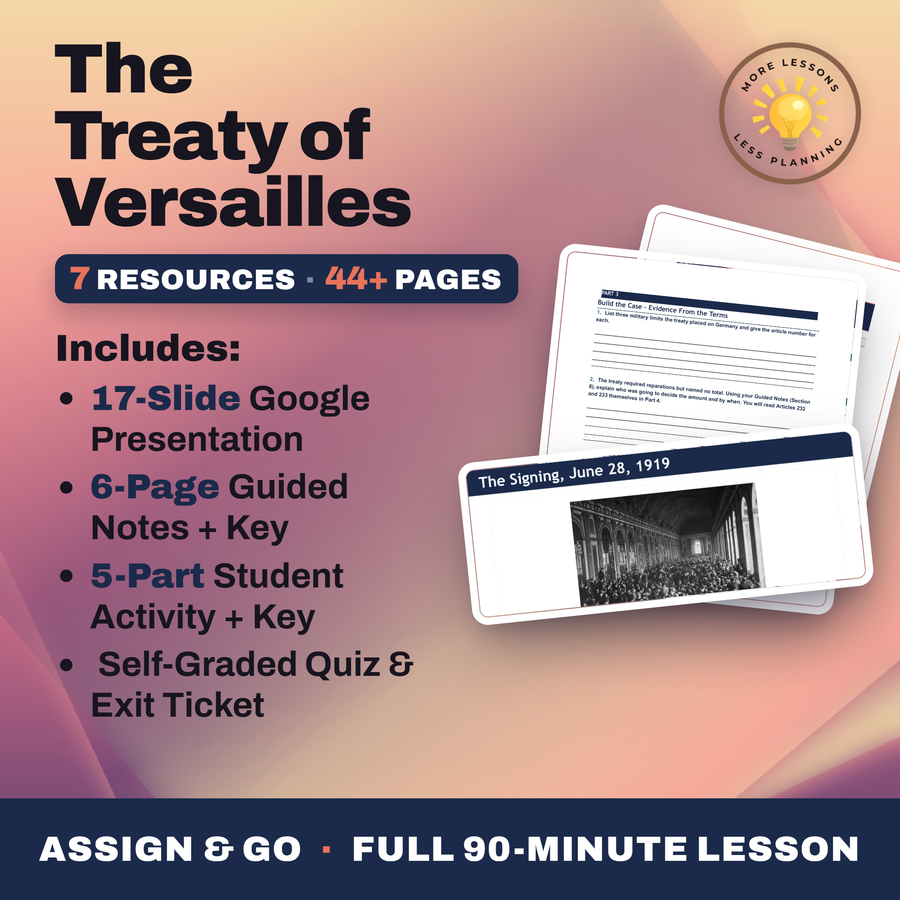
The Treaty of Versailles
- Slide deck
- Guided notes
- Guided notes teacher key
- Activity + answer key
- Quiz + answer key
- Exit ticket + answer key
- Teacher guide
- Teacher presentation notes
Where should I send the next one?
Everything here is free and it stays that way. Leave your email and I'll send you the new lessons as they go up. You can unsubscribe from any one of them.
Every file in this toolkit
Related resources
Alliances and the Causes of WWI
Rise of Totalitarianism
The Home Front
Aggression and Appeasement
Blitzkrieg and the Fall of France
Causes of the French Revolution
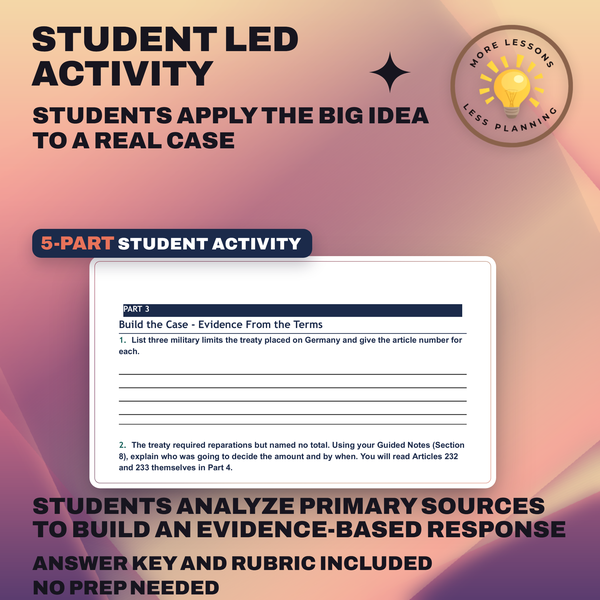
What students do
- Read the actual text of Article 231 to determine whether it says "guilt" or "responsibility"
- Analyze the territorial losses table to trace what Germany gave up in the Polish Corridor, the Saar, and Alsace-Lorraine
- Argue whether the treaty caused World War II using dated evidence from the closing debate
- Compare the treaty's silence on a reparations figure in 1919 to the 132 billion mark total set in 1921
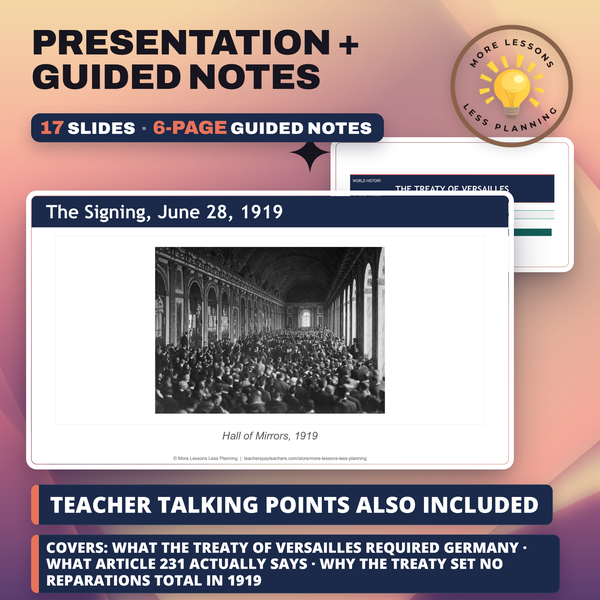
What it covers
- Why Article 231 was nicknamed the War Guilt Clause even though those words never appear in it
- The territory and military limits the treaty imposed on Germany, including the Rhineland and the 100,000-man army cap
- How the reparations total was set two years after the treaty was signed, not written into the treaty itself
Learning targets
- Explain what the Treaty of Versailles required Germany to give up.
- Describe what Article 231 actually says and what it was nicknamed.
- Explain why the treaty set no reparations total in 1919.
- Use evidence to debate whether the treaty caused the next war.
From one teacher to another
I used to teach the Treaty of Versailles as one bad decision and move on, but that wasn't fair to how complicated the decision actually was. This lesson makes students sit with the bind the peacemakers were actually in: punish the losers enough to satisfy a grieving public, but not so much that the peace collapses under its own weight. It closes out my World War I unit and hands straight into the interwar lesson on totalitarianism that follows.
Every lesson on this site is free to download and use. If one of them saved you a prep period, you can chip in a few bucks toward my three kids' daycare fund. That's genuinely where tips go.