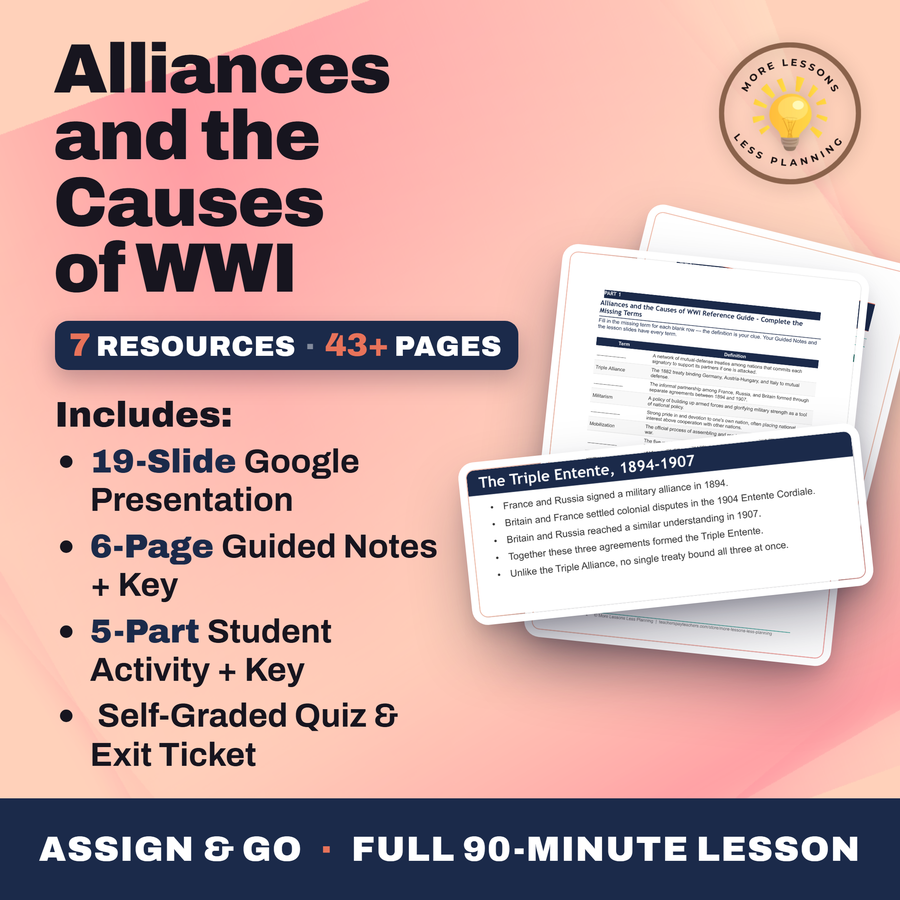
Alliances and the Causes of WWI
- Grades
- Grades 9-12
- Time
- About two 50-minute class periods
- Includes
- 11 ready-to-teach files
- Format
- Word (.docx) · PowerPoint (.pptx)
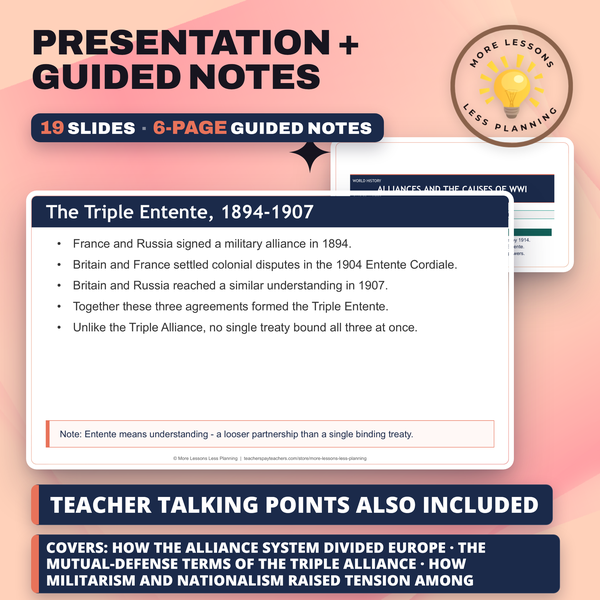
- Slide deck
- Guided notes
- Guided notes teacher key
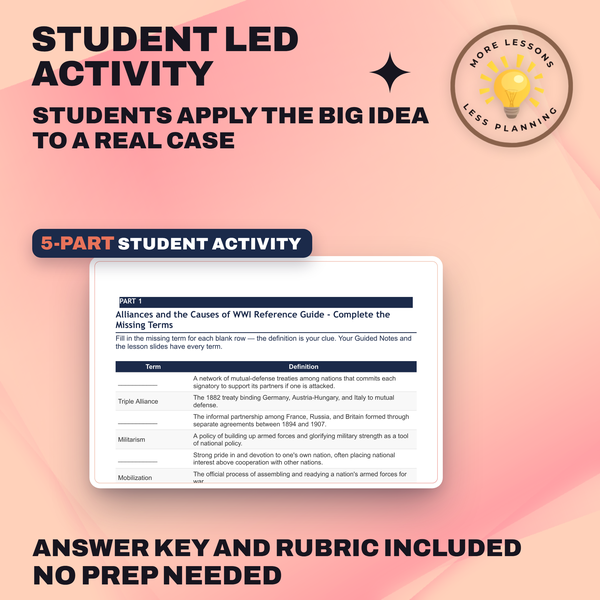
- Activity + answer key
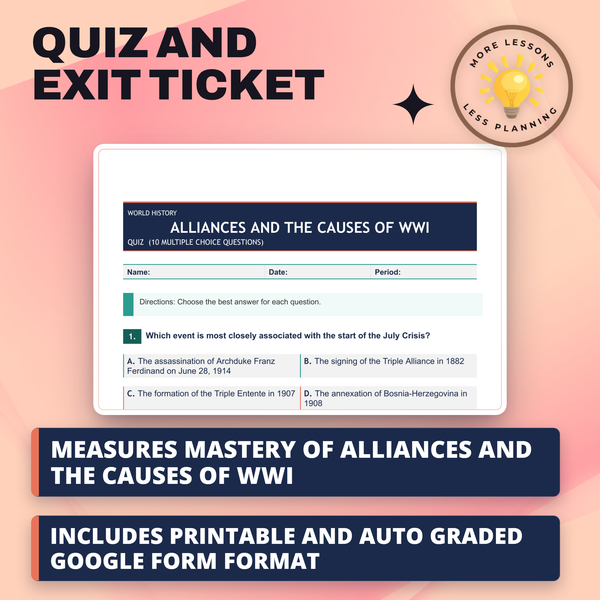
- Quiz + answer key
- Exit ticket + answer key
- Teacher guide
- Teacher presentation notes
What students do
- Explain how the alliance system divided Europe into two competing blocs by 1914
- Analyze the 1882 Triple Alliance treaty text as primary-source evidence of its mutual-defense terms
- Argue how militarism and nationalism raised tension among the great powers before 1914
- Trace the July Crisis from Franz Ferdinand's assassination to the outbreak of general war
What it covers
- The mutual-defense terms of the Triple Alliance and the Triple Entente
- How the alliance system turned a regional crisis into a continental war
- Key vocabulary including alliance system, militarism, mobilization, and the July Crisis
Learning targets
- Explain how the alliance system divided Europe into two competing blocs by 1914.
- Describe the mutual-defense terms of the Triple Alliance and the Triple Entente.
- Analyze how militarism and nationalism raised tension among the great powers.
- Explain how Franz Ferdinand's assassination triggered the July Crisis.
- Evaluate how alliances turned a regional crisis into a continental war.
Peek inside
By 1900, six major powers competed for influence across Europe.
Britain, France, Germany, Austria-Hungary, Russia, and Italy led the continent.
Each power built its economy, empire, and military to rival the others.
No single treaty bound all six powers together as one system - yet.
Smaller Balkan states had far less say over their own national affairs.
Six Rivals, One Continent
By 1900, major powers competed for influence across Europe.
Britain, France, Germany, , Russia, and Italy led the continent.
Each power built its economy, , and military to rival the others.
Smaller states had far less say over their own national affairs.
1. By 1882, Germany, Austria-Hungary, and Italy had committed to mutual defense in a network of treaties known as the .
Why this matters
Two rival blocs, bound by treaties like the 1882 Triple Alliance, had already divided Europe's great powers years before Franz Ferdinand's assassination gave the system something to react to. Reading that alliance's actual mutual-defense language shows students a promise sitting behind a war that swallowed five great powers within weeks.
Starting the unit with alliances instead of the assassination reorders the usual story on purpose, since the July Crisis only makes sense once students know which countries were obligated to back which others. By the time Franz Ferdinand comes up, the treaty language they've read explains the chain reaction better than an account of the shooting could.
From one teacher to another
Twenty-eight days sat between Franz Ferdinand's assassination on June 28, 1914, and a war that had swallowed five great powers by early August. I put the Triple Alliance treaty of 1882 itself in front of students, in its own words, so the mutual-defense promises they weigh aren't my paraphrase of them. The lesson opens the WWI unit on purpose, teaching the alliance system before the fighting starts so the July Crisis makes sense once it hits.
Every file in this toolkit
Download
Where should I send the next one?
Everything here is free and it stays that way. Leave your email and I'll send you the new lessons as they go up. You can unsubscribe from any one of them.
Related resources
America Enters the War
New Weapons of War
Rise of Totalitarianism
The Assassination at Sarajevo
The Great Depression
The Home Front
Every lesson on this site is free to download and use. If one of them saved you a prep period, you can chip in a few bucks toward my three kids' daycare fund. That's genuinely where tips go.