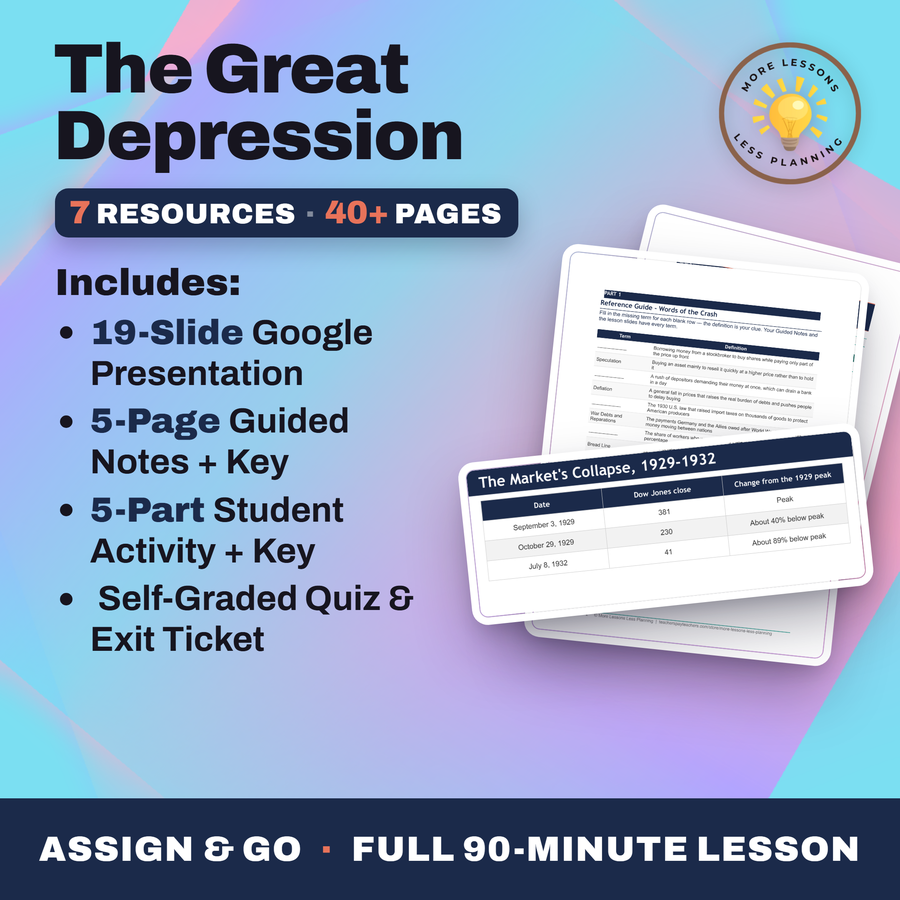

The Great Depression
Quality reviewed September 2026
- Grades
- Grades 9-12
- Time
- About two 50-minute class periods
- Includes
- 11 ready-to-teach files
- Format
- Word (.docx) · PowerPoint (.pptx)
- Slide deck
- Guided notes
- Guided notes teacher key
- Activity + answer key
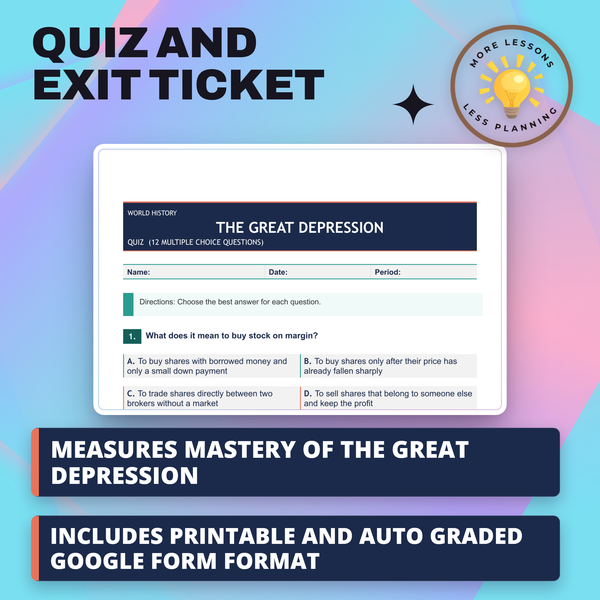
- Quiz + answer key
- Exit ticket + answer key
- Teacher guide
- Teacher presentation notes
What students do
- Trace the forced-selling loop that turned the October 1929 crash into a three-year collapse
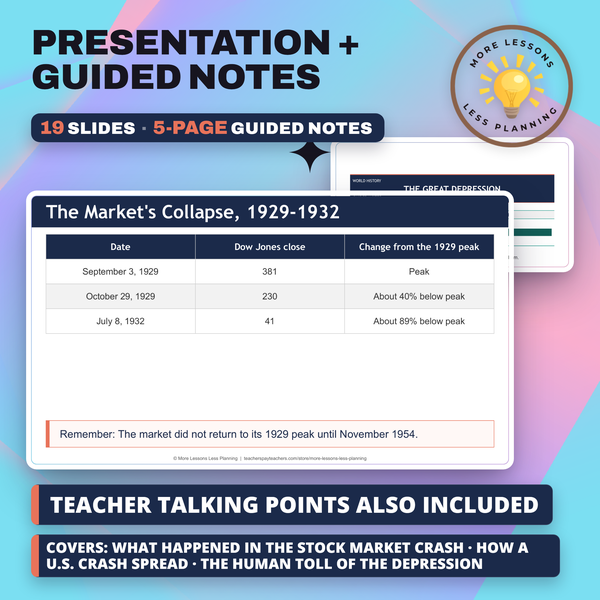
- Read the Dow's fall from 381 to 41 and compute what that actually cost a saver
- Compare unemployment in the United States, Germany, and Britain at the crisis's worst
- Analyze FDR's 1933 inaugural address as evidence of a banking system in full panic
What it covers
- Buying on margin and how a 10% down payment wiped out ordinary investors
- Bank runs, uninsured deposits, and why a healthy bank could still fail in a day
- The Dust Bowl as a second disaster layered on top of an economy already broken
- Smoot-Hawley and how a tariff meant to protect American jobs deepened the crisis worldwide
Learning targets
- Explain what happened in the stock market crash of October 1929.
- Trace how a U.S. crash spread into a worldwide economic collapse.
- Describe the human toll of the Depression on ordinary families.
- Compare unemployment in the United States, Germany, and Britain.
- Use FDR's 1933 inaugural address as evidence about the crisis.
Peek inside
The 1920s brought factory jobs, cars, radios, and rising wages.
Ordinary Americans began buying stocks for the first time.
Easy credit let people buy goods and shares before they could pay.
Stock prices rose far faster than company profits did.
By 1929 the market ran on confidence more than on earnings.
A Decade of Easy Money
Easy let people buy goods and shares before they could pay for them.
By 1929 the market ran on more than on company earnings.
1. Investors in 1928 bought stocks they never meant to keep, planning to resell them within weeks at a higher price, a practice called .
Why this matters
A tariff written to protect American jobs ended up costing many instead, once other countries answered Smoot-Hawley with tariffs of their own and world trade seized up. Unemployment at the crisis's worst sat alongside comparably brutal rates in Germany and Britain, proof a stock market crash in New York had become a problem no single country could fix alone.
The Dust Bowl gets treated as a separate disaster in most classrooms, but I teach it as a second collapse landing on top of the first, since farmers who had already lost savings to failed banks watched the land itself blow away. Layering the two keeps students from reaching for a single cause.
From one teacher to another
Half my students picture the Depression as one bad day on Wall Street, and the 230-point close on October 29, 1929 is where that idea comes from. I make them sit with the real number instead: the Dow bottomed out at 41 in July 1932, not October 1929, and nobody in the room between those two dates knew the bottom was still years away. They trace the loop themselves - margin calls forcing sales, sales forcing prices lower, lower prices forcing more margin calls - until a stock market problem becomes 9,000 failed banks and one in four American workers out of a job. By the time they reach FDR's inaugural address, "the only thing we have to fear is fear itself" reads less like a slogan and more like a diagnosis.
Every file in this toolkit
Download
Where should I send the next one?
Everything here is free and it stays that way. Leave your email and I'll send you the new lessons as they go up. You can unsubscribe from any one of them.
Related resources
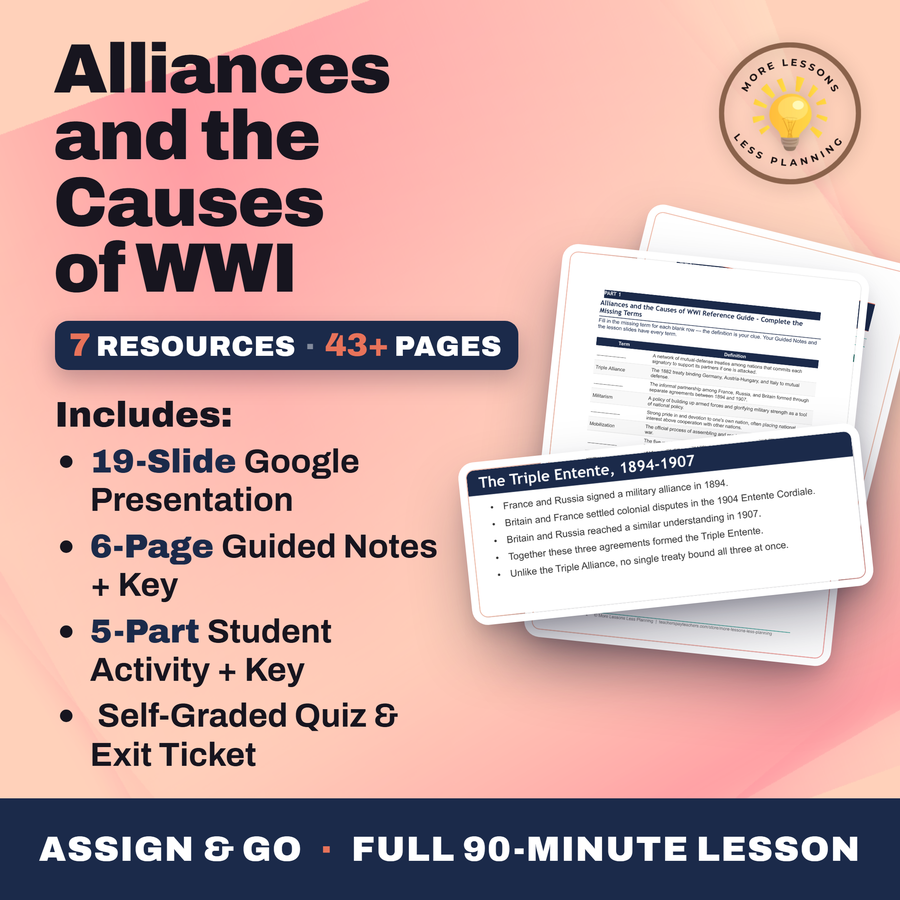
Alliances and the Causes of WWI
America Enters the War
New Weapons of War
Rise of Totalitarianism
The Assassination at Sarajevo

The Home Front
Every lesson on this site is free to download and use. If one of them saved you a prep period, you can chip in a few bucks toward my three kids' daycare fund. That's genuinely where tips go.