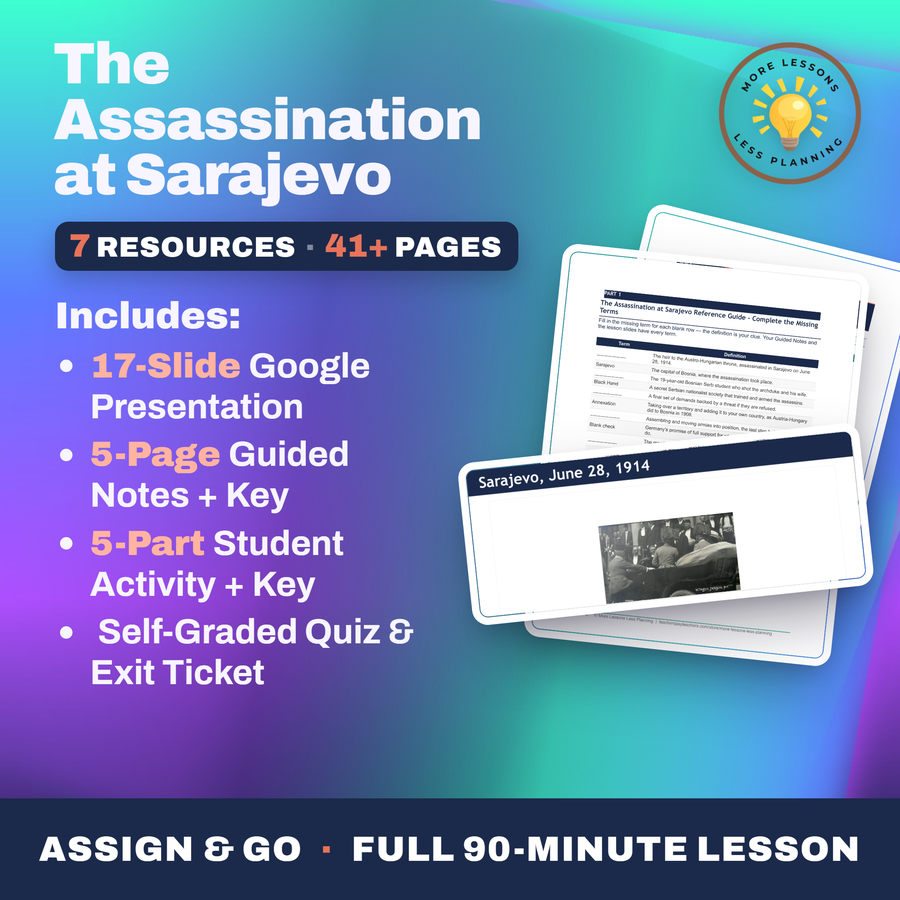

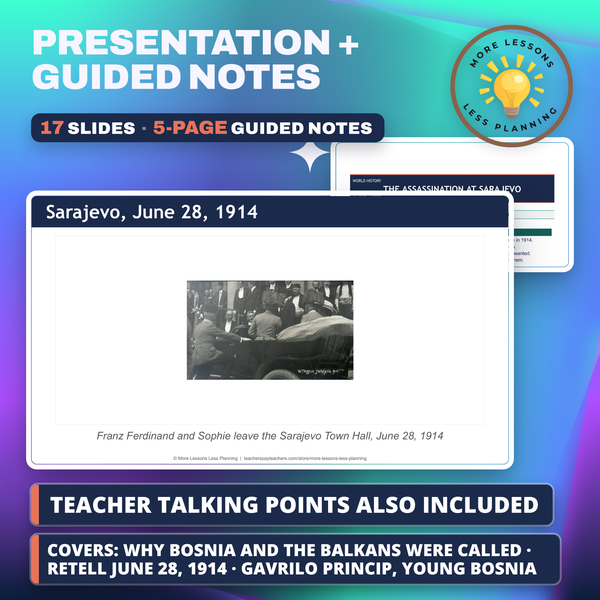
The Assassination at Sarajevo
Quality reviewed September 2026
- Grades
- Grades 9-12
- Time
- About two 50-minute class periods
- Includes
- 11 ready-to-teach files
- Format
- Word (.docx) · PowerPoint (.pptx)
- Slide deck
- Guided notes
- Guided notes teacher key
- Activity + answer key
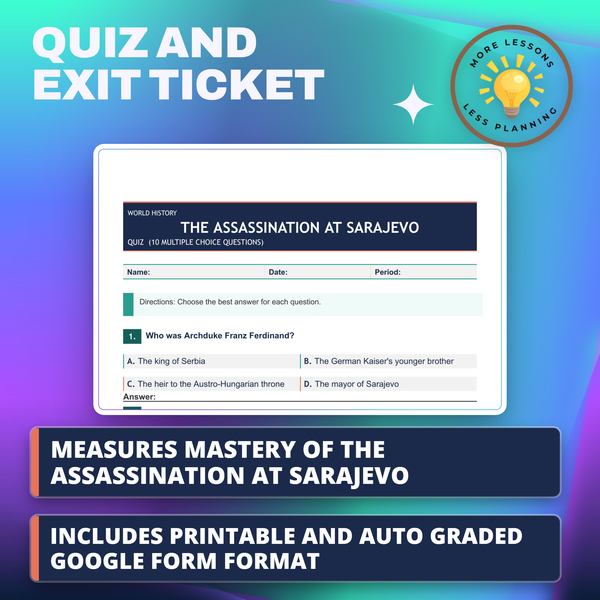
- Quiz + answer key
- Exit ticket + answer key
- Teacher guide
- Teacher presentation notes
What students do
- Reconstruct June 28, 1914, the failed bombing, the wrong turn, and the fatal shots
- Read Austria-Hungary's July 23 ultimatum and identify the demands built to be refused
- Trace how the alliance system turned mobilization orders into a continent-wide war
- Explain why Bosnia was called the powder keg of Europe before the assassination
What it covers
- Gavrilo Princip, the Black Hand, and what each wanted from the assassination
- The specific ultimatum demands that reached inside Serbia's own government and courts
- Germany's blank check, and how it changed what Austria-Hungary was willing to do
- The alliance chain of declarations and mobilizations between July 28 and August 4
Learning targets
- Explain why Bosnia and the Balkans were called the powder keg of Europe in 1914.
- Retell June 28, 1914: the failed bombing, the wrong turn, and the two shots.
- Identify Gavrilo Princip, Young Bosnia, and the Black Hand and what each wanted.
- Analyze the demands of the July 23 ultimatum and how Serbia answered them.
- Trace the July Crisis chain from the assassination to a Europe-wide war.
Peek inside
By 1914 Europe was split into two armed camps.
Triple Alliance: Germany, Austria-Hungary, and Italy.
Triple Entente: France, Russia, and Great Britain.
Militarism ruled: armies had doubled in size in a generation.
Nationalism made every border dispute feel like a matter of honor.
Two Armed Camps
Germany, Austria-Hungary, and formed the Triple Alliance.
The Triple linked France, Russia, and Great Britain.
Observers called the Balkans the keg of Europe.
Rising made every border dispute feel like a matter of honor.
1. Austria-Hungary's July 23 note gave Serbia just 48 hours to answer its demands. A final set of demands backed by a threat is called an .
Why this matters
Austria-Hungary's July 23 ultimatum to Serbia was written so its terms could not be met, which changes how the assassination reads. Gavrilo Princip and the Black Hand lit the spark in Sarajevo, but Bosnia was already the powder keg of Europe, and Germany's private promise of support let Austria-Hungary demand more than it might otherwise have risked.
The alliance chain from the July 28 declaration through the mobilization orders that followed into early August is worth tracing day by day: a war reaching five continents grew out of decisions made in under a week, not the assassination alone.
From one teacher to another
This lesson traces how one assassination in Sarajevo became a war that reached five continents, using Austria-Hungary's own July 23 ultimatum so students can see exactly how the demands were built. I have them read the document as one side's case, not a neutral record, so they can judge for themselves why historians argue Austria-Hungary expected Serbia to refuse it. From there we trace the mobilization orders and alliance declarations through early August, so the chain from two gunshots to a European war is something they've reconstructed, not just been told about. It's a serious lesson for a serious subject, and I want students able to explain the difference between the spark and the powder that was already there.
Every file in this toolkit
Download
Where should I send the next one?
Everything here is free and it stays that way. Leave your email and I'll send you the new lessons as they go up. You can unsubscribe from any one of them.
Related resources
Alliances and the Causes of WWI
America Enters the War
New Weapons of War
Rise of Totalitarianism
The Great Depression

The Home Front
Every lesson on this site is free to download and use. If one of them saved you a prep period, you can chip in a few bucks toward my three kids' daycare fund. That's genuinely where tips go.