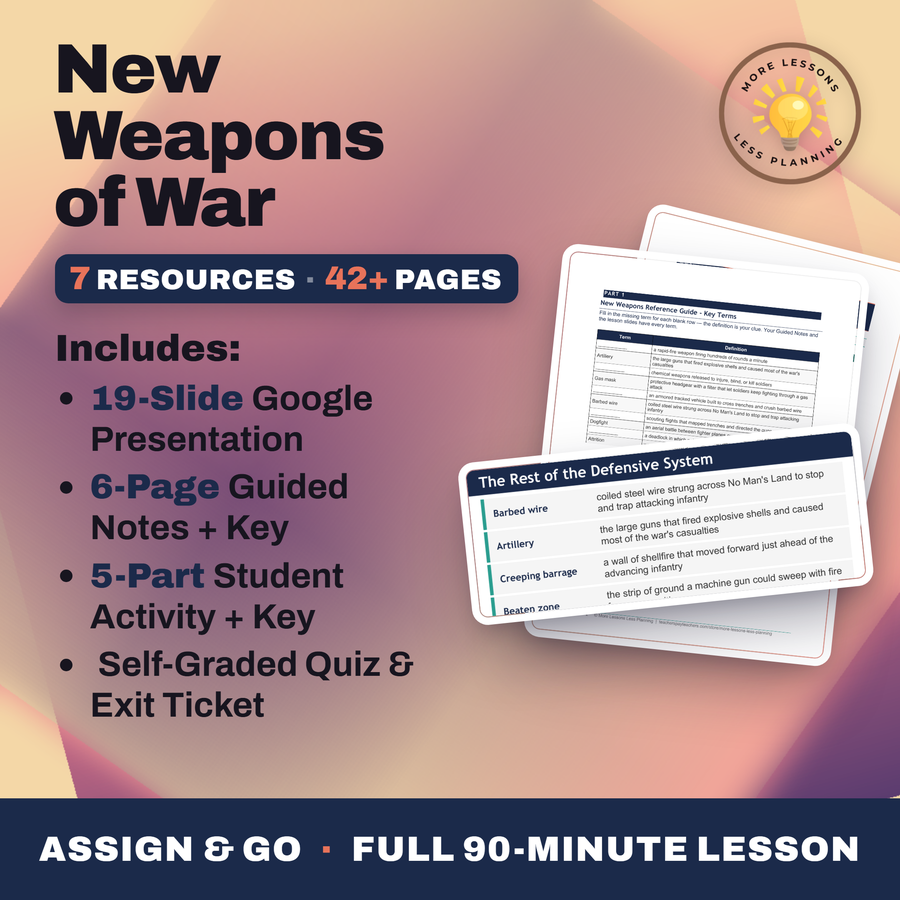

New Weapons of War
Quality reviewed September 2026
- Grades
- Grades 9-12
- Time
- About two 50-minute class periods
- Includes
- 11 ready-to-teach files
- Format
- Word (.docx) · PowerPoint (.pptx)
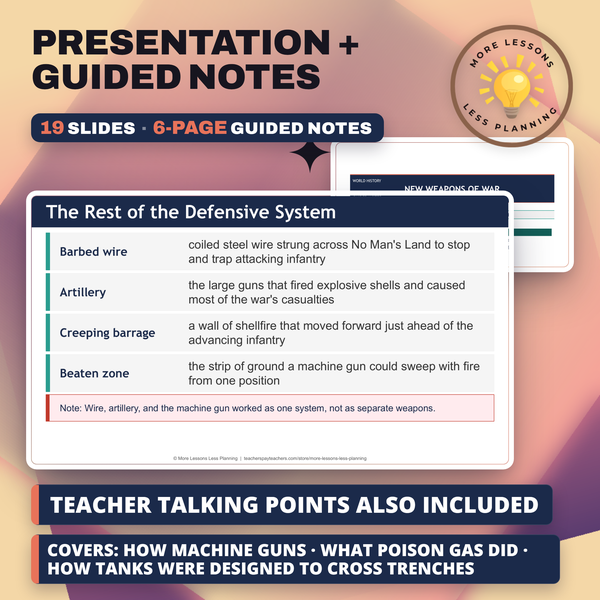
- Slide deck
- Guided notes
- Guided notes teacher key
- Activity + answer key
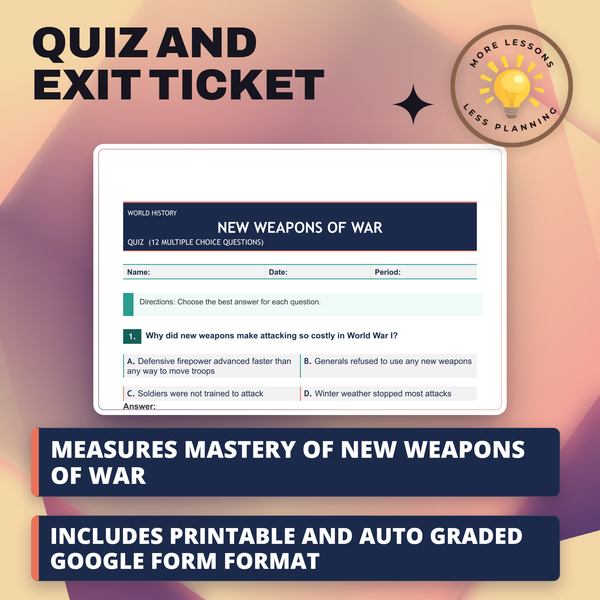
- Quiz + answer key
- Exit ticket + answer key
- Teacher guide
- Teacher presentation notes
What students do
- Explain how the machine gun and barbed wire created the trench stalemate while poison gas never won a lasting breakthrough
- Source a November 1918 Scientific American article on tanks, written nine days before the war ended
- Read a casualty table showing artillery caused about 60% of wounds and gas only 2-3%
- Write a museum memo defending one weapon as the centerpiece of a WWI technology gallery
What it covers
- Machine gun rates of fire, the beaten zone, and how one crew could stop a company
- Chlorine, phosgene, and mustard gas, and why gas masks and drill cancelled out the threat
- The tank's rhomboid shape and tracks, from Flers-Courcelette in 1916 to Cambrai in 1917
- Reconnaissance aircraft and dogfights, and why planes mattered more for their cameras than their guns
Learning targets
- Explain how machine guns and barbed wire created the trench stalemate
- Describe what poison gas did and why it never won a lasting breakthrough
- Explain how tanks were designed to cross trenches and crush wire
- Describe how aircraft changed what commanders could see
- Use a 1918 technical article as evidence about new weapons
Peek inside
New Weapons, Old Tactics
Armies in 1914 carried weapons but still used older tactics.
Defensive advanced faster than any way to move troops across open ground.
- a deadlock in which neither side can advance or win.
- wearing the enemy down through steady losses, not one breakthrough.
1. The large guns that fired explosive shells, called , caused the largest share of battle casualties.
Why this matters
Poison gas is the weapon this war is remembered for, yet the casualty table here credits it with only 2-3% of WWI wounds against roughly 60% from artillery. Memory and evidence pulling apart is the real subject. A Scientific American article from November 2, 1918, written nine days before the war ended, still treats the tank as a promising experiment, not history's verdict.
Ranking machine guns, gas, tanks, and aircraft against each other forces students to weigh a rate of fire against a casualty percentage instead of picking whichever weapon sounds most dramatic. My students almost always start certain gas was deadliest, and the casualty table is what changes their minds.
From one teacher to another
Poison gas is the weapon students remember best from every documentary, so the casualty table showing it caused only 2-3% of WWI battle wounds genuinely shocks them, and this lesson is built around that gap between memory and evidence. I pair the casualty table with a real Scientific American article from November 2, 1918, written while nobody yet knew the war would end nine days later. Students work through the machine gun's beaten zone, the three chemical weapons and why gas masks made them survivable, and the tank's whole design logic before I ask them to defend one weapon as the centerpiece of a museum gallery using evidence from both the notes and the primary source.
Every file in this toolkit
Download
Where should I send the next one?
Everything here is free and it stays that way. Leave your email and I'll send you the new lessons as they go up. You can unsubscribe from any one of them.
Related resources
Alliances and the Causes of WWI
America Enters the War
Rise of Totalitarianism
The Assassination at Sarajevo
The Great Depression

The Home Front
Every lesson on this site is free to download and use. If one of them saved you a prep period, you can chip in a few bucks toward my three kids' daycare fund. That's genuinely where tips go.