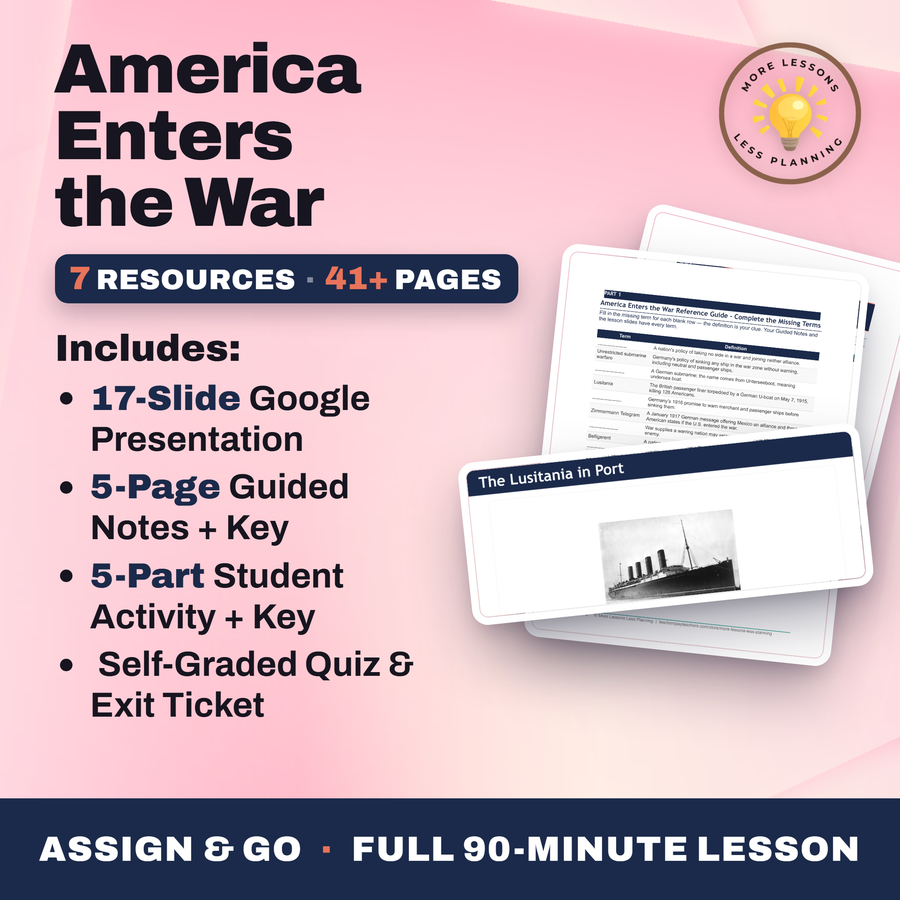
America Enters the War
Quality reviewed September 2026
- Grades
- Grades 9-12
- Time
- About two 50-minute class periods
- Includes
- 11 ready-to-teach files
- Format
- Word (.docx) · PowerPoint (.pptx)
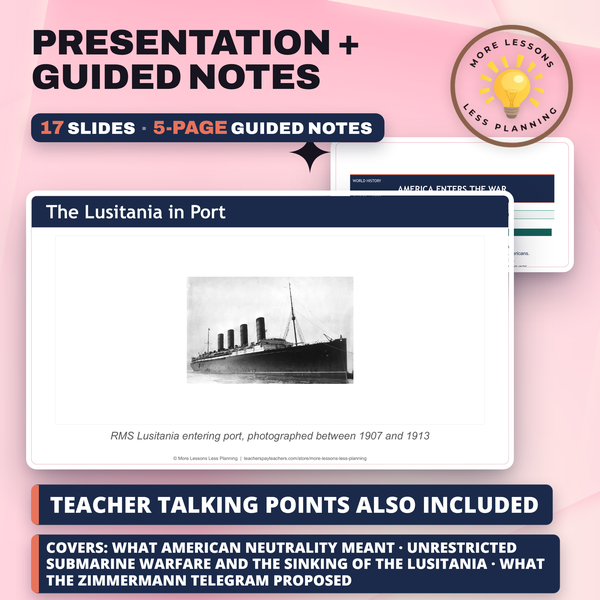
- Slide deck
- Guided notes
- Guided notes teacher key
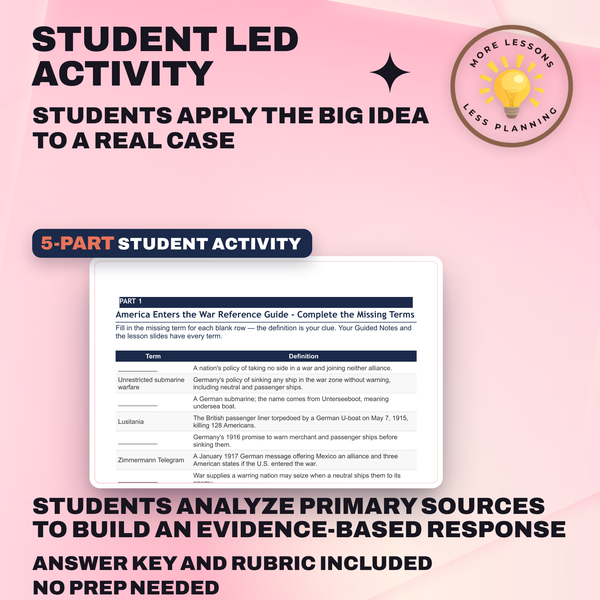
- Activity + answer key
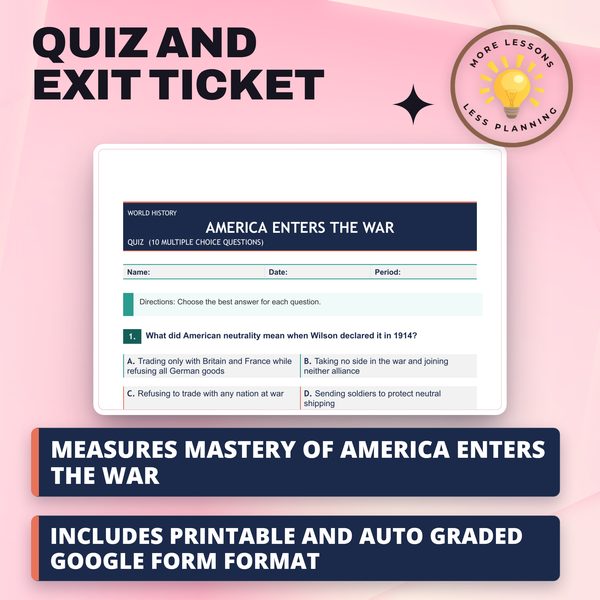
- Quiz + answer key
- Exit ticket + answer key
- Teacher guide
- Teacher presentation notes
What students do
- Trace the path from American neutrality in 1914 to the declaration of war in April 1917, including the Lusitania and the Sussex Pledge
- Read the Zimmermann Telegram's proposal of a German-Mexican alliance and explain why it moved the war to America's own border
- Compare America's roughly $3.2 billion in Allied trade and $2.3 billion in Allied loans against its almost nonexistent economic ties to Germany
- Read Wilson's own war message and identify the three moves of his argument before writing a verdict on which cause weighed most
What it covers
- The erosion of neutrality from the 1915 Lusitania sinking through the 1916 Sussex Pledge to Germany's January 1917 return to unrestricted submarine warfare
- The Zimmermann Telegram and what it offered Mexico in exchange for entering the war
- The trade and loan figures that tied the American economy to an Allied victory
- Wilson's April 2, 1917 address to Congress, read as an argument in three parts rather than a simple announcement
Learning targets
- Explain what American neutrality meant and why it was hard to keep.
- Describe unrestricted submarine warfare and the sinking of the Lusitania.
- Explain what the Zimmermann Telegram proposed and why it alarmed Americans.
- Describe how American trade and loans tied the United States to the Allies.
- Analyze Wilson's April 1917 war message and what U.S. entry meant for the war.
Peek inside
In August 1914 President Wilson declared American neutrality.
Neutrality means taking no side and joining neither alliance.
Wilson urged Americans to stay impartial in thought and action.
Millions of German and Irish Americans opposed helping Britain.
But American factories and banks kept trading across the Atlantic.
What Staying Out Meant on Paper
American was declared by President Wilson in August 1914.
Neutrality means taking no and joining neither alliance.
Wilson urged Americans to stay in thought and action.
American factories and kept trading across the Atlantic.
1. In August 1914 the United States announced it would take no side in the war and join neither alliance. That policy was called .
Why this matters
Roughly $3.2 billion in wartime trade with the Allies, against next to nothing with Germany, meant the United States was never as neutral as 1914 pretended. The Zimmermann Telegram made that tilt personal, offering Germany's support to Mexico for entering the war, moving the conflict to a message about America's own border.
Reading Wilson's April 2, 1917 address as an argument means separating what he says happened at sea from what he says the war is actually for. The goal is an argument over which cause weighed most, using the trade figures and the telegram as evidence, not the reason that came first.
From one teacher to another
I built this one around the question my students always get wrong on the first guess: why didn't the U.S. just jump into World War I when it started in 1914. The answer takes three years to build, so that's what the lesson does. Students track neutrality eroding step by step - the Lusitania, the Sussex Pledge, the trade and loan numbers that quietly tied the American economy to an Allied win - before Germany's return to unrestricted submarine warfare and the Zimmermann Telegram close it out. The primary source is Wilson's own war message, and I have students read it as an argument, not a speech: the facts at sea, why armed neutrality stopped working, and what he says the war is actually for. The activity ends with a verdict - which cause mattered most, and whether "safe for democracy" was Wilson's real reason or the reason he gave out loud. Guided notes, quiz, exit ticket, and a teacher guide all come with answer keys.
Every file in this toolkit
Download
Where should I send the next one?
Everything here is free and it stays that way. Leave your email and I'll send you the new lessons as they go up. You can unsubscribe from any one of them.
Related resources
Alliances and the Causes of WWI
New Weapons of War
Rise of Totalitarianism
The Assassination at Sarajevo
The Great Depression
The Home Front
Every lesson on this site is free to download and use. If one of them saved you a prep period, you can chip in a few bucks toward my three kids' daycare fund. That's genuinely where tips go.