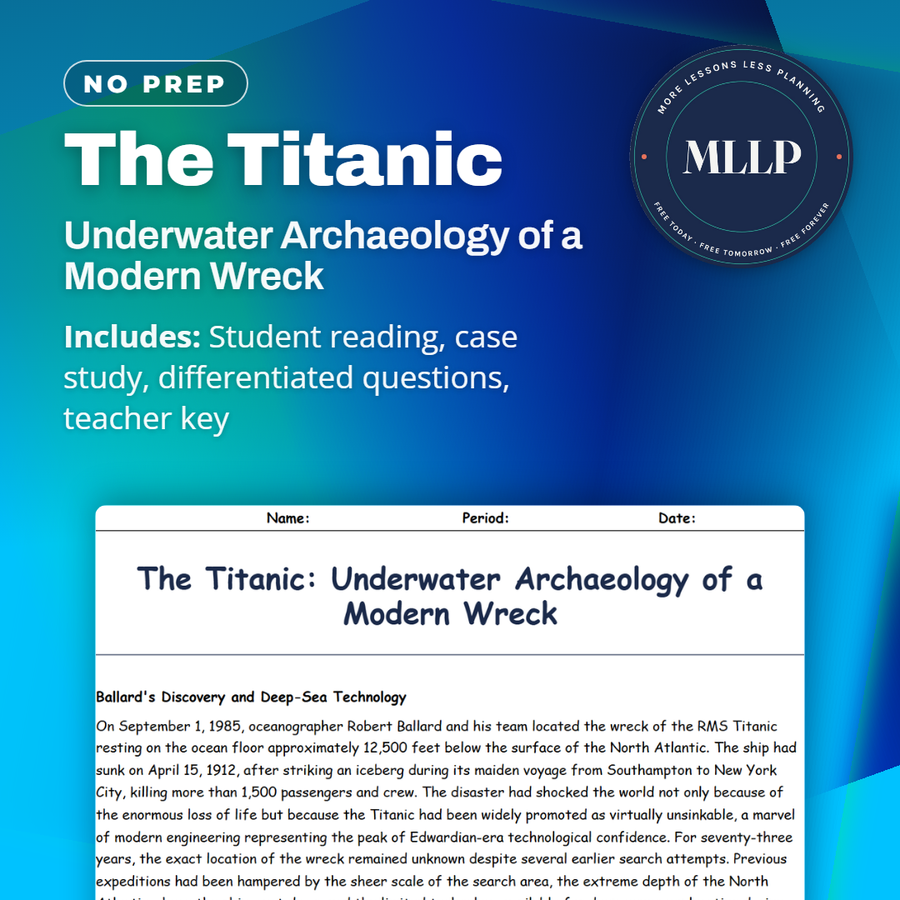
The Titanic: Underwater Archaeology of a Modern Wreck
Quality reviewed September 2026
Facts verified September 21, 2026
- Subject
- Social Studies
- Grades
- Grades 9-12
- Length
- 9-page student worksheet
- Time
- About one 50-minute class period
- Great for
- Sub plans and independent work
- Includes
- Reading passage, comprehension questions + full answer key
- Format
- Print-and-go PDF
What students do
- Recommend salvage conditions as expert witness Dr. Elena Vasquez, weighing $30 million in conservation costs against lost archaeological context
- Three short-answer questions ask how Robert Ballard's team located the Titanic in 1985 by searching for its debris field instead of the hull
- Match five terms, including ROV and rusticles, to their correct definitions
- Consider how iron-eating bacteria called Halomonas titanicae are dissolving the wreck's steel hull year by year
What it covers
- The salvage-versus-preservation legal fight over more than 5,000 artifacts recovered from the wreck
- How Halomonas titanicae bacteria are consuming the Titanic's steel hull faster each year
- Dr. Elena Vasquez's expert-witness case study over a sealed bag of passenger letters
Start reading this worksheet
Ballard's Discovery and Deep-Sea Technology
On September 1, 1985, oceanographer Robert Ballard and his team located the wreck of the RMS Titanic resting on the ocean floor approximately 12,500 feet below the surface of the North Atlantic. The ship had sunk on April 15, 1912, after striking an iceberg during its maiden voyage from Southampton to New York City, killing more than 1,500 passengers and crew. The disaster had shocked the world not only because of the enormous loss of life but because the Titanic had been widely promoted as virtually unsinkable, a marvel of modern engineering representing the peak of Edwardian-era technological confidence. For seventy-three years, the exact location of the wreck remained unknown despite several earlier search attempts. Previous expeditions had been hampered by the sheer scale of the search area, the extreme depth of the North Atlantic where the ship went down, and the limited technology available for deep-ocean exploration during much of the twentieth century. Ballard's expedition was secretly co-funded by the United States Navy, which wanted him to first survey two nuclear submarine wrecks lost during the Cold War. After completing those classified surveys, Ballard used the remaining time to hunt for the Titanic. His success was made possible by a new deep-sea technology: the Argo, a remotely operated vehicle, or ROV, equipped with cameras that could be towed near the ocean floor and transmit live video to the surface. The Argo allowed researchers to survey vast stretches of seafloor without risking human lives in manned submersibles at crushing depths. Rather than searching for the hull directly, Ballard's team used the Argo to scan for the debris field, the trail of objects scattered across the seafloor as the ship sank. This strategy proved decisive when the team spotted one of the Titanic's massive boilers on their camera feeds. Subsequent dives using the manned submersible Alvin and its small ROV companion Jason Junior allowed researchers to photograph the wreck in extraordinary detail. Jason Junior was small enough to navigate through the ship's interior corridors, capturing haunting images of chandeliers still hanging from ceilings and staircase railings encrusted with marine growth. The images revealed that the Titanic had broken into two main sections during its descent, with the bow and stern resting roughly two thousand feet apart, connected by a vast debris field of personal belongings, coal, and ship components. The technology developed during the Titanic expeditions, particularly the use of ROVs for deep-sea exploration, went on to transform marine archaeology, ocean science, and even military and industrial deep-water operations.
The Salvage vs. Preservation Debate
Almost immediately after the Titanic's discovery, a fierce legal and ethical debate erupted over whether artifacts should be recovered from the wreck site. In 1987, a company called Titanic Ventures (later reorganized as RMS Titanic, Inc.) began salvage operations, eventually recovering more than five thousand artifacts from the debris field including jewelry, personal belongings, ship fittings, and even a seventeen-ton section of the hull known as the Big Piece, which required specialized lifting equipment and years of conservation treatment after being raised to the surface. The company argued that recovering and conserving these objects preserved history by allowing millions of people to see them in traveling exhibitions and museums. They pointed out that leaving artifacts on the ocean floor meant condemning them to slow destruction by salt water, bacteria, and deep-sea currents, and that bringing them to the surface was the only way to ensure their long-term survival for future generations. Many archaeologists, historians, and survivors' families strongly disagreed. They argued that the wreck site was essentially a graveyard where more than 1,500 people died and that removing artifacts for commercial profit was disrespectful to their memory. Descendants of victims expressed particular outrage at the idea that personal items belonging to their relatives, including letters, clothing, and keepsakes, were being recovered and displayed as exhibition pieces for paying audiences. From an archaeological perspective, critics pointed out that salvage operations often prioritized visually impressive or commercially valuable objects while ignoring or destroying the contextual information that gives artifacts their scientific meaning. When a gold pocket watch is pulled from the seafloor without carefully recording its exact position relative to other objects, the structural remains, and the surrounding sediment, crucial information about the ship's final moments and the experiences of its passengers is permanently lost. The position of personal items relative to the ship's structure, for example, can reveal how passengers moved through the vessel during its final hours and which escape routes were accessible or blocked. Robert Ballard himself became one of the most outspoken critics of the salvage operations, arguing that the Titanic should be treated as a protected underwater museum rather than a source of collectible relics. This debate helped shape international discussions about the legal status of historic shipwrecks and who has the right to excavate or profit from underwater cultural heritage. In 2012, the Titanic wreck site received additional legal protection when UNESCO recognized it under the Convention on the Protection of the Underwater Cultural Heritage, reinforcing the principle that historic wrecks deserve the same careful treatment as archaeological sites on land.
Like what you read? The full reading, the case study, and every question set are in the free download below, along with the answer key.
Why this matters
The salvage debate around the Titanic gives students a genuine disagreement between two positions that both sound reasonable, recovering objects lets millions of people see them in museums, while leaving them in place respects a site where more than 1,500 people died and preserves the context that makes an object scientifically useful rather than just a curiosity. Dr. Vasquez's case study asks students to actually propose a middle position instead of picking a side and moving on, which is closer to how these decisions get made in real courtrooms. The bacteria eating away at the hull adds urgency to all of it, since the wreck itself is not going to wait around while people argue about who has the right to it.
From one teacher to another
Robert Ballard found the Titanic in 1985 using an ROV called Argo, a strategy built on searching for the ship's scattered debris field rather than hunting for the hull directly, and this reading tracks the site from that discovery through the legal fight that followed. Titanic Ventures began recovering artifacts in 1987, eventually raising more than 5,000 objects including a seventeen-ton section of hull, while critics like Ballard himself argued the wreck was a grave site being stripped for profit rather than studied. A case study puts students in the position of marine archaeologist Dr. Elena Vasquez, an expert witness asked to recommend conditions under which a company could recover a sealed bag of passenger letters before they deteriorate further. The last passage covers the wreck's physical decline, driven by iron-eating bacteria called Halomonas titanicae that are slowly converting the hull's steel into crumbling rust, a process serious enough that researchers now race to build complete 3D scans before sections of the ship collapse for good.
What you get
Download
Where should I send the next one?
Everything here is free and it stays that way. Leave your email and I'll send you the new lessons as they go up. You can unsubscribe from any one of them.
Related resources
Angkor Wat: The Jungle Temple Complex
Doggerland: The Lost Land Beneath the North Sea
Lost Cities & Underwater Archaeology: An Overview
Machu Picchu to Gobekli Tepe: Sites That Rewrote the Textbooks
Petra: The Rose-Red City Carved in Stone
Pompeii and Herculaneum Revisited: New Discoveries Still Emerging
Every lesson on this site is free to download and use. If one of them saved you a prep period, you can chip in a few bucks toward my three kids' daycare fund. That's genuinely where tips go.