The Ticketmaster Monopoly Investigation
Quality reviewed September 2026
- Grades
- Grades 9-12
- Time
- About two 50-minute class periods
- Includes
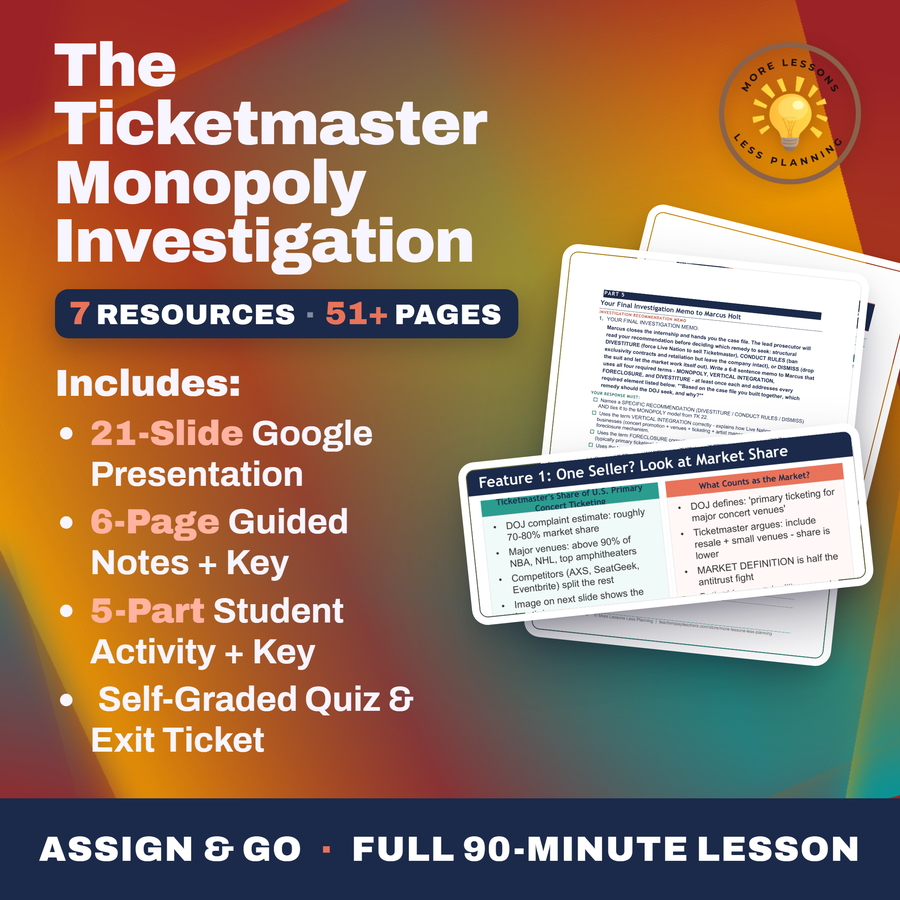
- 11 ready-to-teach files
- Format
- Word (.docx) · PowerPoint (.pptx)
- Slide deck
- Guided notes
- Guided notes teacher key
- Activity + answer key
- Quiz + answer key
- Exit ticket + answer key
- Teacher guide
- Teacher presentation notes
What students do
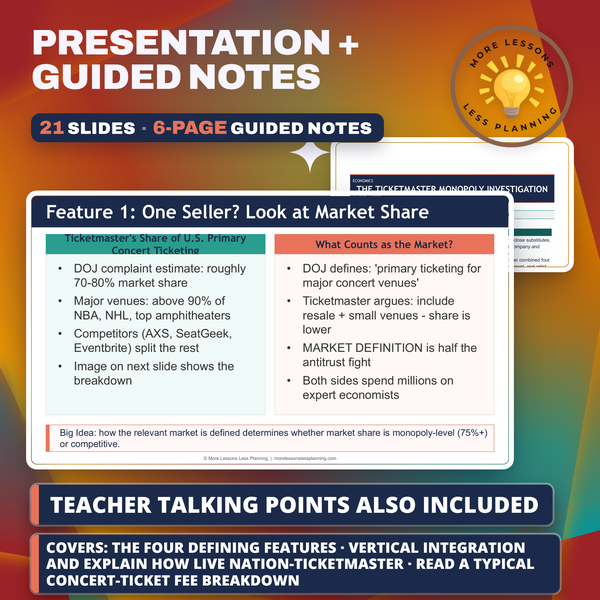
- Apply the four features of monopoly to Live Nation-Ticketmaster's roughly 75% share of primary concert ticketing
- Read a $100 ticket's fee breakdown chart and compute the markup, then read a vertical-integration market-share chart
- Work four scenarios - a tying allegation, a startup's barriers to entry, divestiture's effects, and the 2022 Eras Tour meltdown
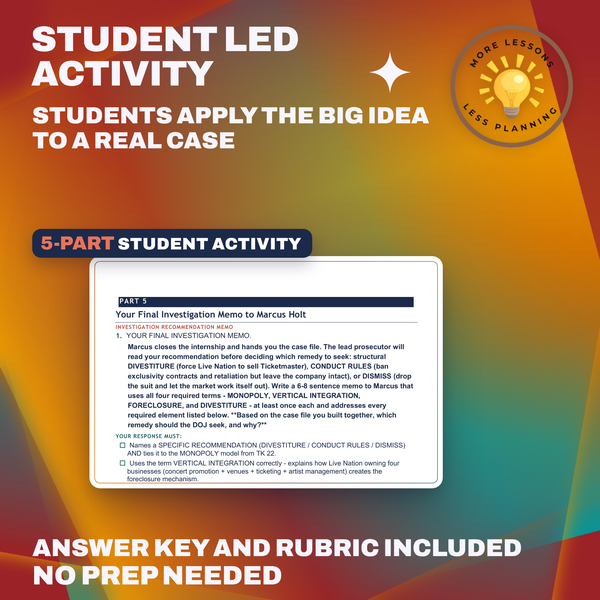
- Write a Final Investigation Memo to a DOJ supervisor recommending divestiture, conduct rules, or dismissal, citing real numbers
What it covers
- How Live Nation's four connected businesses - promotion, venues, ticketing, artist management - create vertical integration
- The real 2024 DOJ antitrust suit under the Sherman Act, and the 2010 consent decree the DOJ says was violated
- Tying and foreclosure as the specific anticompetitive practices alleged, including venue exclusivity contracts
- How to read a $135-total-cost ticket fee chart and a market-share chart as actual case evidence, not made-up numbers
Learning targets
- Apply the four defining features of MONOPOLY from TK 22 (one seller, no close substitutes, high barriers to entry, price-maker firm) to the real Live Nation-Ticketmaster company and explain which features the DOJ argued were present in the 2024 antitrust suit
- Define VERTICAL INTEGRATION and explain how Live Nation-Ticketmaster combined four separate businesses (ticketing, concert promotion, venue ownership/management, and artist management) under one roof - and why the DOJ argued that combination foreclosed competition
- Read a typical concert-ticket fee breakdown and a Ticketmaster market-share chart to extract real numbers, then write a Final Investigation Memo recommending REMEDY (breakup, conduct restrictions, leave alone) and citing specific evidence from the case
Peek inside
The 2024 DOJ Suit (Quick Facts)
FILED: May 23, 2024 - Southern District of New York
WHO SUED: U.S. DOJ + 30 state attorneys general
TARGET: Live Nation Entertainment (parent of Ticketmaster)
CHARGE: Monopolization under Sherman Act Section 2
The 2024 DOJ Suit - Quick Facts
The DOJ filed the suit on May 23, (year).
The U.S. DOJ + state attorneys general sued.
The target was Live Nation Entertainment, parent of .
The charge was monopolization under Sherman Act Section .
The Backstory
1. Marcus opens the case file with the core charge. A market structure with ONE dominant seller, no close substitutes for the product, and high barriers that keep new firms out - the structure the DOJ accuses Live Nation-Ticketmaster of holding - is called a .
Why this matters
A concert ticket listed at $100 turning into $135 by checkout is the fee breakdown behind the 2024 DOJ lawsuit against Live Nation-Ticketmaster, not invented for class. A company can control roughly three-quarters of a market, own the promotion, venues, ticketing, and artist management at once, and still not be automatically illegal.
Most students assume a monopoly needs total market control, so watching the DOJ build a case around a 75 percent share and connected businesses resets that fast. I grade the closing memo on whether they defend the side they didn't pick, since arguing Live Nation's side of the 2022 Eras Tour meltdown beats repeating the popular opinion.
From one teacher to another
This one takes the monopoly model students already learned and drops them into the actual 2024 DOJ lawsuit against Live Nation-Ticketmaster, working the case the way an intern in the Antitrust Division would. Students apply all four features of monopoly to a real company that doesn't even hold 100% of any single market, then see how owning four connected businesses, concert promotion, venues, ticketing, and artist management, lets vertical integration do the work that market share alone can't. The chart work is where it gets concrete: they read an actual $100-ticket fee breakdown that totals $135 at checkout and have to identify which single fee is the clearest evidence of pricing power, then work through a market-share chart showing Ticketmaster at roughly 75%. From there they run four real scenarios, including a tying allegation at a hypothetical Texas venue and a steel-man argument for Live Nation's side of the 2022 Eras Tour meltdown, because I want them defending the side they didn't pick before they write their own verdict. The closing memo asks for a specific recommendation, divestiture, conduct rules, or dismissal, and I grade it on whether they use the vocabulary correctly and cite real numbers, not on which remedy they choose.
Every file in this toolkit
-
Activity (Student)
Marcus Holt's investigation has students read Ticketmaster's 75 percent market share, break down a $100 ticket's climb to $135 at checkout, then argue both sides of the Eras Tour ticket meltdown before picking one specific remedy to bring to a DOJ supervisor.
-
Activity (Answer Key)
Numbers in this key put Ticketmaster's share at 75 percent against AXS's 10 percent, the $100 ticket's $35 in fees at a 35 percent markup, and Live Nation's four businesses running 70, 60, 75, and 35 percent shares before naming the recommended remedy.
-
Exit Ticket (Student)
Short questions summarize why the DOJ sued Live Nation-Ticketmaster in 2024, calculate the typical total fees on a $100 face-value ticket, and separate what tying and foreclosure each describe. Three required terms and one specific number from the case round out the answer.
-
Exit Ticket (Answer Key)
Using vertical integration to block rival ticketing platforms is the DOJ's theory, about $35 is the typical fee total on a $100 ticket, and tying a second product on buyers differs from foreclosure blocking competitors outright. Three terms, a clear position, and one lesson number need to show up.
-
Guided Notes (Student)
Four monopoly features get applied to a company controlling roughly 75 percent of primary ticketing, then a $100 face-value ticket gets traced through its fees, a $24 service charge among them, until the total paid reaches $135.
-
Guided Notes (Teacher Key)
The case gets dated, filed May 23, 2024 by federal and state authorities together, then two allegations get named, tying and foreclosure, and the notes show a 2010 consent decree extended five years after repeated violations before a structural remedy got signaled.
-
Quiz (Student)
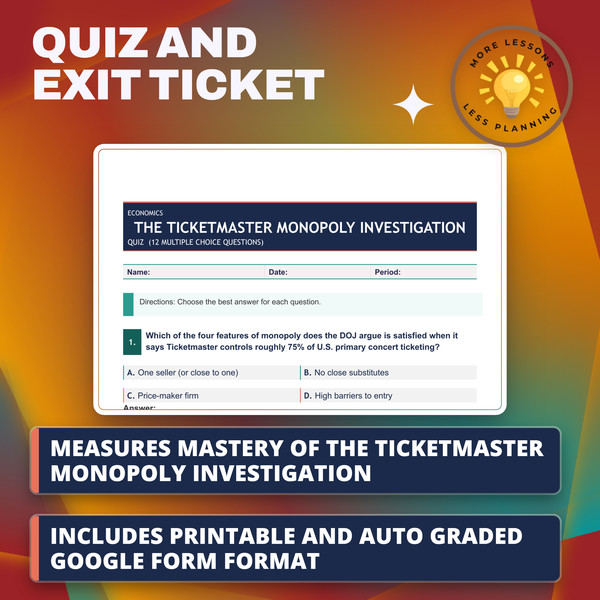
Fees stacked on a $100 ticket set up chart items on vertical integration, tying, and foreclosure, while others name the statute behind the 2024 suit and what a 2010 consent decree required.
-
Quiz (Answer Key)
One seller controls a 75 percent ticketing share, the feature the DOJ leans on most, venue exclusivity contracts get marked as what locks out rivals, and divestiture stands as the remedy the DOJ is reportedly seeking.
-
Slides
A $100 ticket becoming $135 at checkout gets its own chart before Live Nation's four businesses stack up, 70% of touring, 60% of amphitheaters, and 75% of ticketing, and the tying and foreclosure allegations lead toward a divestiture recommendation.
-
Teacher Guide
Reading the actual DOJ complaint replaces a summary in one extension, sending students hunting for two specific allegations to quote from the May 2024 filing. A later discussion asks whether primary concert ticketing is the right market definition or one drawn too narrow.
-
Teacher Presentation Notes
A 2010 consent decree resurfaces as the case's central failure, revisited right before the DOJ's 2019 finding that Live Nation had already broken its terms. A follow-up slide ties the November 2022 meltdown straight to the Congressional hearings it triggered.
Download
Where should I send the next one?
Everything here is free and it stays that way. Leave your email and I'll send you the new lessons as they go up. You can unsubscribe from any one of them.
Related resources
Big Tech Antitrust - Google Apple Amazon Meta
Cartels and Collusion - How OPEC Controls Oil
Monopolistic Competition: Brand Wars
Monopoly: One Seller, All the Power
Oligopoly - When a Few Dominate
Perfect Competition: The Theoretical Ideal
Every lesson on this site is free to download and use. If one of them saved you a prep period, you can chip in a few bucks toward my three kids' daycare fund. That's genuinely where tips go.