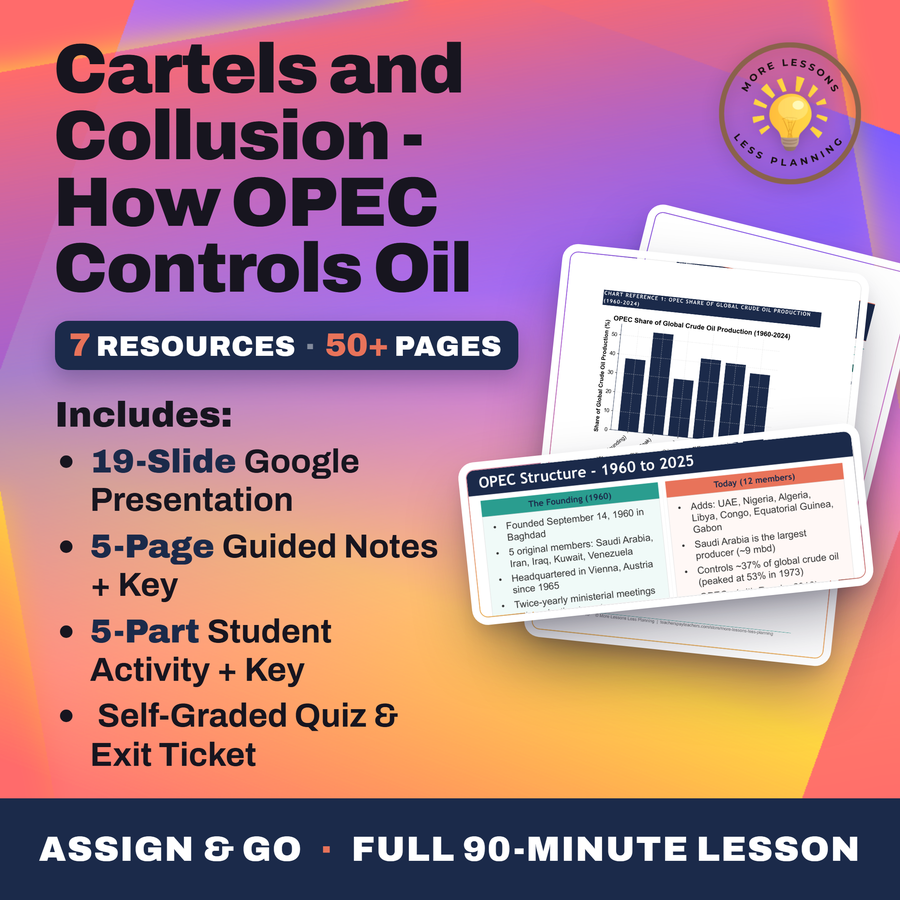
Cartels and Collusion - How OPEC Controls Oil
Quality reviewed September 2026
- Grades
- Grades 9-12
- Time
- About two 50-minute class periods
- Includes
- 11 ready-to-teach files
- Format
- Word (.docx) · PowerPoint (.pptx)
- Slide deck
- Guided notes
- Guided notes teacher key
- Activity + answer key
- Quiz + answer key
- Exit ticket + answer key
- Teacher guide
- Teacher presentation notes
What students do
- Identify what makes a cartel a cartel and place OPEC's size, headquarters, and market share inside that definition
- Explain why cartels are inherently unstable, using the swing producer's role in holding OPEC together
- Trace three real breaks in OPEC discipline, the 1985 Saudi flood, the 2014 shale price war, and the 2020 COVID cut
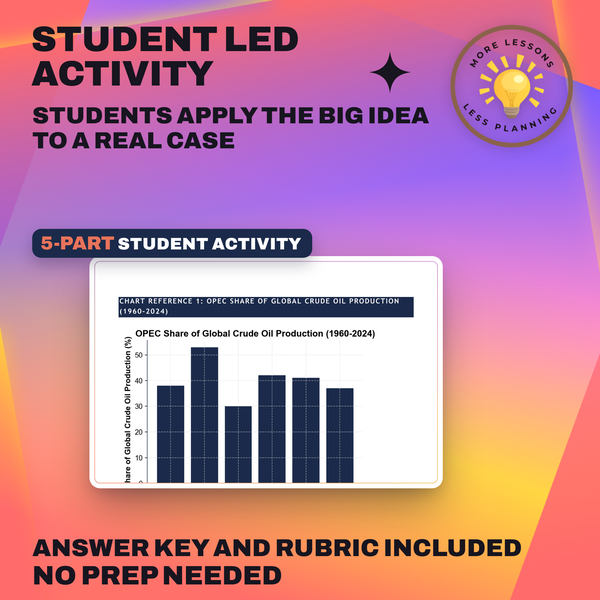
- Read three real charts on OPEC's market share, quotas, and prices, then write a briefing memo recommending U.S. policy
What it covers
- Why Saudi Arabia's role as the swing producer is the one thing that has held OPEC together for 65 years
- The three times OPEC discipline actually broke, and how the U.S. shale boom changed what OPEC can still do to prices
- Explicit collusion, OPEC's formal agreement, next to the tacit kind, and why the Sherman Antitrust Act can't touch either one on Vienna soil
- OPEC+ and its 2020 production cut, the largest in the cartel's history
Learning targets
- Identify what a CARTEL is (a formal agreement among competing producers to limit output and raise prices), name OPEC's founding year (1960), headquarters (Vienna), and current size (12 members controlling about 37% of global crude oil)
- Define CARTEL, PRODUCTION QUOTA, CARTEL CHEATING, COLLUSION (explicit vs tacit), OPEC+, SWING PRODUCER, and STRATEGIC PETROLEUM RESERVE and explain why cartels are inherently unstable
- Read three real charts (OPEC's 1960-2024 global market share, OPEC member quota vs actual production in 2024, and oil prices at seven major OPEC events) and write a Final Briefing Memo recommending what the U.S. should do about OPEC's market power
Peek inside
What OPEC Is and Why It Matters
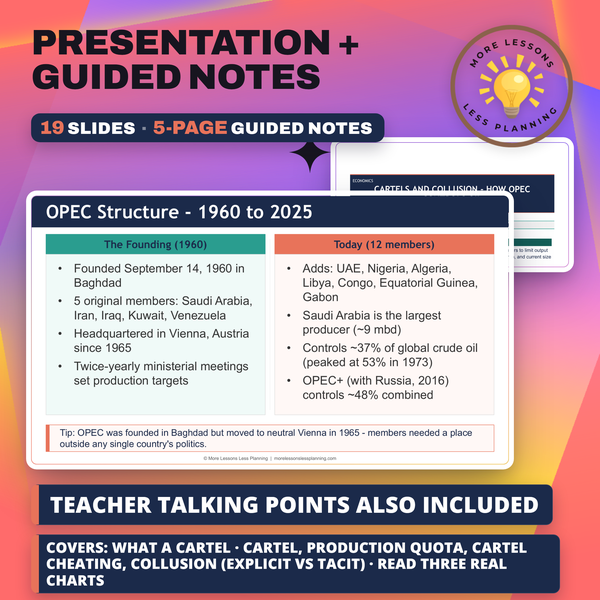
OPEC was founded on September 14, in Baghdad.
OPEC is headquartered in , Austria.
OPEC has member nations today.
OPEC controls about percent of global crude oil.
1. Meera asks you to write the opening definition for the memo. A formal agreement among competing producers to limit total output and raise the market price above the competitive level is called a .
Why this matters
OPEC's members meet in Vienna and agree on how much oil to produce and what price that should bring, coordination that would send U.S. oil executives to federal prison under the Sherman Antitrust Act. The arrangement has lasted 65 years because Saudi Arabia keeps absorbing the overproduction everyone else is tempted to cheat with.
Students picture a cartel as one company setting prices at will, so the three real breaks in OPEC's discipline, the 1985 Saudi flood, the 2014 shale war, and the 2020 COVID cut, correct that fast. A cartel is really a coalition tempted to cheat on itself, which is why the closing memo reads like real policy work.
From one teacher to another
This one puts students on Meera Agarwal's cartel and market structures team at the U.S. Energy Information Administration, working the same question EIA analysts actually work: if everyone in a cartel agrees to keep prices high, why does someone always cheat? They build the cartel definition off OPEC itself, then chase the cheating incentive straight to Saudi Arabia, since the whole 65-year arrangement only survives because one country is willing to be the swing producer absorbing everyone else's overproduction. I built the timeline around three real moments OPEC's discipline broke down entirely, the 1985 Saudi flood, the 2014 shale price war, and the 2020 COVID cut, because a cartel that's always fought amongst its members is a much more accurate picture than a cartel that just sets prices at will. They finish by reading three real charts and writing a briefing memo recommending what U.S. policy should actually do about it.
Every file in this toolkit
-
Activity (Student)
Meera Agarwal's EIA team fills in terms like swing producer and OPEC+, then reads three charts on global market share, each member's 2024 quota against actual output, and Brent crude prices at seven historic events. A closing memo argues for a specific U.S. policy move.
-
Activity (Answer Key)
Saudi Arabia's swing producer math gets solved in full. It shows exactly how much production gets cut below the 10.0 million barrel quota to absorb Iraq and UAE overproduction, plus the worked 1973 embargo price jump behind the closing memo.
-
Exit Ticket (Student)
Short questions ask where OPEC was founded against where it is headquartered now, why a cartel like OPEC counts as inherently unstable, and which episode sent oil prices briefly negative despite a record cut. It takes three vocabulary terms and one lesson number to answer well.
-
Exit Ticket (Answer Key)
Baghdad and Vienna answer where OPEC began versus where it runs today, the cheating incentive and Saudi Arabia's swing-producer role explain cartel instability, and the pandemic-era OPEC+ cut ties to the negative-price answer. Credit requires all four elements.
-
Guided Notes (Student)
Vienna meetings set OPEC's production quotas twice a year, and students track how Saudi Arabia's swing producer role held the cartel together for 65 years before charting three real breakdowns in discipline. Charts on market share since 1960 and prices feed the closing memo.
-
Guided Notes (Teacher Key)
September 14, 1960 in Baghdad, the Vienna headquarters, and the 37 percent share of global crude OPEC controls today sit answered next to the 1973 embargo that tripled prices from $3 to $11 a barrel. Swing producer, OPEC+, and strategic petroleum reserve stand ready to reference.
-
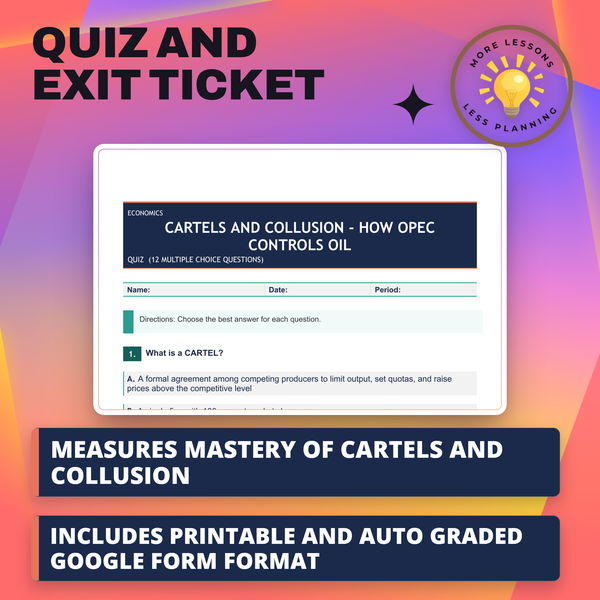
Quiz (Student)
Questions ask where OPEC is headquartered, what a production quota means for a member country, and why economists call a cartel like this one inherently unstable to hold together.
-
Quiz (Answer Key)
Saudi Arabia absorbs the overproduction as OPEC's swing producer, Vienna has held OPEC's headquarters since 1965, and the Sherman Act separates explicit collusion from the tacit kind.
-
Slides
Twelve member nations and Saudi Arabia's willingness to absorb everyone else's overproduction anchor the opening slides. A side by side look at the 1985 price crash and the 2014 price war leads into quotas, cheating margins, explicit versus tacit collusion, and the Sherman Antitrust Act.
-
Teacher Guide
Teaching Tips flag the swing producer role as the concept classes miss first, and the pacing guide stops at the 1985 Saudi flood before students argue Saudi Arabia's next move.
-
Teacher Presentation Notes
The 1985 Saudi flood and 2014's price war against shale get scripted back to back on the timeline as the two real moments cartel discipline broke down, each paired with what Saudi Arabia did differently that time.
Download
Where should I send the next one?
Everything here is free and it stays that way. Leave your email and I'll send you the new lessons as they go up. You can unsubscribe from any one of them.
Related resources
Big Tech Antitrust - Google Apple Amazon Meta
Monopolistic Competition: Brand Wars
Monopoly: One Seller, All the Power
Oligopoly - When a Few Dominate
Perfect Competition: The Theoretical Ideal
The Ticketmaster Monopoly Investigation
Every lesson on this site is free to download and use. If one of them saved you a prep period, you can chip in a few bucks toward my three kids' daycare fund. That's genuinely where tips go.